Tag: Content Marketing

  • Preparing For A Privacy-First Future In APAC

    Preparing For A Privacy-First Future In APAC

    Responding to data and browser policy changes is critical for brand leaders looking to strengthen their business and also meet their customers online for the very first time. Let’s see how Asia-Pacific (APAC) privacy policy is trying to build a safer web.

    Now with growing internet usage, people are more worried about their privacy and use of their information by brands. As more companies explore new ways to reach customers online, APAC companies are increasingly understanding the importance of user trust in successful digital advertising and marketing. The guidelines of APAC differ from country to country. This is because privacy and consent expectations of people also vary.

    Without underlying privacy legislation in APAC, it becomes more critical for the advertisers, industry groups, and internet community to collaborate and unite on successful best practices.

    How is APAC managing with developing browser policies?

    Third-party cookies have been long used by many firms to deliver customers personalized advertisements depending on their browsing habits. However, when users navigate from website to website, it becomes difficult for users to control how their data is used because of these third-party cookies. So, web browsers are avoiding third-party cookies now, but restricting them without putting in place privacy-friendly alternatives may lead to more problems.

    In 2019, the Chrome team launched the Privacy Sandbox aimed at helping advertisers gradually reduce third-party cookies. Sandbox privacy suggestions provide technologies for presenting personalized advertisements, spotting fraud, and measuring advertisement performance without the use of third-party cookies.

    How to responsibly accept first-party data in APAC?

    Diligently using the information that individuals are willing to share will help businesses stay up-to-date and perform better along with adhering to changing policies and regulations. First-party data at this time is of high priority because more brands are looking for ways to improve their business performance without causing a privacy breach.

    Despite this, some of APAC’s major roadblocks to effective first-party data are technological and skill-related, specifically the difficulty to combine data collection and data usage. Many brands will need time to overcome these obstacles, but some big brands have already started solving this problem.

    How does machine learning help in privacy-first data policy?

    With reduced data collection, the importance of automation in expanding first-party data potentially cannot be overstated. Some businesses are developing models to predict consumer behavior. Some are collaborating with partners on Google Marketing Platform.

    With the help of automation, marketers are discovering creative approaches to remain ahead of the ever-changing needs of customers.

    If the brands do not adhere to the privacy policy, there are chances that the customers will choose their competitors over them. From using an automated bidding technique, attribution model based on data, real-time response to consumer needs; there are many ways brands can use automation as they slowly proceed towards first-party data policy.

    How to prepare for a privacy-focused business?

    Let us now check the three steps that can make your business privacy-focused.

    1. Establish direct contact with customers – Provide useful services that improve customers’ purchase experience and also use their data cautiously.
    2. Invest in technology that prioritizes privacy – Sort out data, reveal insights, anticipate performance, and improve revenue with cloud-based and automated solutions that don’t compromise privacy.
    3. Clearly define your privacy policies – Give people clarity, selection, and control about their data and information and inturn gain their trust.

    By concentrating on ways to preserve the privacy of the user, you will strengthen customer connections, boost the performance of your business, and important of all you will comply with the privacy-first policy.

  • 7 B2B Content Marketing Tactics For Long Term Success

    7 B2B Content Marketing Tactics For Long Term Success

    I have an important question for you:


    Athlete A runs a marathon in under 3 hours. Athlete B runs a 40-yard dash in under 5 seconds. Which athlete is more impressive to you?


    Athlete A can run the distance, but Athlete B is explosive. ?


    via GIPHY


    If you’re anything like me, you answered that they’re both very impressive. And you’d be right. Having both endurance and power are extremely important. So, why am I asking this question on a blog all about marketing? Well, the most successful content marketing strategies have tactics that cover those two qualities: endurance and power. AKA long-term and short-term tactics.


    For content marketing to be successful, you need those flashy, attention-grabbing campaigns to meet immediate goals. But you also need reliable, consistent, thought-provoking content to compound results over time. Below, I share the B2B content marketing tactics that combine for the greatest long-term success.


    7 of the Best B2B Content Marketing Tactics

    Long-Term B2B Content Marketing Tactics

    Tactic #1 – Blog Content

    When it comes to tried and true tactics, blogging takes the cake. Blogging is some 26-years old and still drives amazing results. In fact, a recent survey from SEMrush found that it remains the most popular content type with 86% of marketers responding that it is the most important content type they create. Considering how much we marketers value optimization and data, we wouldn’t still be writing blog posts in 2020 if they didn’t drive results.


    How is blogging a long-term tactic, though? Well, similar to most long-term tactics, once you start you can’t stop. A blog is a brand-owned channel and a valuable resource of relevant knowledge for your customers and prospects. Stop publishing there, and it stops being that reliable source of brand perspectives and information.


    All out of new blog content ideas? Read these tips for more efficient content creation from TopRank Marketing CEO, Lee Odden.


    Tactic #2 – Social Media Content

    Back in 2019, Statista reported the average person spent 144 minutes per day on social media. I can only imagine that number has gone up in 2020 due to the COVID-19 health crisis. In marketing, you go where your audience is, making social media content a must for any brand both B2B and B2C.


    And once again, your social media content needs to be consistent over the long term if you’re to grow your social media following into the connected group of prospects, customers, and partners that you desire. Furthermore, social media content requires constant monitoring so you’re able to capitalize on timely topics and discussions that happen on social media platforms in real time. Growing your audience on social media is a laborious and lengthy process, but it’s easily worth it to have an engaged following, ready to consume the content you distribute and promote on your platforms of choice.


    How should you approach social media listening in the age of coronavirus? We have some tips for you that should help


    Tactic #3 – Influencer Content

    Read any other marketing blog and an influencer marketing campaign is probably classified as an ad-hoc, short-term tactic. However, here at TopRank Marketing, we believe in an always-on approach to influencer marketing.


    Think about it this way: do you approach personal relationships as a one and done interaction? No, relationships require nurturing and frequent interactions in order to grow and solidify. We believe influencer relationships, and therefore influencer marketing, needs to be approached in the same way. With nurturing. With empathy. Influencers are people, too, you know.


    Not sure what always-on influencer marketing looks like? View these 5 examples


    Tactic #4 – Podcast Content

    Starting a podcast is not for the faint of heart. It involves working with a new medium: audio. It involves publishing across several channels: Spotify, Apple Podcasts, Stitcher, etc. It involves securing guests. It involves creating thoughtful episodes. And, most importantly, it involves creating a show listeners want to tune into week after week.


    It is because a podcast is intended to be a continual show or series that it’s one of our favorite B2B content marketing tactics. Here at TopRank, we think of our podcasts like TV shows. Each podcast has several seasons made up of carefully designed episodes that match the theme of the season. This allows us to use each episode and each season as a chance to further grow and engage our listeners.


    If you’re wondering how you can launch your B2B podcast, start with these 10 steps.


    Short-Term B2B Content Marketing Tactics

    Tactic #5 – Sponsored & Guest Content

    As stated above, blog content is extremely valuable. But when posted on a brand-owned blog, you’re limiting the exposure of your content to the people who already know or follow your brand. To reach a larger audience, you need to turn outward. And while more social media or email promotion could help — if it’s on a brand-owned channel you’re still limited to people who already follow you. So what about reaching a new audience?


    This is where sponsored or guest content can help you reach a new audience and expand your reach in the short-term. By posting content on a different channel, you’re exposing your content and thought leadership to a different audience. For example, you can secure placement on publications in a new target vertical or write a guest post on an expert’s blog. These are one-time placements, making this tactic drive short-term results, but the pay-off of greater reach and exposure is definitely worth it.


    But wait  isn’t that just advertising? We explain the great content vs. advertising debate here


    Tactic #6 – Digital Advertising Content

    Marketers have the seemingly impossible task of delivering the right message, at the right time, to the right audience, in the right channel. That’s a lot to ask. And it’s reaching that right audience that can be really hard to do with the long-term tactics above. Like I said, using brand-owned channels can make it tough to reach a new audience.


    Luckily, digital advertising content is a great short-term tactic that can help you target your ideal audience with the right message, at the right time, in the right channel. From native social media advertising to traditional display ads, these ad campaigns can help you spread your message in the short-term.


    Digital advertising is best when paired with content marketing. Learn more about how to marry the two tactics here.


    Tactic #7 – eBooks, Infographics, and Larger Content Campaigns

    Campaigns, like eBooks, infographics, and interactive assets, have a beginning, a middle, and an end. Because campaigns aren’t designed to last forever — you need one to end for another to begin — they make it onto our short-term tactics list.


    Why are they a great short-term tactic? You can pack a ton of information and insight into a content marketing campaign. Plus, you can use a wide mix of media and strategies like influencers, video, audio, interactivity, and more to drive powerful engagement among your audience. They aren’t built to last, but they are built to pack a punch.


    Birds of a Feather Flock Together

    The best B2B content marketing strategies use a mix of the tactics above for both long- and short-term success. Short-term tactics help raise awareness for the long-term tactics. And long-term tactics help build up a loyal, engaged audience for future short-term campaigns. In other words, you need both. There’s a mutually beneficial relationship between all content marketing tactics. So use the list above to start plotting your course to B2B content marketing success.


    Hungry for even more B2B content marketing tactics? Well, here’s 50 of them. Enjoy!


    The post 7 B2B Content Marketing Tactics For Long Term Success appeared first on Online Marketing Blog – TopRank®.


  • How to Optimize Original B2B Research Content For Credibility and Impact

    How to Optimize Original B2B Research Content For Credibility and Impact

    For many in the B2B marketing world, original research provides an effective way to build thought leadership and drive content for owned and earned media.

    Unfortunately, many research reports from B2B companies are dry, uninspired and focus solely on pontifications from the brand point of view. Such unremarkable content isn’t helping customers, especially if they never see it due to information overload or they don’t trust it.

    “With more information, options and people involved in a buying process, buyers are paralyzed when trying to move forward.” Gartner

    Fortunately, there’s a better way.

    More often than not, B2B research reports have marketing objectives focused on building brand thought leadership, attracting new names for nurturing and to serve as a resource for sales. Since most B2B brands don’t have the credibility and distribution to reach their marketing goals on their own with such reports, they rely on advertising and PR to attract attention.

    Ads and PR are fine complements to content. But they’re even more effective if that content delivers an experience that is includes built-in credibility and distribution to the the audiences that are probably ignoring most marketing and advertising.

    How can you optimize research report content to deliver this kind of experience?

    Brands that co-create experiential content with relevant experts and influencers can build industry confidence, grow brand trust, create a more effective digital customer experience and drive business growth.

    What does that kind of research report collaboration content process look like?

    B2B marketers have included quotes from industry experts in their reports for many years – but most do not. However there are many more ways to engage with credible voices that have the trust and attention of the audience you’re after.

    For example, you might partner with a mix of industry experts, influential customers and people who work at brands that represent your ideal clients to add perspective to original research.  Adding that expertise isn’t enough. The content itself should be packaged as an experience. Whether it’s interactive or just well-designed, research content doesn’t have to be boring.

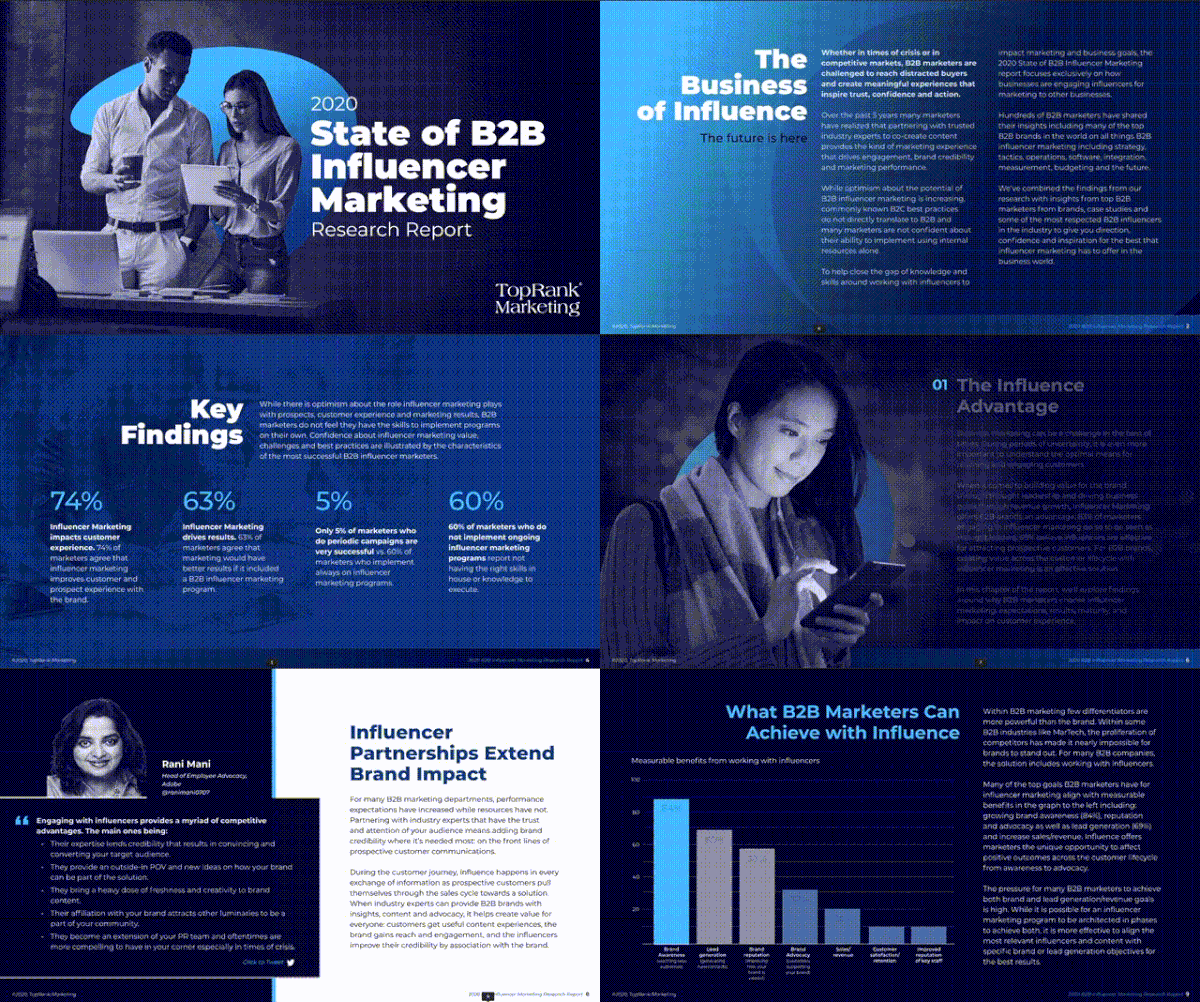
    I think our latest research report on B2B Influencer Marketing is a perfect example of this.

    B2B Influencer Marketing Report Preview

    We partnered with 20+ B2B brand marketing executives and influencers to provide perspective on the key issues surfaced by the research. Instead of the report being authored by me (with some help from my team), there are contributions from influential B2B brands that include:

    • Dell
    • SAP
    • LinkedIn
    • AT&T Business

    There are also insights provided by some of the top B2B influencers in the industry including:

    • Brian Solis
    • Ann Handley
    • Tamara McCleary
    • Mark Schaefer

    Pulling together credible voices to join your own in an experiential piece of content is far more likely to be shared by contributors and your community, looked at by industry media and potential customers, and actually used by your sales people in their communications with prospects.

    Such a rich content experience can deliver far more value than a one time campaign, especially if you roll it out in phases.

    For example, you might extend the value of original research by implementing a phased content approach. For example:

    The first phase might be the co-creation and publishing of the original research with industry experts and clients.  Promotion would focus mostly on owned channels, organic social and private channels like email, forums, etc.

    The second phase could emphasize earned media and extensions of the narratives highlighted by the research. Names captured can be nurtured with useful resources that go deeper on the topics and a video interview series with the experts who contributed would feature more in-depth conversations around the key report findings. Online events and some useful tools and more visual versions of the original content could also help with promotion hang time.

    The third phase takes the report content and repurposes it into new formats: explainer videos, a podcast, infographics. An interactive microsite that gives viewers and opportunity to assess themselves against the benchmark data from the research provides an engagement opportunity without substantial investment in new content. The original group of influencers is now expanded to invite more people in those roles to contribute their expertise to content around the report’s narratives.

    What you do specifically for your B2B business is up to you, but publishing original research in white paper format without any 3rd party validation within is simply no longer enough to attract, engage and inspire a meaningful experience or a return on your investment.

    Creating a content experience that is credible and that can rely on distribution by its influential contributors on top of brand channels, PR efforts and ad buys will certainly achieve the expected thought leadership, engagement and demand gen goals more effectively. In the case of our report mentioned above, we hit one of our most important 3rd Quarter goals in just the first 2 weeks because of following this advice.

    Imagine what you could do?

    The post How to Optimize Original B2B Research Content For Credibility and Impact appeared first on Online Marketing Blog – TopRank®.

  • How To Level Up Marketing Content From B2B Influencers

    How To Level Up Marketing Content From B2B Influencers

    B2B Marketing- Methodology

    Why do you even need a content person for influencer marketing?


    After all, the influencers are providing the content. You just have to collect their pearls of wisdom, make them look pretty in a PDF, and you’re good to go, right?


    I’ll confess, on my first influencer marketing project, I wasn’t quite sure what I was doing there. Over the last few years, however, I’ve come to understand the role that content marketers can play in shaping influencer content.


    It’s the content lead’s job to shape the conversation with the influencer. We have to ask the right questions, and provide a structure and framework to elicit thoughtful, detailed responses.


    There are a few extraordinary thought leaders who will dash off a thousand-word, amazingly insightful response to the vaguest prompt. But most folks — even those who write for a living — need more to go on than “What is the biggest problem facing our industry?”


    The influencers you’re talking to have spent hours of time and effort learning about their subject matter, building an audience with powerful, useful content that provokes action. When you email that list of questions, or sit down for an interview, make sure you don’t leave any insight untapped.


    Here’s how we at TopRank are evolving our influencer approach to get at that next-level content.


    How to Unleash Your Influencer Content

    So you’ve identified the true influencers to your target audience, you’ve developed relationships, and now you’re ready to co-create content together. Before you start, make sure you lay the groundwork for a productive Q&A.


    Ask More Specific Questions

    Influencers will take their cue on how to answer based on how you ask the question.  If you start with a mile-high question like, “What challenges should leaders be aware of right now?”, you’re likely to get a high-level response, something vague and oracular. That’s not because the interviewee can’t get into specifics — it’s because you didn’t invite them to.


    A better approach is to find out the biggest challenges that your industry is facing, pick one, and ask what we should be doing about it: “The latest Gartner report says that 75% of managers don’t have enough donuts in the breakroom. What are the options for HR leaders to fix this problem? What do you recommend?”


    Limit the scope of your question, and you invite the influencer to give a more detailed response.


    [bctt tweet=”Limit the scope of your question, and you invite the influencer to give a more detailed response. @NiteWrites on #InfluencerMarketing interviews.” username=”toprank”]


    Don’t Ask Questions Everyone Knows the Answer To

    It’s easy to fall into this particular trap. You offer the influencer softball questions that have a broad consensus for the answer, they agree with the consensus, everyone goes home happy. 


    I’m talking about questions like, “Do you think automation is, on the whole, a good thing or bad thing?”  And they answer, “Well, it’s a different thing. It will cost some people their jobs, but for others it will make their jobs less repetitive and more meaningful, and that will open up new opportunities to innovate.” 


    The above is perfectly acceptable, content-wise, but it’s a waste of your influencer’s time and talent. You don’t hire LeBron James to dunk on a 4-foot rim. Ask questions you don’t know the answer to, questions that your industry is struggling with, questions that cry out for guidance!


    [bctt tweet=”You don’t hire LeBron James to dunk on a 4-foot rim. Ask questions you don’t know the answer to, questions that your industry is struggling with, questions that cry out for guidance! @NiteWrites on #InfluencerMarketing” username=”toprank”]


    And, of course, give your influencer plenty of time to think about these questions and formulate thoughtful responses.


    Let Your Audience Ask the Questions

    One of the best ways to get at these more detailed, more challenging questions is to see what questions your audience is actually asking. There are two ways to go about soliciting audience questions for an influencer.


    The first is the direct one: Ask on your social media channels and your email newsletter. For example, a Twitter post could say, “If you could ask Lee Odden one question about influencer marketing, what would it be? Answer with #AskLeeO.” Collect the most pertinent questions and let them guide the interview.


    The second way to let your audience ask the questions is to do some keyword research. The topics your audience is searching for are the ones they need answers on. If they had the answers, they wouldn’t be searching! But don’t stop at the highest-volume keywords; those are likely to be too general. Dig into the long-tails on a tool like SEMrush to get at the burning questions.


    Ask for Stories

    Many of the influencers we work with are consultants, keynote speakers, or have been executives at multiple companies. These folks have a ton of practical experience — we just have to ask them to draw on it.


    Instead of asking, “What do you think are the three biggest challenges,” ask, “What problems are your clients coming to you with?” Or, even better, “Have you had clients with a similar problem? Tell me about how you advised them, what they did to solve it, and what success looks like.”


    Asking for stories like this gives your influencer a chance to demonstrate their expertise in action, and offers your audience a more grounded, relatable look at your topic.


    Power Up Your B2B Influencer Content

    Content planning is a crucial part of influencer marketing. It’s the content team’s job to ask questions that meet audience demand, inspire thoughtful contemplation, and make full use of the influencer’s experience and insight. Asking the right questions is the difference between good and great influencer content.


    If you want to level up your B2B influencer marketing content, make your questions specific, skip telling the audience what they already know, and ask for unique stories that only your influencer could tell.


    Want to power up your influencer marketing even more? Check out The B2B Marketing Force Multiplier: Integrated SEO and Influencer Marketing.


    The post How To Level Up Marketing Content From B2B Influencers appeared first on Online Marketing Blog – TopRank®.


    Source