Category: Business Consulting

  • Fastvertising Success Stories: Brands that Nailed It!

    Fastvertising Success Stories: Brands that Nailed It!

    Staying ahead of the curve is essential in the dynamic world of marketing. The trending phrase “ fastvertising” which is a combination of two words “ fast” and “advertising” inculcates the spirit of swift and successful marketing campaigns. In this blog, we aim to highlight few of the world’s biggest brands that have adopted fastvertising and have left an everlasting impression on its target audiences world wide.

    The Power of Fastvertising

    This modern marketing technique is all about planning and delivering the right messages to the target audiences at the right time. Marketing departments in big brands have honed their skills over time to adapt quickly and capture the most out of the momentum created by events happening around the world. It can be an inclusion of new technology, a wave of emotions or changes in the economic environment. Below we are mentioning some of the worlds most recognisable brands and their success stories related to fastvertising.

    1. Oreo: Real time Marketing Genius Campaigns

    Back in 2013, when the stadium lights went out during the biggest sporting event in the world, the super bowl, marketing leaders in Oreo seized this moment by quickly tweeting out with an Image of an Oreo with the caption “ You can still dunk in the dark”. It was indeed a clever way to go viral, creating a massive buzz for the brand.

    Key Takeaway: Stay vigilant during the global events, and be prepared to respond swiftly with unexpected opportunities.

    1. Taco Bell: Harnessing the Power of Snapchat Innovations

    Snapchat, a video sharing platform, was first used by brands to share entertaining content with its user base. Taco Bell was one of the first fast food brand to launch a new product, the Doritos Locos Taco on the social media platform, sharing exclusive content and behind-the-scenes access, creating a strong bond with the customers.

    Key Takeaway: It is essential to explore new platforms, analyse shifts in consumer behaviour and provide unique, engaging content.

    1. Red Bull: Taking Content Creation to Extreme Levels

    Red bull, an energy drink brand synonymous with extreme sports and adventure not only sponsors famed events, but also create astonishing content to promote their brand. Counting down from Felix Baumgartner’s famous space jump to numerous sporting events, red bull’s strategy worked wonders which immerses itself in the world that is the most frequent buyers of their products.

    Key Takeaways: Showcase your expertise in your field to become the most preferred brand.

    1. Dove: Products that connect with you emotionally

    One of the world’s leading brand in FMCG, Dove’s “Real Beauty” campaign aimed at challenging stereotypes and promoting a healthy body image for women of all ages. This brilliant campaign struck a chord with most women, spreading and promoting a positive, empowering message.
    Key Takeaway: In the world of data-driven marketing, do not forget to build that emotional connection with your audience that they crave for in a trusted brand.

    1. Nike: Empowerment through Storytelling

    One of the biggest brand in sportswear, Nike has focused on “Just Do It” slogan which now resonates with almost all of its target audience. Their digital advertisements often feature powerful, stories of underprivileged athletes overcoming dreaded challenges. By inspiring their communities, they focus on building empowerment and a sense of belonging in the community.
    Key Takeaway: Storytelling is one of the most powerful tool to spread and promote your marketing message.

    .

    Learning from the Fastvertising Pioneers

    As marketing evolves above and beyond the 4P’s, let’s draw some key lessons that can help you in applying Fastvertising to your next marketing campaigns.

    1. Be Agile

    The first and most crucial lesson is to be agile. Keep your marketing team ready to act swiftly when opportunities arise. Monitor events and trends closely, and be prepared to jump in when the moment is right.

    2. Embrace New Platforms

    Don’t limit your brand to traditional platforms. Explore new and emerging ones, and understand how they can work to your advantage. Whether it’s social media, video-sharing platforms, or innovative apps, adapt and conquer.

    3. Become an Expert

    Know your field inside and out. If you’re promoting sports, be a part of the sports community. This expertise will give your brand authenticity and authority, making it easier to connect with your audience.

    4. Forge Emotional Connections

    Connect with your audience on an emotional level. Address their concerns and aspirations. Tell stories that resonate with them. A brand that touches hearts is more likely to win loyal customers.

    5. Tell a Compelling Story

    Your brand should have a story to tell. Whether it’s a tale of overcoming adversity, empowering others, or simply inspiring positive change, a compelling narrative can make your brand more relatable and memorable.

    Fastvertising isn’t just a buzzword; it’s a dynamic marketing approach that’s proven to be highly effective. By studying the successes of brands like Oreo, Taco Bell, Red Bull, Dove, and Nike, we’ve learned that agility, platform diversity, expertise, emotional connection, and storytelling are the keys to nailing Fastvertising.

    So, as you gear up for your next marketing campaign, remember the lessons from these Fastvertising pioneers. Be quick, be innovative, and be authentic. In a fast-paced digital world, these qualities will set your brand apart and lead you to success. Fastvertising is not just about speed; it’s about strategy, and these brands have shown us the way.
    TIQ Digital is a performance marketing agency helping brands to take full advantage of Fastvertising. Reach out to us for your next viral marketing campaign.

    FAQs – Fastvertising

    1. What is Fastvertising?

    Fastvertising is a marketing approach that emphasizes delivering quick, effective messages to the right audience at the right time.

    2. How did Oreo excel in Fastvertising?

    Oreo’s real-time marketing during the 2013 Super Bowl power outage showcased their agility in responding swiftly to unexpected opportunities.

    3. Why is emotional connection important in marketing, as shown by Dove?

    Dove’s “Real Beauty” campaign demonstrated that an emotional connection with the audience can promote a positive and empowering message.

    4. What can brands learn from Taco Bell’s use of Snapchat?

    Taco Bell’s use of Snapchat illustrated the significance of exploring emerging platforms and providing unique, engaging content.

    5. How does storytelling play a role in Fastvertising, as seen with Nike?

    Nike’s use of powerful stories in their advertising creates a sense of community and empowerment, making storytelling a key tool in Fastvertising.

    TIQ Digital: Your Fastvertising Ally

    At TIQ Digital, we understand that staying ahead in the ever-evolving marketing landscape requires agility, creativity, and real-time responsiveness. We are your partners in the pursuit of Fastvertising excellence, and we have the tools, expertise, and passion to help your brand thrive in the digital age.

    Why Choose TIQ Digital for Fastvertising?

    • Expertise: With years of experience in the industry, we’ve honed our Fastvertising skills to perfection.

    • Cutting-Edge Tools: We leverage the latest technologies and tools to ensure your brand remains agile and responsive.

    • Strategic Insight: Our team is armed with strategic insight, enabling us to craft personalized, real-time campaigns that engage and convert.

    We encourage you to take the leap into the world of Fastvertising with TIQ Digital as your trusted guide. Explore the endless possibilities, seize the real-time opportunities, and lead the race for consumer attention.

    For a personalized consultation on how Fastvertising can revolutionize your brand’s marketing strategy, don’t hesitate to contact Mr. Amit Sharma at amit@technocratiq.com. Our team are ready to help you chart a course toward marketing excellence.

    Chat with Us now!!

    Call Us Now..

    Spread the Word!

    Lastly, if you found this blog post insightful, please share it with your network. Click on the social media sharing buttons below and let others in your industry benefit from the wisdom of Fastvertising.

  • B2B Marketing News: Digital Marketing Priorities, Ultimate CX, B2B Burnout, The Power of Podcasting

    B2B Marketing News: Digital Marketing Priorities, Ultimate CX, B2B Burnout, The Power of Podcasting

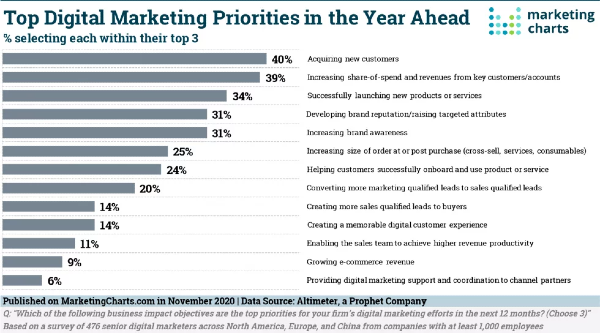
    Where Do Digital Marketers’ Priorities Lie for the Year Ahead?

    Digital marketers have a clear vision of their priorities though some are working with less marketing resources than others, according to Altimeter’s State of Digital Marketing report for 2020. The report highlights that organizations are either cutting costs as a response to the financial uncertainties of the crisis or upping investments in digital to keep up with customers moving online. MarketingCharts


    The CX Courtship: How B2B Brands Get To The Partnership Stage [Merkle Study]
    The B2B customer experience should be just as smooth as B2C. But too often it’s not. Indeed, 35% of businesses with 1,000 or more employees find choosing a B2B supplier to be almost a nightmarish process, judging by Architecting The Ultimate Customer Experience, a study by Merkle, with participation from its gyro and B2B International agencies. MediaPost


    B2B Pros Say: ‘We’re Burned Out’ By Pandemic: Study
    B2B marketers are falling apart from the stress of COVID-19 and its ongoing impact, according to Revealing What’s Fact And What’s Fiction, a study by RollWorks. Of the marketers surveyed, 50% have suffered from pandemic-related burnout, And 50% say the lines between work and personal life have become more blurred in a negative way.  Email Marketing Daily


    Google Page Experience Update To Launch May 2021 With New Snippet Labels.
    The update will show new basic page performance and expected experience statistics to searchers, Google says. Search Engine Roundtable


    How Social Issues Are Sparking Action Among Brands
    A majority of consumers now expect brands to take a stand on social issues and work to effect positive change—though their sentiments are sometimes complicated. A June 2020 survey by Mindshare found that more than two-thirds of US adults said brands should play an important role when it comes to speaking out against racial inequality and injustice. However, six in 10 believed brands that spoke out were being opportunistic. eMarketer


    B2B influencer marketing budgets 2021Marketers Raise Podcast Volume to Eleven – The format is poised to become a permanent and powerful marketing channel
    With podcast advertising racking up 48 percent year-over-year growth in 2019, according to an IAB study, the medium’s 14.7 percent projected growth in 2020 might seem anemic. But that slowed growth is merely a pandemic-induced blip on the radar. The longer-term outlook remains stellar, with spending projected to rebound almost 45 percent, to more than $1 billion in 2021, according to eMarketer, and marketers and media companies are making big bets on the format’s staying power. ANA

    We’re in this together: 5 takeaways from Adobe Experience Makers EMEA 
    This is a unifying moment for businesses. Across virtually every industry and discipline, business leaders are rethinking their approach to leadership, employees are finding new ways to perform their jobs in a digital world, and consumers are re-evaluating the way they make purchases. Adobe


    Instagram Adds Keyword Search in Addition to Profiles and Tags 
    Instagram has announced an update to its search functionality which will give users the capacity to search for specific keywords, as opposed to being limited to profiles, hashtags and locations. Social Media Today


    Executing A B2B Integrated Marketing Strategy: Who and What’s Involved?
    7 in 10 organizations have implemented integrated marketing to some extent, though it remains challenging for many, according to Demand Gen Report and True Influence’s report on the state of integrated marketing in B2B. When it comes to the best tools for executing an integrated marketing strategy, respondents cited CRM (80%), data tools (65%), reporting platforms (63%) and collaboration tools (44%) as particularly useful. MarketingCharts


    New Survey Says We’re Spending 7 Hours Per Day Consuming Online Media 
    A new survey conducted by the research firm DoubleVerify found that we’re now spending about seven hours per day consuming online content. In the past we typically spent about three hours per day consuming media. YouTube streaming has sky-rocketed, up 43% since the pandemic started. We’re also even more obsessed with Facebook with a usage increase of 40%. Forbes


    ON THE LIGHTER SIDE:

    How to do strategic planning by Tom Fishburne — Marketoonist


    TOPRANK MARKETING IN THE NEWS:


    TopRank Marketing – 2020 Research: The Current State & Future of B2B Influencer Marketing – Onalytica

    TopRank Marketing Blog – Top 20 Digital Marketing Blogs and Their Specialties – Vocal


    Have you found your own favorite B2B marketing story from the past week of industry news? Please let us know in the comments below.


    Thank you for joining us for our weekly B2B marketing news, and we hope that you will return again next Friday for another round-up of the most relevant B2B and digital marketing industry news. In the meantime, you can follow us at @toprank on Twitter for even more timely daily news.


    The post B2B Marketing News: Digital Marketing Priorities, Ultimate CX, B2B Burnout, The Power of Podcasting appeared first on B2B Marketing Blog – TopRank®.

  • 3 Ways Humans Can Do PPC Better Than Machines Alone

    3 Ways Humans Can Do PPC Better Than Machines Alone

    Artificial Intelligence is a hot topic in PPC, but until the machines fully take over day-to-day account management, there are a few key areas where human PPC pros can still add a lot of value.

    Use business data for bid management

    Bid management can be one of the most repetitive and boring tasks of managing PPC because after a model has been built, you are left with an ongoing task of executing the plan, and this may involve downloading the data, putting it into the correct format, and then running it through your formulas to determine the new bid. For machines, this might sound like the perfect dinner on a Caribbean beach at sunset, but for us humans? Not so much. Repetition is dull, and since it’s a dull task, we tend to become a bit less thorough with our analysis as time goes on.

    This is why both Google and Bing offer automated bid management solutions. There are also many third-party bid management solutions that aim to improve on shortcomings of the bid management solutions from an engine. Though it is a well-known fact that the engines can do amazing bid management work, their solutions are generic and can ignore aspects that the business owner knows will impact their online conversions.

    There are four clear advantages to using the engine’s bid management systems:

    1. They are free to use.
    2. They are based on best-in-breed algorithms.
    3. They have access to a lot of auction-time signals that advertisers don’t get (e.g., who is the user, what did they search before).
    4. They can set bids in real-time based on auction time signals.

    But there are several things these automated bid systems cannot do:

    1. Know the context of the performance that is measured through conversion tracking (e.g., conversions were slow yesterday because there was an issue with servers in one of the data centers).
    2. Understand the factors that impact the industry (e.g., a plumber with 15 vans will be better able to service a distributed customer base than one with just three vans).

    The ideal bid management system combines the algorithms from the engines with data from your business. To this end, advertisers should calculate their own CPCs based on in-house data and then submit these bids to the engine as an Enhanced CPC, so that Google or Bing can adjust the bid up or down based on what they know about each auction.

    This is a reason why tools like Optmyzr are popular for managing bids. They can help automate bid strategies that use a combination of data from the search engine (like historical conversion rates for individual keywords) and business data (like phone sales data, e-commerce returns data, or even how the weather impacts sales).

    Optmyzr’s Rules-Based Optimizations let advertisers mix business data with AdWords data to create the perfect bid management automation.

    Optmyzr’s Rules-Based Optimizations for bids are also ideal for agencies who want to add value beyond what the engine’s own bidding system can do but don’t want to build complex technology in-house that they need to maintain as Google and Bing go through their frequent updates to the API. Prebuilt recipes can be installed in seconds to help advertisers reach goals like target CPA, target ROAS or target position. These recipes can be enhanced over time as more is learned about factors that impact performance, whether they’re based on Google’s data or internal business data.

    Use keywords to target shopping ads

    A second area where PPC pros should take back some control from the machines is with managing keywords for shopping ads. While shopping ads are automatically targeted to relevant queries that match the product in an advertiser’s feed, there is always the option of adding negative keywords.

    In a rather extreme, yet interestingly practical way, you could actually target a specific keyword not by the inclusion of that term, but rather by the exclusion of all other terms.

    This is the foundation of “Query Sculpting,” a PPC technique that deploys negative keywords to drive traffic to the desired target. And because negative keywords are much more explicit than positive keywords, they are the main tool.

    Even in search campaigns, query sculpting is done with the addition of negative keywords. And while this makes a strange sort of sense, our logical side is still asking, “Why can’t it be done by simply adding exact match positive keywords?” Because ever since Google’s latest change to the algorithm, exact match no longer truly means “exact.”

    Query sculpting for shopping campaigns was invented by Martin Roettgerding and later refined by various entities, including SmarterCommerce. Martin’s technique requires maintaining three parallel Shopping campaigns and proactively adding certain types of negative keywords.

    But proactively adding extra campaigns and unnecessary negative keywords can really eat into an account’s allowance for a number of keywords under management. Optmyzr, taking into account the pros and cons of both sides, has a solution that uses recent performance data to sculpt queries when it is clear they could perform better elsewhere in the account: The Shopping Negatives Tool.

    The Shopping Negatives Tool analyzes the performance of the same search queries across different ad groups in a shopping campaign, finds the ad group in which the query is not performing well, and recommends adding it as an exact match negative.


    Optmyzr’s Negative Keyword tool for shopping ads identifies where negative keywords should be added to “query sculpt” the traffic so that more sales, and more profitable sales, will result from the budget spent with the search engine.

    Using this technique, advertisers can run as many shopping campaigns in parallel as they want or keep everything in one campaign, and Optmyzr’s analysis will make suggestions for how to sculpt the traffic to drive more sales at a better ROAS.

    Create better ad tests

    Googler Matt Lawson has recently covered the new ways to think about A/B ad testing. Thanks to Google’s improvements in Machine Learning, there is less need to manually cull underperforming ads from an account. The premise is that the worst ad in an ad group could actually perform quite well with a subset of users hitting that ad group, which means that removing a slightly losing ad could actually be counterproductive.

    But he also says, “Delete stuff whenever an ad stops seeing a large fraction of the impressions and therefore generates minimal to no clicks. Then add a new ad to the mix. It’s better to have options.”

    To help with cleaning up ads that are seeing a minimal share of impressions in an ad group, you could use AdWords Scripts, like some that are part of Optmyzr’s suite of tools.  

    While Google is removing the need for manual testing of ads, and though they’re even doing some automatic generation of new ad text challengers, this remains an area where the human expert — someone who is close to the business being advertised — will have a leg up on automation.

    You’ve heard the story that if you gave 1,000 monkeys typewriters and an infinite amount of time, they’d eventually write all the works of Shakespeare. But monkeys eat lots of bananas and tend to prioritize climbing trees before writing those famous soliloquies, so they’d most likely take forever. And though the concept of play-writing monkeys does seem very attractive, advertisers aren’t willing to wait for an infinite amount of time. That’s why we still need tools that help us write great ads in the least possible time.

    Tools like Optmyzr can help with the ideation for new ads by highlighting ad text elements that have performed well historically.

    Tools like Optmyzr help you create better tests in less time. Here the tool makes suggestions for ad text variations to try.

    Frederick Vallaeys made the point that the PPC agencies of the future will be the ones with the best process for testing. Machine learning means computers can figure out the winners and losers, but conclusive test results will happen more quickly when using human insight to prioritize the most valid hypotheses for testing.

    Conclusion

    Exciting and perhaps scary times are ahead for all sorts of professions where AI will take over a plethora of tasks that used to require human intelligence. There’s a slight fog surrounding the future of human intelligence in the workplace, and though it isn’t thick enough to cover us just quite yet, it creates a bit of unease in many circles. What will happen when machines take over?

    It’s an inevitable passage, but the more human input we give these machines all throughout this transition period, the more effective they will be at helping achieve the shared goal of improving PPC performance. And in the meantime, human PPC pros have many opportunities to transform their day-to-day into something that will endure over time and set a solid foundation for working in an AI-first world.