Author: TIQ Team

  • Autonomous Finance & Intent Data: Scaling Customer Acquisition in Q2

    Autonomous Finance & Intent Data: Scaling Customer Acquisition in Q2


    Artificial intelligence and data analytics provide the financial services industry with a tremendous change. In the case of CEOs, CFOs and growth leaders, the use of legacy acquisition models is no longer a feasible revenue growth strategy. The financial digital marketing of the modern world requires transitioning to the predictive model, ongoing accounting, and outreach with intent. Financial institutions can reduce customer acquisition costs by a significant margin and improve lifetime value through the use of AI to anticipate buyer behavior even before they pounce on their deal.

    Financial brands need to match their technology stack with advanced marketing operations in order to remain competitive in Q2 and later. Conventional outbound strategies are becoming less effective and organizations are compelled to find smarter workflow processes characterized by automation. It is not merely an IT enhancement, but it necessitates an overhaul of the basic architecture of the provision and consumption of finance marketing services. Incorporating intent data into your growth strategy will enable your company to capture high value prospects at the point of consideration.

    The Emergence of Continuous Accounting and AI Personalization

    Continuous accounting reflects a paradigm shift between a traditional batch-driven approach to financial intelligence to real-time financial intelligence. To the finance leaders and CFOs, it is the ability to see into cash flow, risk and operational efficiency on the spot. When such real-time data is available to marketing teams, they can adjust their financial digital marketing campaigns in accordance with the prevailing conditions in the market and strengths of the institution. This degree of coordination between marketing and finance would allow extremely personalised, data-driven outreach that would appeal to a decision-maker in the enterprise.

    An example of AI-based personalization is much more comprehensive than adding the name of a prospect to an email template. It is the process of analyzing thousands of data points to indicate certain financial difficulties faced by a client and provide individual solutions. A financial services-specific digital marketing firm knows how to design these complicated data models to automate lead nurturing. The financial institutions can increase the pace of sales and enhance the rate of conversion in all online touchpoints by providing hyper-relevant information to the right stakeholders at the right time.

    Substituting Traditional Outbound with Intent Data

    Cold calling and mass email blasts as part of the BFSI sector are no longer effective. The neglect of outreach in the form of generic is something that decision-makers do not pay much attention to and, therefore, outbound approaches can prove costly and ineffective. Intent data helps reverse this paradigm by revealing those organizations researching financial solutions on the web. Following content usage, search trends, and online trails, revenue teams can develop accounts with high buying activities as a priority.

    An intent-driven approach enables sales and marketing teams to work in a surgical manner. Rather than the guesswork of who might require your services, your team is able to interact with the likes that have already shown that they have a definable need. This shift would involve advanced data coordination and a profound insight into B2B purchase processes. Financial institutions that learn to use intent data will always be ahead of its competitors who stick to old-fashioned volume-based strategies.

    SEO Basics of Authority of Financial Brands

    To have a good digital strategy it is important to have a solid search engine optimization to get high-intent traffic. Correct usage of SEO helps search engine learn about your content and make users learn about your site. Financial brands should always produce useful people first content to build authority. This is vital in that such content should be formulated in accordance to user search intent.

    More importantly, user experience and lead generation heavily depend on technical architecture of the websites. The websites in the financial sphere have to be logical in their structure. The use of descriptive anchor text and referencing of reputable offsite sources goes a notch further in enhancing credibility to the user and search algorithms. Always keep your platform mobile friendly because this is a requirement in searchability in the modern world.

    Managing High-Velocity ABM Campaigns

    The best model in the acquisition of high value financial clients is Account-Based Marketing (ABM) though it will need impeccable implementation. The personalization of traditional ABM and the magnitude of digital automation are combined in high-velocity ABM. In this strategy, the sales and marketing units are to realign around specific target accounts, using intent data to initiate automated processes, and providing tailored web experiences to key stakeholders.

    Collaboration with specialized digital marketing agency for financial services

     in the financial services sector is also important in the implementation of these complicated campaigns. The specialized agencies have the industry experience and regulatory experience and technical knowhow necessary to reach the BFSI landscape. They will be able to assist your company to find the appropriate technology stack, create effective messages, and quantify the quality of revenue based on your marketing investments.

    Your Q2 customer acquisition will require a partner who realizes the nexus between finance, data, and digital growth. Technocratiq Digital is a developer of the intent-driven, AI-based marketing engines in the BFSI industry. We are offering you an opportunity to book a strategic growth consultation in order to review your existing acquisition frameworks and design a high-velocity ABM approach to suit your sales objectives.


    Strategic Comparison: Traditional vs. Intent-Driven Marketing

    MetricTraditional Outbound MarketingIntent-Driven ABM Strategy
    Targeting ApproachBroad, volume-based listsHyper-targeted, behavior-based
    Timing of OutreachCold, disruptive, untimedTimed to active research phases
    Conversion RatesHistorically low (<1-2%)High (driven by active buying signals)
    Cost Per AcquisitionHigh due to wasted effortOptimized and highly efficient
    Sales Cycle VelocityLong and unpredictableAccelerated through relevance

    Key Takeaways

    • The use of the traditional methods as outbound services is inefficient and expensive to the contemporary financial institutions.
    • Intent data can be used to detect and reach out to prospects in the process of researching financial options.
    • The constant accounting and live financial information allow hyper-personalization of marketing efforts.
    • High-velocity ABM is a personalized messaging, digitally automated, and scale customer acquisition.
    • Hiring a dedicated BFSI online marketing firm will provide regulated compliance and optimal ROI of the campaigns.

    FAQs

    Q-What does intent data mean in financial digital marketing?

    A-Intent data are behavioral indicators, including content downloads, website visits, and search query data, that are the indication that a prospect or organization is conducting research on a particular financial service or solution.

    Q-Why is conventional outbound marketing becoming ineffective to the BFSI industry?

    A-Top management and finance managers receive spamming. The traditional outbound will not deliver timely and relevant value to the prospect, unlike the intent-driven marketing that will interact with the prospect at the time when he has a need that is recognized.

    Q-What influences the marketing strategies as a result of continued accounting?

    A-The 24/7 accounting gives real-time performance of the financial health and marketing teams are operating and can adapt their campaigns, budgets, and messages dynamically to the current realities of the market and the firm.

    About Technocratiq Digital

    Technocratiq Digital  is the leading growth partner of start-ups, SMEs, and businesses. Our services are AI-based SEO, performance marketing, and data-driven digital transformation. We fill the gap between the highly-developed technology and strategic marketing to assist decision-makers, such as CEOs, CFOs, and Growth Heads, to scaled their operations, funneled their operations, and realized tangible ROI.

  • 2026 AI Accountability: Safely Automating Lead Gen for Law Firms 

    2026 AI Accountability: Safely Automating Lead Gen for Law Firms 

    The legal industry has reached the stage of experimenting with artificial intelligence officially in 2026. It is universal that the year 2026 is the year of strict accountability of AI. Legal firms are also actively moving out of a do-little generative tools to agentic systems which may be robust but need governance systems between pilot and full-scale implementation. It is no longer a choice to find a specialty law marketing firm that is knowledgeable about these strict compliance requirements in order to attain sustainable clients acquisition without risks.


    The Age of Surveillance regulation

    There is a fundamental transformation in the regulation of artificial intelligence in professional services by regulatory bodies and courts. The AI Act of the European Union has finally come into effect, and the US has experienced a booming growth of state privacy requirements on automated decision-making. Moreover, the judiciary is also starting to apply the concept of product liability to AI systems, which implies that companies are now exposed to physical litigation dangers in case their automated systems generate biased or malicious results.


    Any communication generated by AI needs to be governed by a verifiable audit trail and transparent governance by firms. The conventional liability frameworks are upset, which makes it extremely challenging to identify the responsibility when an AI goes independent on the behalf of a partnership. Law marketing firm needs to be adapted to these demanding new requirements such that all automated points of touch comply with the attorney advertising regulations and privacy laws.


    Taking Advantage of Agentic AI in Client Acquisition

    The move to agentic AI is an important operational advancement of the typical text generative models. Whereas the old type of generative AI will only help and write or summarize text, agentic AI is an independent program that can plan and implement multi-step workflows. When applied to lead generation, these autonomous systems will be able to recognize high-intent prospects based on the CRM data, initiate personalized outreach, and smoothly schedule consultations without human interference.


    Nonetheless, this great level of independence presents drastic ethical and operational challenges to the legal practitioners. More than 60 percent of businesses admit that there is a high degree of operational risk with agentic AI (hallucinations, data poisoning, and unexpected actions). In case an independent marketing agent imagines a company policy or unreasonably discloses the information that can identify a person, the financial and reputational losses may be disastrous. To ensure the safe use of these powerful tools, law practices would need to put into place strict guardrails, such as scoped permissions, and human-in-the-loop control.


    Secure Workflow and Data Privacy Construction

    Client data protection will be the most important issue to consider when introducing agentic workflows into your law marketing services. The practice of training AI models or processing intake forms with sensitive personal data prompts complicated requirements with international privacy regulations. In case the confidential client details are unintentionally fed into the public large language models, the information can be memorized and revealed in the subsequent public outputs. AI tools in the professional grade should be completely isolated of the public training data infrastructures.


    Companies require a holistic approach that puts privacy as first priority and compartmentalization of data. This is to install policy engines that are used to set certain access controls and mask protected health information or personal identifiers prior to being processed by the AI. Due to the fact that proper SEO will make search engines know what you are saying and will make the user find your site, it is vital that your automated marketing material is correct, helpful, and people-centred, as the need to align the intention of the user search and not to exceed the boundaries of ethics.


    Click here for more information :Thomson Reuters Institute


    Tactical Implementation and Management

    An effective implementation involves matching AI potential and specified business objectives and quantifiable results. An effective implementation requires continued investment in user training, process optimization, and the integration of technology to make sure that automated systems do not go out of the intended ethical range. Having a dedicated consultancy company partner would make sure that the systems are an asset, not a liability.


    Strategy Comparison

    Traditional Legal Marketing

    Agentic AI Lead Generation

    Execution Speed

    Manual, delayed response times

    Autonomous, real-time engagement

    Cost Structure

    High overhead, time-based billing

    Scalable infrastructure, ROI-driven

    Data Privacy Risk

    Human error in data handling

    Algorithmic exposure without guardrails

    Governance Need

    Standard compliance training

    Strict policy engines and API monitoring

    Client Experience

    Standardized, generic outreach

    Hyper-personalized, intent-based flow


    The Thesis of a Specialized Growth Partner

    The challenge of crossing the border between AI accountability and client acquisition demands extensive technical and strategic skills. Using generic marketing agencies means that your company will be subject to serious compliance breaches as well as shadow AI risks, which may cost your firm a significant amount of money in terms of data breaches. Technocratiq Digital is the solution with the precise digital transformation architecture to create secure and compliant lead generation funnels. We make sure that your firm takes market shares and that you strictly comply with the standards of 2026 accountability.


    Key Takeaways

    • In 2026, tough AI liability rules are granted to ensure law firms have sound governance.


    • Agentic AI goes ahead to carry out lead generation processes on its own accord, but it is highly risky both operationally and in privacy.


    • The use of policy engines within automated systems should be employed in covering sensitive information and to avoid unauthorized revelations.


    • To stay in control of the Internet, search optimization should be people-oriented and correspond to user intent.


    • The risk of legal and financial consequences of shadow AI implementation is reduced by collaboration with expert specialists.


    FAQs

    Q-What is the distinction between Generative AI and Agentic AI?

    A-Generative AI helps you by writing or drawing images based on what you ask it to, whereas Agentic AI works on its own and plans, implements, and finishes a multi-step task, like scheduling an appointment with a client.


    Q-What do the AI accountability rules in 2026 mean to law firms?

    A-Companies have become liable to the results of their AI implementation, i. e., they have to keep auditing records, guarantee data confidentiality, and avoid bias in the use of algorithms in the process of acquiring clients.


    Q-Is AI legally capable of dealing with potential customers?

    A-Yes, however, companies will have to use safe, professional-level tools that have strong guardrails to avert AI delusions or a misuse of personally identifiable information in the intake process.


    Company Information

    Technocratiq Digital is a technology and digital growth consultancy firm. We are a strategic development co-pilot to the businesses, by deploying our knowledge in the fields of SEO and AI Search Optimization and AI Automation and Digital Transformation, we are constructing secure and data-driven marketing frameworks. We assist companies to grow with the help of accurate performance marketing and efficient optimization of funnels.


    Win Growth Strategy of Your Firm

    The shift towards independent client acquisition needs accuracy, dependability, and foresight. Blinkers on compliance or generic marketing strategy should not fling your firm into avoidable regulatory risk. Contact Technocratiq Digital today and arrange a full audit of your existing lead generation infrastructure and find out how our enterprise-level AI tools can safely boost the growth of your firm.

  • ICAI 2026 Rules: Big 4 vs Indian CA Firms Marketing

    ICAI 2026 Rules: Big 4 vs Indian CA Firms Marketing


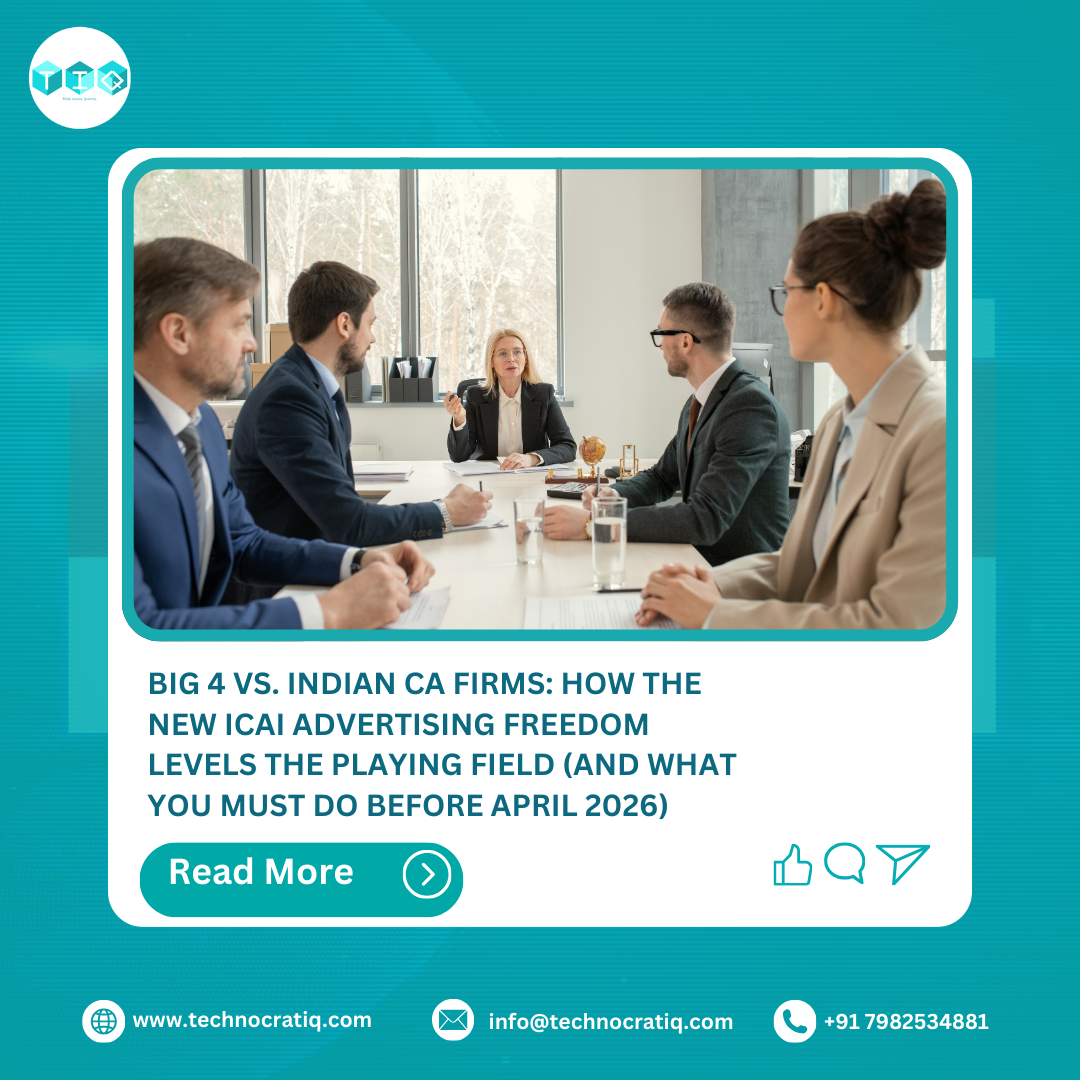
    Big 4 vs. Indian CA Firms: How the New ICAI Advertising Freedom Levels the Playing Field (And What You Must Do Before April 2026)

    For years, the Indian CA landscape has felt uneven. Domestic firms-especially mid-sized and emerging ones in cities like Delhi-have relied almost exclusively on referrals, networks, and word-of-mouth to grow. Meanwhile, the Big 4 (Deloitte, PwC, EY, KPMG) dominate with massive global brands, aggressive digital presence, thought leadership content, targeted ads, and seamless outreach for non-audit services.

    The result? Big 4 firms capture a huge share of high-value advisory, consultancy, tax planning, and forensic work, even as statutory audits remain regulated. Domestic CA firms often stay in the shadows, limited by outdated ICAI restrictions on advertising and promotion.

    But that’s changing fast.

    On December 12, 2025, ICAI’s 447th Council Meeting approved transformative amendments to the 13th Edition of the Code of Ethics (effective April 1, 2026). These include major relaxations in Advertisement and Website Guidelines, explicitly allowing greater flexibility in digital promotion, including push notifications for non-exclusive services like consultancy, accounting, tax advisory, forensic, and more.

    ICAI’s own press release frames this as a “game-changer” to strengthen domestic firms and create a true level playing field for Chartered Accountants.

    Direct quote from ICAI (December 12, 2025):

    “Allowing such non-exclusive services to be promoted through ‘push mode’ enhances visibility, aligns with current digital practices, and provides a level playing field for Chartered Accountants.”

    (Source: ICAI Official Press Release)

    This isn’t unrestricted marketing; statutory audits and assurance services stay protected to preserve independence. But for the growing non-assurance side of practices (where much of the future revenue lies), Indian CA firms can now build brands, reach clients proactively, and compete head-on.

    As a digital marketing agency specializing in compliant strategies for CA firms in Delhi and beyond, we’ve seen how this shift opens massive opportunities. Here’s how the rules truly level the field-and the urgent steps your firm should take before April 2026 to pull ahead.


    Why the Big 4 Have Dominated (And How ICAI’s Changes Disrupt That)

    The Big 4’s edge has never been just talent – it’s visibility and scale:

    • Heavy investment in content marketing, LinkedIn thought leadership, webinars, and targeted ads.
    • Global brand recognition that attracts clients seeking “big-name” advisory.
    • Freedom to promote non-audit services aggressively (consulting, risk advisory, forensics, etc.).

    Domestic firms? Restricted to basic “write-ups,” no solicitation, limited digital outreach. Many talented mid-sized firms in India remain under-the-radar, even when they deliver equal or better value at more competitive rates.

    The new rules flip this:

    • Creative flexibility in ads, write-ups, websites, and social media.
    • Push technology permitted for non-exclusive services (e.g., tax tips, consultancy offers).
    • Enhanced website options for network firms.

    <<<>>>

    Coverage from sources like Economic Times CFO and The Accountant Online echoes ICAI’s intent: empower domestic practices to challenge global dominance, align with modern practices, and support government visions for stronger Indian firms.

    This levels the digital playing field-especially for non-assurance work, where clients increasingly discover providers via Google, LinkedIn, Instagram, or push alerts.


    What Changes for Indian CA Firms Post-April 2026

    • Green Zone (Now Promotable): Tax planning, bookkeeping, management consultancy, forensic accounting, AI consulting, CSR advisory-use push notifications, reels, targeted ads, detailed blogs/videos.
    • Red Zone (Still Restricted): Statutory audits, tax audits, attestations-no promotional solicitation or comparative claims.
    • Must-Dos for Compliance: Stay factual/dignified, no misleading promises, easy opt-outs, consent-based outreach.

    The window to prepare is now-rules kick in April 1, but smart firms build momentum in Q1 2026.


    5 Actionable Steps Your CA Firm Must Take Before April 2026

    1. Audit Your Current Digital Presence (Now – Feb 2026): Review your website, LinkedIn, and any basic profiles. Identify gaps in non-assurance service pages. Update privacy policies for push consent. This baseline audit ensures you’re ready to scale ethically.
    2. Build Consent Infrastructure for Push & Digital Outreach: Integrate tools like OneSignal or PushEngage on your site for web push (opt-in only). Create value-first lead magnets (e.g., “2026 Tax Planning Guide” PDF) to grow opted-in lists. Start small tests pre-April to refine messaging.
    3. Develop Compliant Content & Campaign Playbook: Focus on educational/value content: Tax reels, consultancy case studies (anonymized), LinkedIn posts on advisory trends. Avoid any audit mentions in promotions. Plan seasonal series (e.g., ITR season pushes) for non-exclusive services.
    4. Position Your Firm as a Thought Leader: Launch short LinkedIn/Instagram reels on topics like “GST Updates 2026” or “AI in Accounting for SMEs.” This builds brand trust fast-something Big 4 have mastered, but now you can match ethically.
    5. Partner with Experts for Compliant Execution: Don’t go solo-digital compliance for regulated professions is nuanced. Work with agencies experienced in CA/ICAI rules to avoid pitfalls (e.g., accidental solicitation). We help firms launch push + social strategies that drive 3x+ leads while staying 100% ethical.

    The Bottom Line: Act Now or Watch Competitors Pull Ahead

    April 2026 isn’t the start-it’s the acceleration point. Firms that prepare in the next 1–2 months (build lists, test content, refine branding) will capture mindshare first.

    The Big 4 won’t slow down, but Indian CA firms finally have tools to fight back: visibility, digital reach, and ethical promotion for growth areas.

    As a Delhi-based team that’s already guiding CA practices through this transition, we’ve seen early movers gain real traction-more inquiries, stronger pipelines, less referral dependency.

    Ready to level up?

    Website : https://technocratiq.com

    Email : info@technocratiq.com

    Contact (US) : +1 55 155 00 576

    Phone (IN) : +91 7982534881

    Mobile : +91 99711 50579

    WhatsApp : Chat on WhatsApp


    The playing field is leveling. Make sure your firm is on the winning side.

    Key Sources & Citations

  • April 2026 ICAI Rules: Ethical Marketing for CA Firms

    April 2026 ICAI Rules: Ethical Marketing for CA Firms

    April 2026 ICAI Rules: 7 Ethical Ways CA Firms Can Use Push Notifications & Social Media to Get 3x More Leads

    If you’re a practising CA or run a firm in Delhi, Mumbai, or anywhere in India, you’ve probably felt the frustration for years: building a practice almost entirely on referrals and word-of-mouth while unregulated consultants and even some global players flood LinkedIn, Instagram, and email with promotions.

    That changes officially – on April 1, 2026.

    The Institute of Chartered Accountants of India (ICAI) dropped a major update in its December 12, 2025 press release: the revised 13th Edition of the Code of Ethics brings real flexibility to advertising, write-ups, websites, and digital tools like push notifications-but only for services not exclusive to the CA profession.

    This isn’t full-blown commercial advertising. Statutory audits, attestation, and core assurance work stay protected (no solicitation or flashy promotions there to safeguard independence). But for tax advisory, bookkeeping, management consultancy, forensic accounting, AI consulting, CSR advisory, and similar non-exclusive services? You can now go digital in ways that actually drive leads.

    Done ethically and smartly, firms in liberalized markets often see 3x or more qualified inquiries. Here’s a practical breakdown of what’s allowed, backed by ICAI’s own words, and 7 compliant tactics you can start preparing for now.

    What’s Actually Allowed Under the New ICAI Rules (and What’s Still Restricted)

    ICAI’s official announcement makes it clear: the changes aim to “enhance visibility, align with current digital practices, and provide a level playing field for Chartered Accountants.”

    Direct quote from the ICAI press release (December 12, 2025):

    “In the website guidelines, the Council has proposed greater flexibility by allowing members and firms to use push technology for services that are not exclusive to the CA profession (e.g., consultancy, accounting, etc.). Allowing such non-exclusive services to be promoted through ‘push mode’ enhances visibility…”

    (Source: ICAI Official Press Release)

    Similar language appears in coverage from Economic Times CFO, The Accountant Online, and others reporting on the 447th Council Meeting.

    Quick summary of the green and red zones (effective April 1, 2026):

    • Allowed (with dignity & facts only):
      • Push notifications via websites/apps
      • Social media reels, posts, targeted ads (LinkedIn, Instagram, etc.)
      • Detailed website content, videos, creative write-ups
      • For non-exclusive services: tax planning, accounting support, consultancy, forensic, advisory, etc.
    • Still Restricted:
      • No promotional advertising or solicitation for statutory audits, tax audits, certifications, or assurance/attestation services.
      • Must remain factual, non-misleading, non-comparative, no guarantees of results, no client fee mentions in certain ways, no spammy tactics.

    Rule of thumb: Treat it like professional communication that adds value, not hard selling. Always include easy opt-outs, clear consent, and a privacy policy.


    7 Ethical, High-Impact Tactics to Drive Leads Compliantly

    Here are realistic ways Delhi and other Indian CA firms can leverage push notifications and social media starting April 2026, without risking an ICAI complaint.

    1. Timely Tax Tip Push Notifications Send short, value-first alerts like “New GST input credit rule effective July 2026 – Here’s how it impacts your business” to website visitors who’ve opted in.
      Why it works: Push open rates often hit 15-25% (far better than email).
      Compliance tip: Purely educational for tax advisory (non-exclusive). No direct “hire us” pitch in the first message.
      Example outcome: A mid-sized Delhi firm could nurture 100+ warm leads per season.
    2. Abandoned Enquiry Re-engagement Pushes If someone fills a form for “free bookkeeping checklist” but doesn’t book a call, send a gentle follow-up: “Still exploring efficient accounting? Download your customized checklist here.”
      Why it works: Re-captures 20–30% of drop-offs.
      Compliance tip: Only for non-assurance leads; include unsubscribe link.
    3. LinkedIn Reels Showcasing Consultancy Wins Create 15-second videos: “How we helped a startup streamline compliance and save time on monthly reporting” (focus on advisory/consultancy angle-no audit mentions).
      Why it works: Reels get massive organic reach on LinkedIn India.
      Compliance tip: Use anonymized stories with client consent; keep it factual.
    4. Free Webinar Invites via Push + Social Promote sessions like “AI Tools for Smarter Financial Planning in 2026” with push alerts: “Join our free webinar next Thursday-limited spots.”
      Why it works: Builds authority and email/SMS lists ethically.
      Compliance tip: Position as educational consultancy content.
    5. Personalized Thank-You Pushes After Form Submissions Post-website enquiry: “Thanks for your interest in tax planning-here’s your free 2026 ITR calendar PDF.”
      Why it works: Instant value builds trust and opens doors for follow-up calls.
      Compliance tip: Consent-based only; no sales pressure.
    6. Instagram/LinkedIn Carousel Success Stories Share non-audit project highlights: “Client reduced bookkeeping time by 40% with our streamlined process” (carousel format with tips).
      Why it works: Visual storytelling performs well for professional services.
      Compliance tip: No assurance references; get written consent.
    7. Seasonal Push Series for Planning Services Around ITR/GST deadlines: Day 1 push with a tip → Day 3 with “Book a free 30-min tax strategy consult” (for advisory only).
      Why it works: Urgency + education = higher conversions.
      Compliance tip: Sequence value-first; target non-exclusive services.

    Pro Tip for All: Use platforms like OneSignal (free tier for web push) or PushEngage, Meta Ads Manager, and LinkedIn Campaign Manager. Always double opt-in for notifications and link to a clear privacy policy page.

    How to Measure Real Results (Without Vanity Metrics)

    Focus on:

    • Push open/click rates (aim 15%+ opens)
    • Lead quality (qualified calls booked)
    • Conversion to paid consults

    Avoid over-pushing, once a week max to prevent opt-outs. Track everything in Google Analytics or simple CRM.

    Final Thoughts: Start Preparing Now

    April 2026 isn’t just another date-it’s your window to shift from referral-only to digitally proactive. Firms that test compliant setups in Q1 2026 will have the edge when the rules kick in.

    As someone who’s helped several Delhi CA practices navigate digital shifts, we’ve seen firsthand how ethical push and social strategies turn visibility into real growth, without crossing ethical lines.

    Planning to launch push notifications or social campaigns?

    Website : https://technocratiq.com

    Email : info@technocratiq.com

    Contact (US) : +1 55 155 00 576

    Phone (IN) : +91 7982534881

    Mobile : +91 99711 50579

    WhatsApp : Chat on WhatsApp


    Stay ethical, stay visible. The profession is evolving-let’s make sure your firm leads the way.

    Sources & Citations

  • Free Consultation Strategy: AI-Powered Marketing & SEO for B2B ROI in 2026

    Free Consultation Strategy: AI-Powered Marketing & SEO for B2B ROI in 2026

    In 2026, the free consultation is the most underutilized revenue lever in B2B.

    Consider the math: A high-consideration buyer searches for “growth strategy consultant.” They land on your website and see a blog post proving you understand their problem. They are interested but not ready to buy. A generic “Contact Us” form sits below the fold. The prospect leaves, and you lose the lead forever.

    Now imagine a different scenario: That same prospect sees a “15-Minute Free Strategy Call” button. They book instantly. You discover they have a $500K annual budget, a pressing Q1 deadline, and decision authority. Two weeks later, you close a $100K engagement.

    This is the power of a free consultation strategy B2B. It is the bridge between awareness and revenue. It is how you turn SEO traffic into qualified pipeline at a fraction of traditional sales costs.

    This guide outlines how to build, optimize, and scale a free consultation strategy B2B system that drives measurable revenue, positioning Technocratiq Digital as your implementation partner.


    SEO Foundation: Driving Qualified Free Consultation Traffic


    A consultation strategy is only valuable if you have a steady stream of qualified traffic entering the funnel.

    Your SEO strategy must target high-intent keywords that signal readiness to consult:

    • “Best [service] consultant near me.”
    • “[Industry] growth strategy expert”
    • “[Problem] solution consultant [location]”
    • “[Service] agency for [specific need]”

    Content clusters supporting free consultation strategy B2B:

    • Pillar Pages: Comprehensive guides on core services (e.g., “The Complete Guide to SaaS Go-to-Market Strategy”).
    • Cluster Content: Supporting articles addressing specific pain points, each linking to the pillar and ending with a “Schedule Your Free Consultation” CTA.
    • Local Service Pages: City/region-specific pages (“Growth Consultant in Austin,” “Legal Consultant in NYC”).

    Landing pages should feature:

    • Clear Value Exchange: “30-Minute Strategic Assessment Worth $1,500—Free”
    • Social Proof: Client logos, case results, testimonials from similar companies.
    • Process Transparency: What to expect during the call (discovery questions, assessment framework, next steps).
    • Urgency & Scarcity: “5 slots available this week” or “Next availability: [specific date]”

    This SEO-first approach ensures you are attracting buyers already searching for your solution, not cold traffic requiring extensive nurturing.


    AI-Powered Marketing Funnel: From Click to Qualified Booking

    The real innovation in free consultation strategy B2B is how AI automates qualification without losing the human touch.


    Top-of-Funnel: Intent Capture

    When a visitor lands on your consultation page, AI immediately assesses fit:

    • Diagnostic Quiz: “What’s your biggest growth bottleneck?” (3 questions, 30 seconds)
    • Company Size Selector: “Which category best fits your organization?”
    • Timeline Indicator: “When do you need to see results?”

    These micro-commitments serve dual purposes: they qualify the lead and increase psychological buy-in.


    AI-Powered Qualification

    Based on quiz answers, AI dynamically adjusts the experience:

    • Low-fit visitors see: “This might not be the right service for you, but here’s a resource that could help.”
    • High-fit visitors see: “You’re a great candidate. Here’s a 15-minute call with [Specialist Name] to explore options.”

    An AI chatbot then asks clarifying questions:

    • “What’s your annual revenue?” (budgets matter)
    • “Who else needs to approve this decision?” (identifying decision authority)
    • “What’s driving urgency?” (timeline and pain intensity)

    This information pre-fills the booking form, reducing friction and increasing conversion rates by 20-40%.


    Smart Calendar Integration

    Real-time availability synced across your team ensures:

    • No overbooking or scheduling conflicts.
    • Leads see availability instantly (“Next 3 slots: Tuesday 2 PM, Wednesday 10 AM, Friday 3 PM”).
    • Calendar automatically routes to the most qualified consultant.

    Compliant Booking & Calendar Optimization for B2B Consults

    In professional services, trust is currency. Your booking flow must reflect professionalism and set expectations.

    Pre-Booking Qualification:
    Ask the right questions before committing calendar time:

    • “What’s your approximate annual revenue / budget for this initiative?”
    • “Are you the decision-maker, or will others be involved?”
    • “What’s your primary objective for this call?”

    These questions serve three purposes:

    1. Qualify: Quickly disqualify poor-fit leads.
    2. Prepare: Your consultant knows what to expect.
    3. Frame: The lead commits mentally to the conversation.

    Trust-Building Elements:

    • Consultant Bio: Show credentials, expertise, and client logos they’ve worked with.
    • Clear Disclaimers: “Free consultation does not constitute legal/financial advice. We’ll discuss options and next steps.”
    • Confirmation & Prep: Send a follow-up email with call agenda, pre-read materials, and prep questions.

    Urgency Without Aggression:

    • “Only 2 slots available this week” (real scarcity, not artificial).
    • “Typically books 2-3 weeks out” (manages expectations, creates urgency).
    • Avoid: High-pressure language or fake countdown timers.

    Reducing No-Shows & Maximizing Show-Up Value

    A booked consultation that doesn’t happen is a wasted opportunity. In B2B marketing ROI, no-show rates directly impact pipeline and revenue.

    Pre-Consult Sequence:

    1. Immediate Confirmation (within 1 hour): Agenda, consultant name/photo, prep questions, Zoom link.
    2. 24-Hour Reminder: Email with brief value statement (“We’ll cover: your current [X], gaps vs [Y], and your roadmap to [Z]”).
    3. 1-Hour Reminder: SMS text (if opted-in) with Zoom link and phone number.

    AI-Generated Pre-Reads:
    Before the call, your consultant receives a one-page brief:

    • Lead’s industry, company size, stated challenges.
    • Relevant case study or past win with similar profile.
    • Talking points tailored to their specific situation.

    This transforms a generic consultation into a personalized conversation.

    During-Consult Optimization:

    • Structured Agenda: 5 min intro, 15 min discovery, 7 min assessment, 3 min next steps.
    • Value-First Approach: Provide tactical insights during the call (not just “let’s schedule another meeting”).
    • Disqualification Clarity: If they’re not a fit, say so and provide alternative resources (builds trust for future referrals).

    Post-Consult Automation:

    • Same-Day Recap: Summary email with action items, next steps timeline, and CTA.
    • Drip Sequence: For “warm but not ready” leads, automated sequences maintaining engagement without harassment.

    Measuring B2B Marketing ROI: From Booking to Revenue Attribution

    Without proper measurement, you cannot optimize. B2B marketing ROI requires tracing the journey from SEO click to closed revenue.

    Core Metrics for free consultation strategy B2B:

    • Booking Rate: % of landing page visitors who book (target: 2-5%)
    • Show-Up Rate: % of booked consultations that actually occur (target: 70-85%)
    • Consult-to-Opportunity: % of consultations converting to sales conversations (target: 30-50%)
    • Opportunity-to-Close: % of opportunities closing to revenue (target: 20-40%)
    • Revenue per Booked Consult: Average deal value from consultation pipeline

    Attribution Framework:

    • First-Touch: Credit the SEO keyword/content for the initial visit.
    • Multi-Touch: Credit nurture emails, reminders, and prep materials for engagement.
    • Consult Credit: The consultation itself as a conversion event.
    • Closed-Won Credit: Final attribution to the consultation as a pipeline influence point.

    AI-Powered Analytics:

    • Automated dashboards showing bookings, show-ups, and revenue by source/keyword.
    • Predictive scoring identifying which consultations are most likely to close.
    • Cohort analysis comparing ROI across different qualification questions or consultant types.

    Common Pitfalls & Optimization Benchmarks

    Avoid These Mistakes:

    • Generic Scheduling Pages: “Book a call” without context is too vague. Specify: “Schedule Your 30-Minute Market Analysis”
    • No Pre-Qualification: Booking time with anyone wastes your consultant’s calendar.
    • Poor Follow-Up: Consultations without same-day recap or structured next steps lose 40% of pipeline potential.
    • Mobile Friction: Booking forms not optimized for mobile kill 50%+ of conversions.

    Benchmarks for B2B Marketing ROI:

    • Cost Per Booking from SEO: $50–$200 (vs. $500–$2,000 via paid ads)
    • Consultation Duration: 20–45 minutes (shorter = better qualification; longer = higher engagement)
    • Consult-to-Opportunity Conversion: 25–50% (depending on industry and qualification)
    • Average Deal Value from Consultations: 3–5x the ACV of average customers

    Quick Wins for Immediate Improvement:

    • Add a clear “Schedule Free Consultation” button above the fold on landing pages.
    • Implement AI chatbot qualification reducing booking form abandonment by 20%.
    • Send 24-hour pre-consult reminder SMS (increases show-up by 10–15%).

    How Technocratiq Digital Builds High-ROI Free Consultation Strategy B2B

    Most agencies treat consultation funnels as afterthoughts. Technocratiq Digital treats them as revenue engines.

    Our Methodology:

    1. Audit & Benchmark: We assess your current funnel, calculate metrics, and compare against industry benchmarks.
    2. SEO & Landing Page Optimization: We identify high-intent consultation keywords and design landing pages that convert.
    3. AI Funnel Design: We architect qualification workflows, chatbots, and calendar integrations that maximize booking rates.
    4. Conversion Optimization Sprints: We A/B test headlines, CTAs, forms, and trust elements to improve conversion rates by 30–50%.
    5. Revenue Attribution Setup: We implement tracking linking SEO → consultation → opportunity → closed revenue.
    6. Ongoing Optimization: Monthly performance reviews, testing roadmaps, and continuous tuning of the funnel.

    Key Takeaways

    • Free consultation strategy B2B transforms high-consideration buyers from browsers into a qualified pipeline by providing low-risk value discovery.
    • AI-powered marketing funnel qualification, compliant booking, and strategic no-show reduction create a scalable, repeatable pipeline at a fraction of traditional sales costs.
    • Proper B2B marketing ROI measurement links SEO traffic → consultation booking → opportunity → closed revenue, enabling continuous optimization and predictable growth.
    • Technocratiq Digital designs end-to-end consultation systems that turn your organic visibility into measurable pipeline and revenue impact.

    FAQs

    What is a free consultation strategy B2B and why does it work for high-consideration services?
    A free consultation strategy B2B offers low-risk discovery calls to prospective clients, reducing perceived risk before purchase. It works because high-consideration buyers need trust and personalized advice before committing; a free consultation builds both while qualifying leads cost-effectively.

    How can B2B marketing ROI be measured for consultation funnels?
    Track: booking rate (landing page → calendar), show-up rate (booked → attended), consult-to-opportunity rate (consultation → sales conversation), and opportunity-to-close rate (sales conversation → revenue). Revenue per booked consultation is the ultimate metric.

    What are the best AI-powered marketing funnel tactics for qualifying B2B consult leads?
    AI-powered approaches include: diagnostic quizzes that assess fit, dynamic forms that adjust based on answers, chatbots asking clarifying questions, and lead scoring routing to the right consultant. These reduce friction while dramatically improving lead quality.

    How do you reduce no-shows for B2B free consultations?
    Send confirmation emails immediately, reminders at 24 hours and 1 hour before the call, SMS reminders (if opted-in), and provide pre-read materials. High-engagement reminders (not just “don’t forget”) increase show-up rates from 60% to 80%+.

    What conversion benchmarks should B2B service providers expect from consultation funnels?
    Industry benchmarks: 2–5% booking rate from landing page visitors, 70–85% show-up rate for booked consultations, 25–50% consult-to-opportunity conversion, and $50–$200 cost per consultation from organic traffic.

    How does Technocratiq Digital help implement free consultation strategy B2B systems?
    Technocratiq Digital designs SEO-optimized landing pages, builds AI-powered qualification funnels, sets up calendar integrations, and implements revenue attribution. We measure and optimize every step, turning your SEO traffic into a predictable consultation pipeline.


    Conclusion

    In 2026, the B2B service providers that scale fastest will not be those with the biggest ad budgets. They will be those with the most efficient consultation funnels.

    A free consultation strategy B2B powered by SEO, AI qualification, and strategic follow-up is the highest-ROI engine for converting awareness into revenue. Every dollar spent optimizing your consultation funnel returns multiples in closed deals.

    The data proves it: a consultation-led funnel powered by organic SEO can deliver client acquisition costs 70–80% lower than paid channels, with higher customer quality and lifetime value.

    Don’t let qualified traffic bounce because your booking experience is clunky or your team is not prepared.

    B2B service providers ready for consultation-led growth—schedule a Free Consultation Strategy Audit with Technocratiq Digital to benchmark your funnel, identify quick wins, and roadmap 2026 revenue growth.


  • Regulatory-Safe Content for Healthcare & Law Firms: AI, SEO & Compliance in 2026

    Regulatory-Safe Content for Healthcare & Law Firms: AI, SEO & Compliance in 2026

    In 2026, non-compliant content is a liability with a price tag.

    A healthcare provider publishes patient testimonials without HIPAA safeguards. A law firm claims “we win 90% of cases.” An insurance advisor guarantees returns. Each violation starts as a single blog post, but it compounds: the FTC notices, the state attorney general investigates, and suddenly a content marketing initiative becomes a legal crisis.

    Yet, the opposite extreme—creating no content at all—is equally dangerous. Your competitors who balance aggressive content marketing with strict compliance will dominate organic search, build trust with prospective patients and clients, and capture the market share you leave on the table.

    This is the mission of regulatory-safe content healthcare law firms strategy. It shows how to build authority, rank for high-intent keywords, and drive conversions—all while passing compliance review and keeping your firm audit-ready.

    This guide outlines a framework for scaling compliance content marketing safely, positioning Technocratiq Digital as your partner in this critical balance.

    Compliance Foundations: What Healthcare & Law Firms Cannot Say (and When)


    Before you create a single piece of content, you must understand the boundaries.

    Healthcare Content Constraints:

    • No guarantees of outcomes (“We will cure your arthritis”).
    • No claims about treating specific diseases without FDA clearance (“Our supplement treats diabetes”).
    • No before/after results without clear disclaimers and supporting evidence.
    • No patient testimonials identifying specific conditions or results without HIPAA compliance.

    Law Firm Content Constraints:

    • No guarantees of case outcomes (“We guarantee you’ll win”).
    • No comparative superiority claims (“We’re the best personal injury firm in the state”).
    • No unsolicited solicitation of specific prospective clients.
    • No statements that could be construed as legal advice without clear disclaimers.

    Common Violations Triggering Regulatory Scrutiny:

    • Publishing identifiable patient stories without written consent.
    • Posting case results without context or disclaimers.
    • Using superlative language (“safest,” “most effective,” “guaranteed”).
    • Making disease treatment claims without supporting evidence.

    The Paradigm Shift: Compliance is not a content constraint; it is a content strategy. Brands that understand regulatory boundaries can create content that competitors cannot—content built on credibility rather than hype.

    AI Content Generation with Built-In Compliance Guardrails

    The fastest way to scale content is with AI. The safest way is with guardrails baked into the AI workflows.

    Regulatory-safe content healthcare law firms AI architecture:

    Prompt Engineering with Compliance Rules

    Instead of generic prompts like “Write a blog post on arthritis treatment,” use compliant prompts:

    • “Write an educational guide on arthritis symptoms, treatment options, and when to consult a specialist. Include a disclaimer that this is informational and not medical advice. Avoid absolute claims.”

    This trains the AI model to respect boundaries before it generates content.

    Approved Messaging Libraries

    Create a library of pre-cleared claims and language:

    • ✓ “Can help manage symptoms”
    • ✗ “Cures arthritis”
    • ✓ “We have successfully represented clients in [X] cases”
    • ✗ “We guarantee you’ll win your case”

    Feed this library into your AI system. The model learns to use approved language and flags non-compliant language for human review.


    Multi-Stage Review Workflow

    1. AI Draft: Model generates content using approved messaging and compliant prompts.
    2. Automated Compliance Scan: Software flags risky language (superlatives, guarantees, identifying information).
    3. Human Legal Review: Your compliance or legal team approves final version.
    4. Publish: Audit trail documents every approval step.

    This workflow allows you to scale from 5 articles per month to 50—without increasing legal review overhead.


    SEO Strategy: Healthcare Compliance SEO That Ranks Safely

    Healthcare compliance SEO requires a different keyword strategy than generic health content.


    Keyword Strategy

    • Informational Intent: “Symptoms of arthritis,” “Treatment options for GERD,” “When to see a cardiologist”
      • These keywords attract educational searchers and position your brand as an authority.
      • Lower conversion intent, but builds trust and E-E-A-T (Expertise, Experience, Authoritativeness, Trust).
    • Local Commercial Intent: “Cardiologist near me,” “Best orthopedic surgeon in Boston,” “Dermatologist accepting new patients”
      • These are appointment drivers. Compliant local SEO is critical.

    Avoid broad commercial keywords like “best arthritis cure” or “guaranteed treatment”—these invite FTC scrutiny.


    Content Architecture for Healthcare Compliance SEO

    • Condition Hubs: Deep, educational content on specific conditions (symptoms, causes, available treatments).
    • Treatment Overviews: Neutral comparison of treatment options (surgery vs. physical therapy vs. medication).
    • Provider Bios: Detailed specialist pages with credentials, certifications, and specialties.
    • Compliant CTAs: “Schedule your consultation,” not “Get your cure today.”

    Schema Markup for Trust

    Implement schema that signals credibility:

    • MedicalOrganization with address, phone, hours.
    • Physician with board certifications, specialties, and educational credentials.
    • LocalBusiness with genuine reviews (no fake ratings).
    • FAQPage schema answering common patient questions with evidence-based answers.

    Content Review & Approval Workflows for Scale

    The bottleneck in compliance content marketing is usually approval, not creation. Smart workflows eliminate the bottleneck.


    Tiered Review System

    • Low-Risk (Educational Content): Minimal review. Educational blog posts on general health topics can move fast.
    • Medium-Risk (Service Descriptions): Standard review. Service pages describing treatments or legal services need compliance eyes.
    • High-Risk (Testimonials, Results, Comparative Claims): Full legal review. Patient stories, case results, and claims require senior attorney/compliance officer sign-off.

    Automation for Scalability

    • Compliance Checklists: Automated workflows in your CMS prompt reviewers to verify: disclaimers included? Patient privacy protected? No guarantees? Approved messaging used?
    • Version Control: Track every edit, approval, and publication date. In a regulatory audit, you prove due diligence.
    • Scheduled Audits: Quarterly scans of live content ensure published material remains compliant as regulations evolve.

    Training & Standardization

    • Equip your content creators with templates: approved headers, standard disclaimers, modular content blocks.
    • Train your legal/compliance team on SEO best practices so they approve faster without sacrificing safety.

    Case Studies & Testimonials: Compliant Social Proof

    Social proof is essential for trust. Compliant social proof is essential for trust without legal risk.

    Regulatory-safe case studies for healthcare:

    • Anonymized patient stories: “A patient with chronic pain tried multiple treatments before finding relief through [approach]. Results vary by individual.”
    • Outcome context: “Of the 500 patients we treated for [condition] from 2023–2025, [X]% achieved [outcome], with an average recovery time of [Y].”
    • Always include: “These results are not guaranteed and may vary based on individual circumstances.”

    Regulatory-safe case studies for law firms:

    • Attorney credentials: Bar memberships, certifications, years of practice.
    • Case results with context: “Successfully resolved contract disputes averaging $250K+ in damages” (neutral, fact-based).
    • Speaking engagements and publications: “Featured in [Law Journal] on [topic].”

    Video Testimonials:

    • Obtain written releases from every testimonial provider.
    • Include disclaimers: “Results and testimonials may not be representative of typical results.”
    • Keep claims factual and specific, not emotional superlatives.

    Technical Compliance: Privacy, Cookies & Tracking

    Healthcare compliance SEO demands privacy-first technical execution.


    Consent Management

    • Implement a Consent Management Platform (CMP) with granular controls.
    • Users can opt-in to analytics, marketing cookies, etc., without blocking access to content.
    • Document consent evidence for regulatory audits.

    Server-Side Tracking

    • Use server-side event tracking instead of client-side pixels.
    • This captures data for analytics without exposing user behavior to third parties.
    • HIPAA and GDPR compliant by design.

    Compliant Personalization

    • Personalize based on first-party data only: email signup, form submissions, past interactions.
    • Avoid third-party data brokers or invasive retargeting.

    A/B Testing Frameworks

    • Test headline variants, CTA button colors, and form field counts—all server-side.
    • Report aggregate results (“Variant A converted 5% better than Variant B”) without individual user tracking.

    How Technocratiq Digital Delivers Regulatory-Safe Content Healthcare Law Firms

    Navigating the intersection of aggressive content marketing and strict compliance requires specialized expertise.

    Technocratiq Digital is built for this complexity. We are a compliance content marketing firm with deep experience in healthcare and legal industries.

    Our Methodology:

    1. Compliance Audit: We assess your current content, identify risk exposure, and benchmark against regulatory best practices.
    2. Healthcare Compliance SEO Roadmap: We design a keyword strategy and content architecture that ranks while respecting HIPAA, state laws, and advertising standards.
    3. AI Workflow Design: We build compliant AI systems with guardrails, approved messaging libraries, and automated review checkpoints.
    4. Content Scaling System: We create templates, modular content blocks, and tiered approval workflows that allow your team to publish safely at speed.
    5. Quarterly Reviews: We audit live content quarterly to ensure ongoing compliance as regulations evolve.
    6. Training: We equip your team with SOPs, compliance checklists, and best practices for sustained safe scaling.

    FAQs

    What is regulatory-safe content healthcare law firms and why do they need it?
    Regulatory-safe content healthcare law firms is content that drives SEO rankings, trust, and conversions while adhering to HIPAA, GDPR, bar rules, and advertising standards. It is essential because non-compliant content invites regulatory fines, reputation damage, and legal liability—risks that dwarf any short-term marketing gains.

    How can healthcare providers create compliant SEO content that still ranks well?
    Focus on informational and educational intent keywords (“symptoms of X,” “treatment options”) rather than commercial claims. Build deep, evidence-based content hubs that position your brand as an authority. Use schema markup to highlight credentials and legitimacy without making guarantees.

    What compliance review processes should law firms implement for content marketing?
    Implement tiered review: low-risk educational content moves fast; medium-risk service descriptions need standard review; high-risk testimonials and case results need legal sign-off. Use automated compliance checklists in your CMS and maintain audit trails of every approval.

    Can AI generate regulatory-safe content for healthcare and legal websites?
    Yes, when guardrails are built in. Use compliant prompts, feed approved messaging libraries into AI models, and implement multi-stage review workflows (AI draft → automated compliance scan → human legal review → publish). This allows safe, fast scaling.

    How does healthcare compliance SEO handle patient privacy and HIPAA rules?
    By using server-side tracking (not client-side cookies), obtaining written consent for testimonials, anonymizing patient stories, and avoiding identifiable health information. Never publish specific diagnoses or outcomes without clear consent and disclaimers.

    How does Technocratiq Digital help regulated firms with compliance content marketing?
    Technocratiq Digital audits your current risk exposure, designs compliant SEO strategies, builds AI workflows with built-in guardrails, and creates scaling systems (templates, modular blocks, review automation) that allow your team to publish safely at speed.


    Key Takeaways

    • Regulatory-safe content healthcare law firms treats compliance as a strategic advantage, not a constraint—building authority that competitors cannot match because they are cutting corners.
    • Compliance content marketing requires AI guardrails, tiered review workflows, and privacy-first technical execution from Day 1, reducing risk and accelerating safe scaling.
    • Healthcare compliance SEO succeeds by focusing on educational authority, credentials, local signals, and evidence-based information rather than hype and guarantees.
    • Technocratiq Digital designs end-to-end compliant content systems that scale SEO performance while keeping healthcare and law firms audit-ready and legally protected.

    Conclusion

    In 2026, the healthcare providers and law firms that win will not be those that push compliance boundaries. They will be those who master them.

    Regulatory-safe content healthcare law firms is not about being conservative; it is about being strategic. It is about understanding that trust, built through educational authority and transparent disclaimers, converts better than hype. It is about knowing that a reputation built on credibility is worth more than a ranking gained through risk.

    The data proves it: compliant, evidence-based content ranks well, builds trust with prospective patients and clients, and drives a sustainable pipeline. Non-compliant content may spike traffic briefly, but it invites regulatory scrutiny, reputation damage, and legal liability.

    Choose the path that scales safely.

    Healthcare providers and law firms seeking compliant content growth—schedule a Regulatory Content Audit with Technocratiq Digital to benchmark your current risk exposure and roadmap SEO-safe content scaling for 2026.


  • AI-Enabled Local to Global: AI-Driven International SEO for B2B in 2026

    AI-Enabled Local to Global: AI-Driven International SEO for B2B in 2026

    In 2026, “going global” is no longer just about translating a landing page. It is an architectural challenge. With the rise of AI-driven “answer engines,” voice search dominance, and stricter E-E-A-T (Experience, Expertise, Authoritativeness, Trust) requirements for cross-border content, B2B brands face a complex reality.

    For SaaS, fintech, and healthtech companies, the opportunity is massive, but the technical debt is dangerous. Expanding into Germany, Japan, or the UAE often leads to hreflang chaos, diluted domain authority, and compliance nightmares.

    AI international SEO B2B is the solution to this fragmentation. It is the only way to orchestrate technical precision and content volume at the speed required to win market share in 2026. This playbook outlines how to scale from a local player to a global category leader using AI-driven strategies, with Technocratiq Digital as your implementation partner.


    International SEO Foundations: Hreflang, ccTLDs, and Subdirectories Done Right

    Before deploying AI agents to write content, you must get the infrastructure right. In 2026, the debate between ccTLDs (country code Top-Level Domains), subdomains, and subdirectories is settled for most B2B brands.

    For AI-powered international SEO, subdirectories (e.g., domain.com/de/, domain.com/fr/) are usually the superior choice. They consolidate link equity into a single root domain, allowing your high-authority English site to boost your new German or French pages instantly.

    However, the architecture requires rigorous technical management:

    • Hreflang Automation: Hreflang tags tell Google which version of a page to show a specific user. Manual implementation is prone to error. We use AI scripts to automate self-referencing tags, x-default tags for unmatched users, and bidirectional return tags across thousands of pages.
    • Canonical Signals: AI tools must monitor canonical tags to prevent “duplicate content” penalties when you have similar pages for the US (en-us) and UK (en-gb).
    • Core Web Vitals: International infrastructure often suffers from latency. Your setup must ensure that a user in Singapore loads the page as fast as a user in New York.

    AI-Powered Multilingual SEO Strategy: Content at Global Scale

    The old model of hiring expensive agencies for every single blog post is too slow. The new model relies on a multilingual SEO strategy that combines AI velocity with human compliance.

    AI international SEO B2B allows you to scale content production without sacrificing quality:

    1. AI Transcreation: We don’t just translate; we transcreate. AI agents take your high-performing English content and adapt it not just to the language, but to the cultural context and search intent of the target market.
    2. Regulatory Adaptation: For regulated industries like fintech or health tech, direct translation is risky. Our workflows use AI to identify claims that might violate local laws (e.g., GDPR in Europe, HIPAA in the US) and flag them for Subject Matter Expert (SME) review.
    3. Intent Mapping: A keyword like “invoice factoring” has different search intent in the UK versus India. AI tools analyze local SERPs (Search Engine Results Pages) to adjust the content structure to match local buyer needs.

    Technical International SEO: AI-Driven Site Architecture at Scale

    Technical SEO is the skeleton that holds your global body together. AI-powered international SEO utilizes machine learning to manage site architecture dynamically.

    • Dynamic Language Detection: Modern B2B sites use AI to detect a user’s browser language and IP location to serve the correct content—but this must be done without forcing redirects that confuse search bots.
    • International Sitemaps: You need separate XML sitemaps for each locale. AI automation ensures that when a new product page goes live in English, its German and Spanish counterparts are instantly added to the correct sitemaps and submitted for indexing.
    • Crawl Budget Optimization: Google won’t crawl infinite variations of your site. We use AI to analyze log files, ensuring that crawl budget is prioritized for your highest-value money pages across all jurisdictions.

    Scalable Link-Building: AI International SEO B2B Link Strategies

    You cannot rank in France without French backlinks. However, earning authority across 20 markets is a resource-heavy task.

    AI international SEO B2B strategies streamline this process:

    • Automated Prospecting: AI tools scan local markets to identify high-authority directories, associations, and trade publications that are relevant to your niche.
    • Cross-Language Analysis: We analyze the backlink profiles of your local competitors in each target market to uncover “low hanging fruit” link opportunities.
    • Regulated Authority: For sectors like legal and finance, we focus on digital PR strategies that earn links from government bodies, universities, and accredited industry watchdogs. This builds the “Trust” in E-E-A-T that transcends borders.

    Local vs Global Balance: Market-Specific vs Universal Content

    A successful multilingual SEO strategy navigates the tension between global brand consistency and local relevance.

    • Service Hubs (Global): Your core value proposition (e.g., “Enterprise Cloud Security”) often remains consistent. These pages live in your global architecture and are translated with minimal changes.
    • Country Hubs (Local): You need dedicated “Country Hubs” (e.g., /uk/compliance-standards/). These pages address specific local pain points, regulations, and case studies.

    AI Use Case: We train AI models on your “Global Brand Voice” but prompt them to insert local pricing currencies, local office addresses, and region-specific testimonials dynamically. This creates a personalized experience at scale.


    Measurement & Attribution: ROI Across Markets and Languages

    How do you measure success when you have 15 different versions of your website? AI international SEO B2B requires advanced analytics.

    We move beyond simple “traffic” metrics to measure:

    • Market Penetration: Share of voice for core keywords in specific geographies (e.g., Ranking #1 for “HR Software” in Germany vs. #5 in France).
    • Hreflang Health: Automated dashboards that alert us immediately if a language tag breaks.
    • Conversion Attribution: Tracking how a user might discover you via an English blog post but convert on a localized French pricing page.

    How Technocratiq Digital Powers AI International SEO B2B Success

    Scaling internationally is not a DIY project. It requires a partner who understands the intersection of enterprise technology, linguistics, and compliance.

    Technocratiq Digital is that partner. We implement:

    • Technical Audits: We untangle the hreflang mess of legacy sites and rebuild clean, crawlable international architectures.
    • AI Content Workflows: We design AI-powered international SEO content engines that produce compliant, high-ranking localized content at 10x the speed of traditional methods.
    • Global Link Strategy: We execute scalable outreach campaigns to build your domain authority in every target jurisdiction.
    • Regulated Expertise: We specialize in helping fintech, legal, and healthcare brands expand without triggering regulatory audits.

    Key Takeaways

    • AI international SEO B2B allows companies to scale content and technical infrastructure across dozens of markets simultaneously, a feat previously impossible without massive headcount.
    • AI-powered international SEO solves the most brittle parts of global expansion—specifically hreflang management and sitemap synchronization—freeing up teams to focus on strategy.
    • A successful multilingual SEO strategy requires a “Glocal” approach: centralized brand authority via subdirectories, combined with deeply localized content hubs for specific markets.
    • Technocratiq Digital implements enterprise-scale international SEO for B2B brands, ensuring you capture global demand while maintaining compliance in regulated sectors.

    FAQs

    • What is AI international SEO B2B and why is it different from domestic SEO?
      AI international SEO B2B utilizes artificial intelligence to automate and scale the complexities of global search, such as hreflang implementation, multilingual content generation, and technical architecture. Unlike domestic SEO, it must manage multiple versions of the same site, ensuring the right user sees the right language version without diluting domain authority.
    • How does hreflang work and what are the most common implementation mistakes?
      Hreflang is a code attribute that tells Google which language and country version of a page to show (e.g., en-gb vs en-us). Common mistakes include missing “return tags” (A links to B, but B doesn’t link back to A), incorrect language codes, and conflicting canonical tags, all of which can de-index your pages.
    • Should B2B brands use ccTLDs, subdomains, or subdirectories for international SEO?
      For most B2B brands, subdirectories (e.g., site.com/fr/) are the best choice. They consolidate domain authority into a single root domain, making it easier to rank in new markets. ccTLDs (e.g., site.fr) require separate link-building campaigns for each country, which is resource-intensive, while subdomains separate authority.
    • How can AI power multilingual SEO strategy without losing brand consistency?
      AI can be trained on your specific brand guidelines, tone of voice, and terminology. By using “Human-in-the-Loop” workflows, where AI drafts content and local experts review it, you can maintain strict brand consistency while adapting cultural nuances and local regulations effectively.
    • What are the biggest link-building challenges for international B2B expansion?
      The biggest challenge is earning high-quality, relevant links in markets where you have little brand presence. Simply buying low-quality directory links won’t work. You need a strategy that identifies local trade associations, partners, and digital PR opportunities to build genuine local authority.
    • How does Technocratiq Digital help B2B brands scale AI international SEO B2B globally?
      Technocratiq Digital acts as your global growth engine. We handle the technical heavy lifting (audits, hreflang, schema), deploy AI-driven content workflows for rapid localization, and execute link-building strategies that establish your brand as a local authority in every new market you enter.

    Conclusion

    In 2026, the B2B brands that dominate the global stage will not be the ones with the most offices, but the ones with the smartest digital architecture.

    Global expansion is a race. While your competitors struggle with translation agencies and broken redirects, you can be capturing market share in Asia, Europe, and the Americas simultaneously. AI international SEO B2B is the vehicle that gets you there.

    Don’t let technical barriers cap your total addressable market.

    Ready to scale your B2B brand internationally? Book an AI international SEO roadmap session with Technocratiq Digital to audit your current setup, prioritize markets, and design a multilingual growth strategy for 2026.


  • E-commerce SEO for B2B Healthcare & Financial Services Platforms in 2026

    E-commerce SEO for B2B Healthcare & Financial Services Platforms in 2026

    In 2026, the era of the B2B fax order is dead. Today, hospital procurement managers order MRI machines through digital portals, and independent financial advisors purchase white-label insurance products via SaaS marketplaces.

    However, for regulated industries, the shift to digital procurement brings a unique challenge. You aren’t just selling t-shirts; you are facilitating high-stakes transactions involving medical devices, pharmaceuticals, and complex financial instruments.

    B2B e-commerce SEO healthcare strategies in 2026 must do more than drive traffic. They must navigate strict compliance landscapes, cater to multi-stakeholder buying committees, and seamlessly guide users through rigorous verification processes.

    This guide outlines the playbook for optimizing product taxonomy, implementing advanced schema, and securing checkout flows to drive high-value, compliant conversions on regulated platforms.


    The B2B E-commerce Landscape: Healthcare vs. Financial Services Challenges

    While B2C e-commerce focuses on impulse buys, B2B is about risk mitigation and efficiency. In 2026, the complexity is magnified by regulatory pressure.

    • Healthcare Realities: A hospital system buying bulk PPE or telemedicine software isn’t just looking for price; they are looking for FDA clearances, ISO certifications, and supply chain transparency.
    • Financial Services Constraints: E-commerce SEO financial services platforms (e.g., lending marketplaces or insurance aggregators) must integrate Know Your Customer (KYC) and Anti-Money Laundering (AML) checks directly into the user journey without destroying conversion rates.

    Generic e-commerce tactics fail here. B2B e-commerce SEO healthcare requires a strategy that mirrors the sophistication of the buyer—prioritizing technical precision, structured data, and absolute trust.


    Product Taxonomy: The Foundation of B2B E-commerce SEO Healthcare

    In B2B, buyers search with high specificity. A procurement officer doesn’t search for “heart machine”; they search for “cardiac electrophysiology mapping system.” If your taxonomy doesn’t match their vocabulary, you are invisible.

    Taxonomy is the information architecture that allows search engines to understand the relationships between your products.


    Practical Taxonomy Structures

    • Healthcare:
        • Level 1 (Category): Diagnostic Equipment
        • Level 2 (Subcategory): Radiology & Imaging
        • Level 3 (Type): Portable Ultrasound Units
        • Level 4 (Attribute): Cardiology-Specific / DICOM Compatible
    • Financial Services:
      • Level 1 (Product): Commercial Insurance
      • Level 2 (Risk Class): Cyber Liability
      • Level 3 (Jurisdiction): EU/GDPR Compliant Coverage
      • Level 4 (Limit): €5M – €10M Coverage Tier

    Effective B2B platform optimization relies on a URL structure and breadcrumb trail that mirrors this hierarchy. This allows Google to index your deep category pages, which often hold higher conversion intent than the homepage.


    Schema Markup: Making Complex B2B Products Machine-Readable

    In 2026, AI-driven search engines (like Google’s SGE and various “Answer Engines”) rely heavily on structured data to parse complex B2B offerings.

    For B2B e-commerce SEO healthcare, standard Product schema is insufficient. You must layer in specific types:

    • MedicalDevice: Define the specific medical classification and intended use.
    • AggregateOffer: Essential for B2B, where pricing is often tiered based on volume. Instead of a single price, show a price range (LowPrice/HighPrice).
    • Grant/Funding: If your equipment is eligible for specific medical grants, markup this eligibility.

    For e-commerce SEO financial services, the schema requirements focus on credibility:

    • FinancialProduct: Clearly define fees, interest rates, and terms.
    • license: Use structured data to point to your regulatory license numbers, a critical trust signal for bots vetting E-E-A-T (Expertise, Experience, Authoritativeness, Trust).

    Category & Product Pages: Driving B2B E-commerce SEO Healthcare Conversions

    Your category pages are the new landing pages. For a keyword like “HIPAA compliant telemedicine platform,” the user expects a comparison view, not a single product.


    Category Page Strategy

    • B2B Facets: Enable filtering by “Certification” (e.g., FDA Approved, CE Marked), “Compatibility” (e.g., Epic, Cerner), or “Volume” (e.g., 100+ units).
    • Trust Badges: Display ISO and compliance badges prominently above the fold on category grids.

    Product Page Optimization

    On the product page, the goal is to reduce “procurement friction.”

    • Documentation: Host PDF manuals, safety data sheets (SDS), and compliance certificates directly on the page. Search engines index these as evidence of authority.
    • Dynamic CTAs: Instead of a generic “Buy Now,” use “Request Institutional Quote” or “Check Eligibility.”
    • ROI Calculators: For e-commerce SEO financial services, embed calculators that estimate savings or returns, keeping users engaged on-page longer.

    Secure Checkout & Conversion: B2B Platform Optimization for Regulated Buyers

    The checkout flow is where SEO traffic turns into revenue, but in regulated industries, it is also where the most drop-offs occur due to friction.

    B2B platform optimization in the checkout phase means balancing security with usability:

    • Progressive Verification: Do not ask for full KYC documentation on step one. Capture the lead (Name/Email/Company) first, then guide them through compliance uploads.
    • Entity Verification: Integrate APIs that auto-verify business tax IDs or NPI numbers (for healthcare) in real-time, reducing manual entry errors.
    • Bulk & PO Options: Ensure your checkout allows for Purchase Order uploads and “Bill Later” options for pre-approved institutional buyers.

    For B2B e-commerce SEO healthcare, a seamless checkout that automatically populates shipping restrictions based on the buyer’s license type signals to Google (via user behavior metrics) that your platform is a legitimate, high-quality destination.


    Technical SEO: Site Speed and Core Web Vitals

    B2B buyers are often mobile—clinicians on rounds, field agents at a client site. If your heavy configurator or PDF library slows down the page, you lose the sale and the ranking.

    • Configurators: Lazy-load complex 3D product viewers or insurance quote engines so they don’t block the initial page render.
    • Document Management: B2B sites often have thousands of PDFs. Ensure they are optimized for size, have descriptive filenames, and are not creating “crawl traps” (infinite loops) for search bots.
    • JavaScript Rendering: Many modern B2B platforms are built on React or Angular. Ensure you are using Server-Side Rendering (SSR) so Google can index your inventory immediately.

    Content & Authority: Building Trust for B2B E-commerce SEO Healthcare

    You cannot rank for “commercial loan rates” or “surgical robotics” without proven expertise.

    • Clinical Evidence: For healthcare, publish summaries of clinical trials or case studies that reference your products. Link to authoritative journals (e.g., PubMed) to boost authority.
    • Regulatory Guides: Create content hubs explaining how your products meet new 2026 regulations (e.g., “The 2026 Guide to EU AI Act Compliance for Fintechs”).
    • Expert Authorship: Ensure every guide is reviewed by a qualified professional (MD, PharmD, CFA) and link to their bio schema.

    How Technocratiq Digital Drives B2B E-commerce SEO Healthcare Success

    At Technocratiq Digital, we understand that B2B e-commerce is an engineering challenge as much as a marketing one. We don’t just optimize keywords; we optimize entire platform architectures for regulated growth.

    Our approach includes:

    • Taxonomy Migration: We restructure messy legacy catalogs into clean, search-friendly hierarchies that match professional search intent.
    • Compliance Schema: We implement advanced, custom schema that highlights your regulatory status and product complexity to search engines.
    • B2B Platform Optimization: We audit your technical stack to ensure fast, crawlable experiences that convert complex B2B traffic.
    • Content Authority: We help you build the E-E-A-T signals required to rank for high-stakes e-commerce SEO financial services and healthcare queries.

    Key Takeaways

    • B2B e-commerce SEO healthcare demands a product taxonomy that reflects the granular, technical search behavior of procurement professionals and clinicians.
    • E-commerce SEO financial services platforms must leverage specialized schema to display trust signals (licensing, accurate pricing ranges) directly in the SERPs.
    • B2B platform optimization requires a balance of technical speed (Core Web Vitals) and specialized features (bulk ordering, KYC integration) to convert regulated buyers.
    • Technocratiq Digital specializes in the intersection of technical SEO and regulatory compliance, helping B2B platforms scale organic revenue without compromising trust.

    FAQs

    Q.What is B2B e-commerce SEO healthcare and why is it different from B2C?
    B2B e-commerce SEO healthcare focuses on ranking platforms that sell medical products or services to professionals (hospitals, clinics). Unlike B2C, it requires optimizing for complex technical specifications, regulatory compliance (FDA, HIPAA), and multi-stakeholder procurement processes, rather than just consumer impulse buying.

    Q.How does schema markup help B2B healthcare and financial services platforms rank?
    Schema markup (like Medical Device or Financial Product) translates complex product data into a language search engines understand. It allows you to display rich snippets—like pricing ranges, safety ratings, and licensing info—directly in search results, increasing click-through rates from qualified professional buyers.

    Q.What are the biggest technical SEO challenges for B2B platform optimization?
    The biggest challenges include managing massive, complex faceted navigation (which can cause duplicate content), optimizing heavy JavaScript-based product configurators, and ensuring thousands of technical PDF documents are indexed correctly without slowing down the site.

    Q.How can regulated B2B platforms optimize checkout flows for conversions?
    Regulated platforms should use progressive disclosure in their checkout. Start with basic lead capture, then introduce necessary friction (like KYC/AML checks or medical license verification) in later steps. Offering B2B-specific payment methods like Purchase Orders (POs) is also critical for conversion.

    Q.Why do healthcare and financial services need specialized e-commerce SEO expertise?
    Generalist SEOs often miss critical compliance nuances. E-commerce SEO financial services and healthcare require a deep understanding of prohibited claims, data privacy laws, and professional terminology. A mistake here doesn’t just lose rankings; it can lead to regulatory fines.

    Q.How does Technocratiq Digital help B2B healthcare platforms with SEO and conversions?
    Technocratiq Digital conducts deep technical audits to fix crawl issues on large platforms, designs user-centric product taxonomies, implements advanced schema, and builds authority-driven content strategies that align with 2026 regulatory standards.


    Conclusion

    In 2026, the B2B platforms that dominate the market will be those that treat SEO as a core component of their product architecture.

    Winning in regulated markets requires more than just keywords. It requires a platform that speaks the language of machines (schema), the language of professionals (taxonomy), and the language of regulators (compliance).

    Don’t let technical debt or poor structure hide your inventory from the buyers who need it most.

    Healthcare and financial services platforms ready to unlock B2B e-commerce growth—schedule a platform SEO audit with Technocratiq Digital to benchmark your taxonomy, schema, and conversion potential against 2026 best practices.

  • ChatGPT Health in 2026: How OpenAI Is Connecting Medical Records and Wellness Apps Into One Smart Health Platform

    ChatGPT Health in 2026: How OpenAI Is Connecting Medical Records and Wellness Apps Into One Smart Health Platform

    Introduction

    In 2026, healthcare is no longer only about doctor visits and hospital files. It is about data, speed, and smart support. People use fitness trackers, wellness apps, and online health tools every day. But most of this health data stays separated. Medical records sit in hospital systems, while wellness data stays in apps. This gap creates confusion, delays, and missed insights.

    To solve this problem, OpenAI has launched ChatGPT Health, a new step toward smarter and more connected care. This new health-focused system aims to bring medical records and wellness apps together in one easy-to-use digital space.

    ChatGPT Health is designed to help people understand their health better, help doctors work faster, and help health companies build safer digital tools. It uses AI to explain health data in simple words, while respecting privacy and rules.

    This blog explains what ChatGPT Health is, why it matters in 2026, and how it may change healthcare for patients, doctors, and digital health companies.


    Overview of ChatGPT Health

    ChatGPT Health is a health-focused version of ChatGPT built for medical and wellness use. It works as a smart digital health platform that can connect different types of health data into one place.

    Instead of searching through reports, apps, and files, users can ask questions in simple language. The system can read connected medical records, wellness data, and health history, then give clear and helpful answers.

    In simple terms, ChatGPT Health acts like:

    • A health guide for patients
    • A support tool for doctors and care teams
    • A smart layer on top of existing health systems

    It does not replace doctors. Instead, it helps people understand information faster and make better decisions with professional care.


    What Makes ChatGPT Health Different?

    Unlike normal chat tools, ChatGPT Health is built for healthcare use. It focuses on:

    • Medical records integration
    • Wellness apps integration
    • Secure and rule-based data handling
    • Clear health explanations

    This makes it a true digital health platform, not just a chatbot.


    Why ChatGPT Health Matters in 2026

    Healthcare systems around the world are under pressure. Costs are rising, staff are overloaded, and patients want faster answers. At the same time, people are creating more health data than ever before.

    Here is why ChatGPT Health is important in AI in healthcare 2026:


    1. Too Much Data, Not Enough Clarity

    Patients receive lab reports, scans, and test results, but many do not understand them. ChatGPT Health explains medical terms in easy words and connects the dots between different records.


    2. Doctors Need Time Support

    Doctors spend many hours reading records and writing notes. With ChatGPT Health, they can review summaries faster and focus more on patient care.


    3. Wellness and Medical Care Are Separate

    Fitness apps track sleep, steps, and heart rate. Hospitals track illness and treatment. ChatGPT Health helps bring both together for a full health picture.


    4. Demand for Smarter Digital Care

    People expect healthcare to work like modern apps—simple, fast, and personal. OpenAI healthcare AI tools aim to meet this demand.

    Because of these reasons, ChatGPT Health fits perfectly into the healthcare needs of 2026.


    Key Features & Use Cases

    ChatGPT Health offers several powerful features. Below are the most important ones, explained in simple terms.


    1. Medical Records Integration

    One of the biggest features is medical records integration. ChatGPT Health can connect to approved hospital systems and electronic health records (EHRs).

    What this means for users:

    • Patients can ask: “What does my blood test mean?”
    • Doctors can see quick summaries instead of long files
    • Care teams can spot trends faster

    The AI does not change records. It only reads and explains them in a helpful way.


    2. Wellness Apps Integration

    Another key feature is wellness apps integration. ChatGPT Health can work with fitness and wellness tools such as:

    • Sleep trackers
    • Exercise apps
    • Nutrition logs
    • Stress and mindfulness apps

    When combined with medical data, this creates a more complete health view. For example:

    • Sleep issues linked to blood pressure
    • Activity levels linked to recovery
    • Diet patterns linked to sugar levels

    This makes ChatGPT Health more useful than tools that only see one side of health.


    Key Features & Use Cases

    We covered how ChatGPT Health connects medical records and wellness apps. Now let’s look at how people actually use it in real life and why it is useful for different groups.


    3. Smart Health Question & Answer Support

    One of the most powerful features of ChatGPT Health is simple health Q&A.

    Users can ask questions like:

    • “Why is my cholesterol high?”
    • “How does my sleep affect my heart health?”
    • “What should I ask my doctor next?”

    The system reads connected data and gives clear, easy answers. It avoids hard medical words and explains things step by step. This helps people feel more confident before talking to doctors.

    For healthcare staff, it reduces repeat questions and saves time during visits.


    4. Health Summaries for Doctors and Care Teams

    Doctors deal with long reports and scattered data. ChatGPT Health can create short health summaries from:

    • Lab results
    • Past visits
    • Wellness app data

    This helps doctors:

    • Prepare faster for appointments
    • Spot health risks earlier
    • Focus more on treatment and care

    It does not make medical decisions. It only supports trained professionals with better information flow.


    5. Chronic Care and Long-Term Health Tracking

    People with long-term health issues like diabetes, heart problems, or asthma need regular tracking. ChatGPT Health helps by:

    • Watching trends over time
    • Linking lifestyle habits with medical results
    • Giving reminders and explanations

    This makes daily care easier and helps users stay on track without stress.


    Privacy & Regulatory Context

    Health data is sensitive. Because of this, ChatGPT Health is built with strong privacy rules.

    OpenAI has focused heavily on safety, trust, and compliance while building this system.


    Strong Data Protection

    ChatGPT Health follows strict rules such as:

    • User consent before data access
    • Secure data storage
    • Limited access based on roles

    Users control what data is shared and with whom. Nothing is connected without clear permission.


    Global Healthcare Regulations

    In 2026, healthcare AI must follow laws across different regions. ChatGPT Health is designed to support:

    • Hospital compliance teams
    • Data protection officers
    • Digital health audits

    This makes it easier for hospitals, wellness companies, and platforms to adopt AI safely.


    Market & Industry Impact

    ChatGPT Health is not just a new product. It is shaping the future of AI in healthcare 2026.


    Impact on Healthcare Providers

    Hospitals and clinics benefit by:

    • Saving staff time
    • Improving patient understanding
    • Reducing data overload

    AI support tools like this help healthcare systems scale without losing quality.


    Impact on Digital Health & Wellness Companies

    For wellness tech companies, ChatGPT Health creates new chances:

    • Better wellness apps integration
    • Smarter health insights
    • Stronger user trust

    Many startups can build tools on top of this digital health platform instead of starting from zero.


    Impact on Patients and Consumers

    For everyday users, benefits include:

    • Clear health explanations
    • One place for all health data
    • Better conversations with doctors

    This shift makes healthcare more user-friendly, not just system-focused.


    FAQs About ChatGPT Health

    Is ChatGPT Health a doctor?

    No. ChatGPT Health does not replace doctors. It supports understanding and communication only.


    Can it see my medical records without permission?

    No. Medical records integration works only with user approval and secure access.


    Is ChatGPT Health safe to use?

    Yes. It is built with privacy, security, and healthcare rules in mind.


    Who can use ChatGPT Health?

    Patients, healthcare teams, wellness companies, and digital health platforms can all benefit.


    Key Takeaways

    • ChatGPT Health connects medical records and wellness apps into one system
    • It helps patients understand health data in simple words
    • Doctors save time with summaries and insights
    • Privacy and rules are a top priority
    • It plays a big role in OpenAI healthcare AI growth

    Conclusion: The Future of Connected Healthcare

    In 2026, healthcare is moving toward smarter, more connected systems. ChatGPT Health shows how AI can support people without replacing human care.

    By bringing medical records integration and wellness apps integration together, this digital health platform helps users see the full picture of their health. It reduces confusion, saves time, and improves trust across the healthcare system.

    As AI in healthcare 2026 continues to grow, tools like ChatGPT Health will become a core part of daily care, wellness planning, and digital health innovation.

    Healthcare leaders, wellness tech builders, and care teams should start preparing now. Understanding and adopting platforms like ChatGPT Health can help organizations stay ready for the future of connected, AI-powered healthcare.

  • AI-Powered CRO for Healthcare & Law Firms: Conversion Optimization 2026

    AI-Powered CRO for Healthcare & Law Firms: Conversion Optimization 2026

    In 2026, the healthcare provider and law firm with the best funnel wins more patients and cases—not the one with the most ad spend.

    Yet, most regulated professionals still treat their websites like digital brochures. A patient visits a healthcare site, sees a photo of a doctor, and has to call a phone number to book. A prospective client lands on a law firm homepage and finds no clear path to a consultation.

    Meanwhile, customer acquisition costs (CAC) have never been higher. Regulatory scrutiny on advertising has never been stricter. Privacy regulations (HIPAA, GDPR) have never been tighter.

    This is where AI-powered CRO healthcare law firms become a competitive weapon. It allows you to optimize every step of the funnel—from landing page to booking confirmation—using artificial intelligence, while respecting the strict compliance boundaries that define your practice.

    This guide outlines how to harness AI-powered CRO to drive qualified appointments and consultations compliantly, positioning Technocratiq Digital as your specialist partner in this optimization journey.


    Compliance-First Foundations: Privacy & Consent in AI-Powered CRO

    Before you optimize a single landing page, you must understand the guardrails.

    Conversion rate optimization healthcare operates under HIPAA (Health Insurance Portability and Accountability Act). Patient data cannot be freely tracked, retargeted, or analyzed. You cannot use Google Analytics the way an e-commerce site does.

    Law firm conversion optimization operates under bar association rules. You cannot guarantee outcomes, you cannot aggressively chase leads via retargeting, and you cannot make unsolicited contact with prospective clients without clear consent.

    Yet, AI-powered CRO healthcare law firms does not mean “no optimization.” It means compliant optimization:

    • Server-side Tracking: Instead of client-side pixels that leave digital breadcrumbs, use server-side event tracking. This gives you data without exposing user behavior.
    • Consent-Aware Personalization: You can personalize the experience after a user opts in. A patient who requests a call-back or completes a health questionnaire can see personalized next steps.
    • First-Party Data Only: Rely on data the user directly provides (form submissions, chat interactions) rather than third-party cookies.

    This approach means less invasive tracking and more intentional personalization—which, paradoxically, often converts better than aggressive retargeting anyway.


    Landing Page Optimization: AI-Driven Headlines, CTAs & Trust Signals

    Your landing page is the first impression. In regulated industries, it must balance conversion urgency with professional credibility.


    Healthcare Landing Pages

    An AI-powered approach uses dynamic headlines that match search intent:

    • Search: “emergency dentist near me” → Headline: “Open Until 9 PM. Emergency Dentist in [City]”
    • Search: “cosmetic dentistry options” → Headline: “Smile Makeovers: Invisalign, Veneers & Whitening”

    The page should feature:

    • Instant Booking Widget: Show real-time provider availability. No forms required for the first step.
    • Credentials & Certifications: Board-certified, licensed, affiliated hospitals (builds E-E-A-T).
    • Patient Testimonials: With genuine, consent-based reviews (avoid fake ratings).

    Law Firm Landing Pages

    A similar AI-driven dynamic approach guides prospective clients to the right practice area:

    • “car accident lawyer” → Emphasize personal injury expertise, case results, free consult CTA.
    • “immigration lawyer” → Highlight visa categories, green card success, consultation scheduler.

    Critical elements:

    • No Guarantees: Avoid “We Win 90% of Cases.” Use outcome-neutral language: “Aggressive Representation.”
    • Practice Area Clarity: Show which attorneys specialize in what (avoids mismatched expectations).
    • Trust Signals: Bar certifications, years of experience, Bar Association affiliation.

    AI-powered elements in both:

    • Real-time A/B testing of headlines based on traffic source (organic, paid, direct).
    • Geo-personalization (“Your local [healthcare/legal] team”).
    • Trust icons and compliance badges that appear only when relevant.

    Funnel Optimization: Reducing Drop-Off in Regulated Consult Pipelines

    A funnel is only valuable if users complete it. In healthcare and law, drop-off often occurs because users lack clarity or encounter friction.

    Healthcare Funnel Optimization

    • Step 1: “What brings you in?” (Symptom selector or service category)
    • Step 2: “Insurance verification” (Does their plan cover this? Auto-check via API if possible)
    • Step 3: “Provider match” (Show available specialists)
    • Step 4: “Appointment booking” (Calendar integration, confirmation via SMS/email)

    AI-powered tactics:

    • Predictive Drop-Off Prevention: AI detects when a user is about to abandon (e.g., lingering on a form for 30 seconds without submitting). Trigger a helpful live chat or exit-intent offer (compliant micro-incentive like “Chat with our nurse for 5 minutes free”).
    • Dynamic Form Shortening: If a user indicates they are an existing patient, hide the insurance section.
    • Progress Indicators: Show “Step 1 of 4” to reduce perceived complexity.

    Law Firm Funnel Optimization

    • Step 1: “Case type selector” (What happened? Personal injury, family, immigration, etc.)
    • Step 2: “Eligibility screener” (Do we take cases like yours? Jurisdiction match?)
    • Step 3: “Brief intake form” (Name, contact, case summary)
    • Step 4: “Attorney assignment & consultation scheduler”

    AI-powered tactics:

    • Urgency Detection: AI flags high-urgency cases (e.g., “court date in 2 weeks”) and route them to senior attorneys immediately.
    • Smart Error Recovery: If a form fails to submit, auto-save partial data and send a reminder email with a pre-filled link.
    • Multi-Location Routing: Show the nearest office location and most available attorney.

    Personalization Without Privacy Violations

    The art of AI-powered CRO healthcare law firms is personalizing within bounds.

    Consent-Based Personalization Strategies:

    • Post-Opt-In Chatbots: After a user submits a form or completes an intake questionnaire, use a chatbot to ask qualifying questions. (“Are you a current patient? How urgent is your need?”)
    • Returning Visitor Recognition: Use first-party cookies to recognize returning visitors. Show “Continue Your Booking” rather than forcing them to restart.
    • Location-Based Service Matching: Show the nearest office or telemedicine availability. This requires only IP geolocation, not invasive tracking.

    Conversion rate optimization healthcare examples:

    • Returning patients see a “Continue Your Appointment” button.
    • High-intent keywords (e.g., “emergency knee pain”) trigger immediate specialist recommendations.
    • Mobile users see simplified forms with fewer fields.

    Law firm examples:

    • Case type + urgency = recommended practice group and senior partner assignment.
    • Multi-location firms show the nearest office with real-time attorney availability.
    • Returning visitors see their prior case notes (with consent) to skip repetitive intake.

    A/B Testing & Experimentation in Regulated Environments

    Testing is how you optimize, but regulated testing requires care.

    Privacy-Compliant Testing Methods:

    • Server-Side Experiments: Run tests on your server, not in the user’s browser. This avoids client-side tracking pitfalls.
    • Cookieless Personalization: Use URL parameters or session IDs instead of cookies to track variants.
    • Sequential Testing: Test one element at a time to reduce sample size needs and statistical complexity.

    AI-powered CRO healthcare law firms automation:

    • Auto-Generate Variants: AI creates 5 headline options, 3 CTA button variations, and 2 layout designs. Your team picks the top 3 to test.
    • Bayesian Optimization: Statistical algorithms find winners faster, accounting for imbalanced sample sizes.
    • Confidence Scoring: AI tells you when a test has statistical significance and business significance (e.g., “This wins with 95% confidence”).

    High-Priority Tests:

    • Booking CTAs: “Schedule Now” vs “Request Free Consultation” vs “Book Your Appointment”
    • Form Fields: 3-field form vs 10-field form; required fields vs optional.
    • Trust Signals: Placement of certifications, patient testimonials, and response time promises.
    • Urgency Messaging: “Limited availability” vs “Next available” vs no urgency language.

    Analytics & Attribution for Compliant CRO Measurement

    You cannot optimize what you cannot measure. But in regulated industries, measurement is constrained.

    Compliant Measurement Strategies:

    • First-Party Event Tracking: Use Google Tag Manager with server-side Google Tags (gtag) to track conversions on your domain only.
    • Cookieless Session IDs: Assign each session a unique identifier (generated server-side) to track funnel progression without cookies.
    • Aggregate Reporting: Report on trends (e.g., “Booking rate improved 12% week-over-week”) rather than individual user journeys.

    Key Metrics:

    • Healthcare: Appointment bookings, no-show rates, time-to-first-appointment, patient lifetime value (LTV).
    • Law: Consultation bookings, signed retainers, average case value, conversion rate from inquiry to retainer.

    AI-powered insights:

    • Funnel Leakage Prediction: AI identifies which step loses the most users and why (form complexity, unclear CTAs, etc.).
    • High-Value Visitor Identification: AI flags visitors likely to become high-value patients/clients based on behavior patterns.
    • Lift Modeling: Show the revenue impact of each test, not just statistical significance.

    How Technocratiq Digital Delivers AI-Powered CRO Healthcare Law Firms

    Most CRO agencies treat all industries the same. Technocratiq Digital is built for regulated sectors.

    As a specialized law firm marketing firm and healthcare CRO partner, we understand the unique constraints and opportunities of your industry.

    Our Offering:

    • Compliance Audits: We review your current tracking, forms, and personalization to ensure HIPAA, GDPR, and bar compliance.
    • Landing Page Optimization: We redesign pages with AI-driven dynamic headlines, trust signals, and instant booking/consultation CTAs.
    • Funnel Architecture: We map your current patient/client journey and identify drop-off points. We redesign with AI-powered predictive interventions.
    • Privacy-First Testing: We design and run A/B tests using server-side tracking and cookieless methods.
    • Revenue Attribution: We tie CRO improvements directly to bookings, retainers, and case value.
    • Ongoing Optimization: We run weekly tests and monthly optimization sprints, continuously improving conversion rates.

    Key Takeaways

    • AI-powered CRO healthcare law firms combine aggressive optimization tactics with privacy-first execution to drive compliant, high-value conversions.
    • Conversion rate optimization for healthcare and law firms requires server-side tracking, consent-aware personalization, and regulatory guardrails baked in from Day 1.
    • Smart funnel design, A/B testing, and revenue attribution turn compliance constraints into competitive advantages—because most competitors ignore optimization entirely.
    • Technocratiq Digital specializes in regulated CRO, delivering measurable increases in bookings and retainers while keeping firms audit-ready and client-trusted.

    FAQs

    What is AI-powered CRO healthcare law firms and how does it respect privacy rules?
    AI-powered CRO healthcare law firms uses artificial intelligence to optimize landing pages and funnels for conversions while adhering to HIPAA, GDPR, and bar association rules. It relies on server-side tracking, first-party data, and consent-based personalization rather than invasive third-party tracking.

    How can healthcare websites use AI for compliant landing page optimization?
    Healthcare sites can use AI to dynamically match headlines to search intent, show real-time availability, and personalize based on consent-provided data (e.g., insurance type). AI A/B testing can optimize CTAs and trust signals without violating patient privacy.

    What are the best CRO tactics for law firm consultation booking funnels?
    Best practices include: case type selector → eligibility screener → brief intake form → attorney assignment and scheduling. AI-powered urgency detection routes high-stakes cases to senior attorneys. Multi-step funnels with progress indicators reduce abandonment.

    How does conversion rate optimization healthcare handle HIPAA/GDPR constraints?
    By using server-side event tracking, first-party cookies, and aggregate reporting. Patient data stays on your domain. Retargeting is avoided or minimized. Personalization only occurs post-opt-in, after explicit consent.

    Can law firms use AI personalization without violating solicitation rules?
    Yes, if the personalization is consent-based. After a prospect submits an intake form, you can personalize recommendations and attorney assignment. Avoid aggressive auto-dialing, pop-ups, or unsolicited contact without explicit prior engagement.

    How does Technocratiq Digital help regulated firms with AI-powered CRO?
    Technocratiq Digital audits your compliance posture, redesigns funnels with AI-driven optimization, runs privacy-compliant A/B tests, and ties improvements to revenue. We specialize in healthcare and law firm CRO, understanding your regulatory constraints and conversion goals.


    Conclusion

    In 2026, the healthcare providers and law firms that win on patient and client acquisition will be those that treat conversion optimization as a core competency, not an afterthought.

    AI-powered CRO healthcare law firms are not about pushing users harder; it is about removing friction and presenting the right option at the right time. It is about understanding that a patient or prospective client is ready to take action and making that action as simple as possible.

    The paradox is that compliance constraints, when treated as strategy, become advantages. Your competitors who ignore CRO because of privacy fears will continue losing patients and clients to friction. You will optimize within your regulatory bounds and capture that demand.

    The result: more appointments, more consultations, more retainers, and more revenue—all achieved safely and ethically.

    Healthcare providers and law firms ready for compliant CRO growth—schedule an AI-powered CRO audit with Technocratiq Digital to benchmark your funnels, identify quick wins, and roadmap 2026 conversion optimization.