Category: Advertising 1

  • When Innovation Meets Integrity: Why Technocratiq Digital Built Its Compliance-First Marketing & Tech Division

    When Innovation Meets Integrity: Why Technocratiq Digital Built Its Compliance-First Marketing & Tech Division

    A few months ago, during a strategy meeting with a fast-growing law firm, the founder said something that stayed with me:

    “We’ve hired multiple marketing teams. They all know how to run ads. None of them understands how sensitive our work is.”

    That one sentence perfectly captured the disconnect in today’s digital marketing ecosystem.

    Most agencies know how to promote.
    Very few understand what they’re promoting — and the legal, ethical, and operational boundaries that define industries like legal, finance, healthcare, and consulting.

    Businesses today don’t just need marketers.

    They need partners who understand compliance, user behavior, technology, and the regulatory frameworks they operate in.


    The Real Challenge Behind Digital Growth Today

    One poorly worded landing page can trigger a compliance issue.
    One unverified claim on an ad can lead to regulatory scrutiny.
    One automated message can violate privacy rules.

    In a digital-first world, growth without governance isn’t strategy – it’s risk.

    And that’s exactly why Technocratiq Digital was built differently.

    The Technocratiq Digital Difference

    Technocratiq Digital isn’t a conventional marketing agency.
    We’re a tech-enabled marketing & consulting ecosystem, powered by professionals who understand:

    • The business logic behind B2B scaling
    • The technical architecture required to automate growth
    • The compliance and ethical boundaries required in regulated industries

    While others chase vanity metrics, we focus on:

     ✨ Accuracy over assumptions
    Compliance over shortcuts
    Sustainable growth over quick wins

    We’ve helped CFOs, CEOs, CTOs, CA Firms, Law firms, Healthcare groups, consulting companies, and B2B businesses across India and the Middle East build scalable, automated, and governance-focused digital ecosystems — without crossing ethical or regulatory lines.


    Why We Built Our Compliance-Aligned Marketing & Automation Division

    As digital communication evolves, the line between marketing, technology, and regulation is disappearing.

    Growth now depends on:

    ✔ systems
    ✔ automated workflows
    ✔ responsible communication
    ✔ and legal-safe digital execution

    That’s why Technocratiq Digital launched a Compliance-Aligned Marketing & Automation Division — a unit designed to help businesses grow faster, smarter, and safer.


    Our Core Services

    🔹 Digital Compliance Audits

    We evaluate your website, marketing funnels, automation sequences, and messaging to identify legal, operational, and reputation risks as per your industry.

    🔹 Ethical & Industry-Compliant Campaign Frameworks

    Every ad, piece of content, landing page, and automated message is structured to align with regulatory standards for your industry.

    🔹 Automated Outreach Systems (Safe & Compliant)

    We build an Integrated Corporate Communication Ecosystem (including WhatsApp First Responders, Email Series Triggers, and LinkedIn Automation Workflows that scale outreach – without violating platform limits or data privacy norms.

    🔹 Tech-Driven Process Optimization

    From CRM integration to workflow automation, we streamline your internal processes for better delivery, tracking, and reporting.

    🔹 Team Training & Implementation Support

    Your internal team gets trained on digital best practices, communication ethics, and compliant execution.


    A Message to Founders, CXOs, and Decision Makers

    In today’s fast-moving digital landscape, the real competitive advantage is not only visibility but responsibility.

    Your marketing, your communication, your data systems — everything needs to reflect:

    ✔ credibility
    ✔ compliance
    ✔ and clarity

    At Technocratiq Digital, we make sure your digital foundation is built on all three.

    “Every strategy we create passes through three filters: Technical Accuracy, Compliance Safety, and Business Impact.” — Team Technocratiq

    The Future of Digital Growth

    The world doesn’t need louder marketing.
    It needs smarter, cleaner, and more accountable digital ecosystems.

    With our compliance-aligned and tech-powered approach, we’re building a future where businesses grow confidently — knowing every campaign, system, and message is backed by:

    ✔ technology
    ✔ ethical communication
    ✔ and regulatory clarity

    Because in business, just like in life, trust is earned – not advertised.

    Let’s build a Smart, Compliant, & Growth-friendly system together for your business.

    📧 info@technocratiq.com
    🌐 www.technocratiq.com

  • Retargeting Ads Done Right: Techniques to Boost ROI in 2025

    Retargeting Ads Done Right: Techniques to Boost ROI in 2025

    Introduction

    Retargeting ads have come a long way in helping businesses reconnect with potential customers who previously interacted with their brand. Advanced retargeting ad tactics in 2025 shape marketing strategies, resulting in higher conversions and better ROI. In this guide, Technocratiq Digital explores the best retargeting techniques for higher ROI, ensuring businesses make the most of their ad spend.

    What Are Retargeting Ads?

    Retargeting ads are designed to re-engage users who have visited your website but haven’t performed a desired action, like purchases. The ads employ cookies or pixel tracking to serve relevant ads across different platforms, including Google, Facebook, and Instagram.

    Retargeting vs. Remarketing Strategies

    Feature

    Retargeting Ads

    Remarketing Strategies

    Definition

    Display ads targeting past visitors

    Email campaigns targeting past customers

    Channels Used

    Google, Facebook, Display Networks

    Email, SMS, Push Notifications

    Primary Goal

    Bring visitors back to the website

    Re-activate old customers

    Best suited

    Brand awareness, conversions

    Customer retention, repeat sell

    Although paid marketing is an emphasis of retargeting methods in 2025, remarketing involves mainly email marketing.

    Top Retargeting Techniques for Maximized ROI in 2025

    1. Stratify Your Traffic for Smarter Targeting

    Not all visitors are created equal. Stratify them on-

    • Pages visited such as product pages, blog pages, and even checkout pages
    • Time spent at the site
    • Actions such as adding a product to the cart, or the cart is abandoned, forms submitted

    This ensures that ads are targeted to specific user intent, which increases engagement and conversion rates.

    1. Use Dynamic Retargeting Ads for Personalization

    Dynamic retargeting ads tips help show the exact products users viewed, increasing their chances of returning to purchase. Google Ads and Facebook’s Dynamic Product Ads (DPA) are great tools for this.

    1. Create Personalized Retargeting Ad Campaigns
    • Use custom messaging based on user behavior.
    • Offer discounts or incentives to bring users back.
    • Social proof such as testimonials and ratings makes a user believe in the product.

    Example: A person has abandoned the purchase of a shoe from an e-commerce website. A retargeting ad with 10% off, with a customer review could clinch the sale for the user.

    1. AI and Machine Learning for Optimization

    AI-based retargeting can forecast the pattern of a user’s behavior and optimize ad display. Performance Max through Google and Advantage+ through Facebook automate and improve the ads.

    1. Retargeting on Google and Facebook: Which One to Choose?

    Platform

    Benefits

    Best For

    Google

    Huge Display Network, YouTube ads

    Reaching the user on different websites

    Facebook

    Social engagement, Custom Audiences

    Engage users on Facebook & Instagram

    For clients of Technocratiq Digital, a combination of both is the best in terms of delivering maximum reach and conversion.

    1. Optimize Ad Frequency to Avoid Ad Fatigue

    Ads shown  many times are a nuisance to the user and result in wasted ad spend. The optimal frequency should be 3-5 impressions per user per week.

    1. Testing and Optimization of Retargeting Campaigns
    • A/B testing of ad creative, copy, and CTAs
    • Monitoring Key Metrics: CTR, Conversion Rate, CPA
    • Audience targeting refinement on performance data

    Retargeting Campaign Optimization Checklist

    ✔Segment based on behavior

    ✔ Dynamic product ads

    ✔ Personalize messaging

    ✔ Ad frequency optimizes

    ✔ Creatives tested through A/B testing

    ✔ Monitoring and adjustments of targeting

    Frequently Asked Questions (FAQ)

    1. Which are the best retargeting platforms for 2025?

    The biggest platforms are still Google Ads and Facebook Ads, but LinkedIn has become a popular channel for B2C and B2B retargeting.

    1. What are dynamic retargeting ads?

    They serve products a user views automatically. They use Google Merchant Center data or Facebook Catalog.

    1. What is the difference between retargeting and remarketing?

    Retargeting uses paid advertisements, while remarketing is purely email marketing

    1. How can businesses improve retargeting campaigns?
    • Optimize audience segmentation
    • Use targeted messaging
    • Test and optimize ad creatives

    Conclusion 

    Retargeting ads are an essential component of a successful digital marketing strategy in 2025. By leveraging advanced retargeting ad tactics, segmenting audiences, and optimizing ad creatives, businesses can maximize their return on investment. Platforms like Google and Facebook offer powerful retargeting tools, but the key lies in personalization and continuous optimization.

    At Technocratiq Digital, we specialize in creating personalized retargeting ad campaigns that drive conversions and boost brand engagement. Whether you’re looking to refine your retargeting strategies in 2025 or implement the best retargeting techniques for higher ROI, our expertise ensures you achieve the best results.

    Ready to optimize your retargeting campaign? Contact us today!

    References

    1. Google Ads Retargeting Best Practices: ads.google.com
    2. Facebook Dynamic Ads Guide: facebook.com/business


    Get in Touch with Us!

    Phone: +91 7982534881 – 

    Mobile: +91 99711 50579

    Email: info@technocratiq.com

    Whatsapp Us Now! – 7982534881

    Book Your Free Consultation Slot Today and take the first step towards a brighter, more successful digital future with TIQ Digital.

    Let TIQ Digital help you climb the search engine ranks and establish your business as an industry leader in 2025 and beyond.

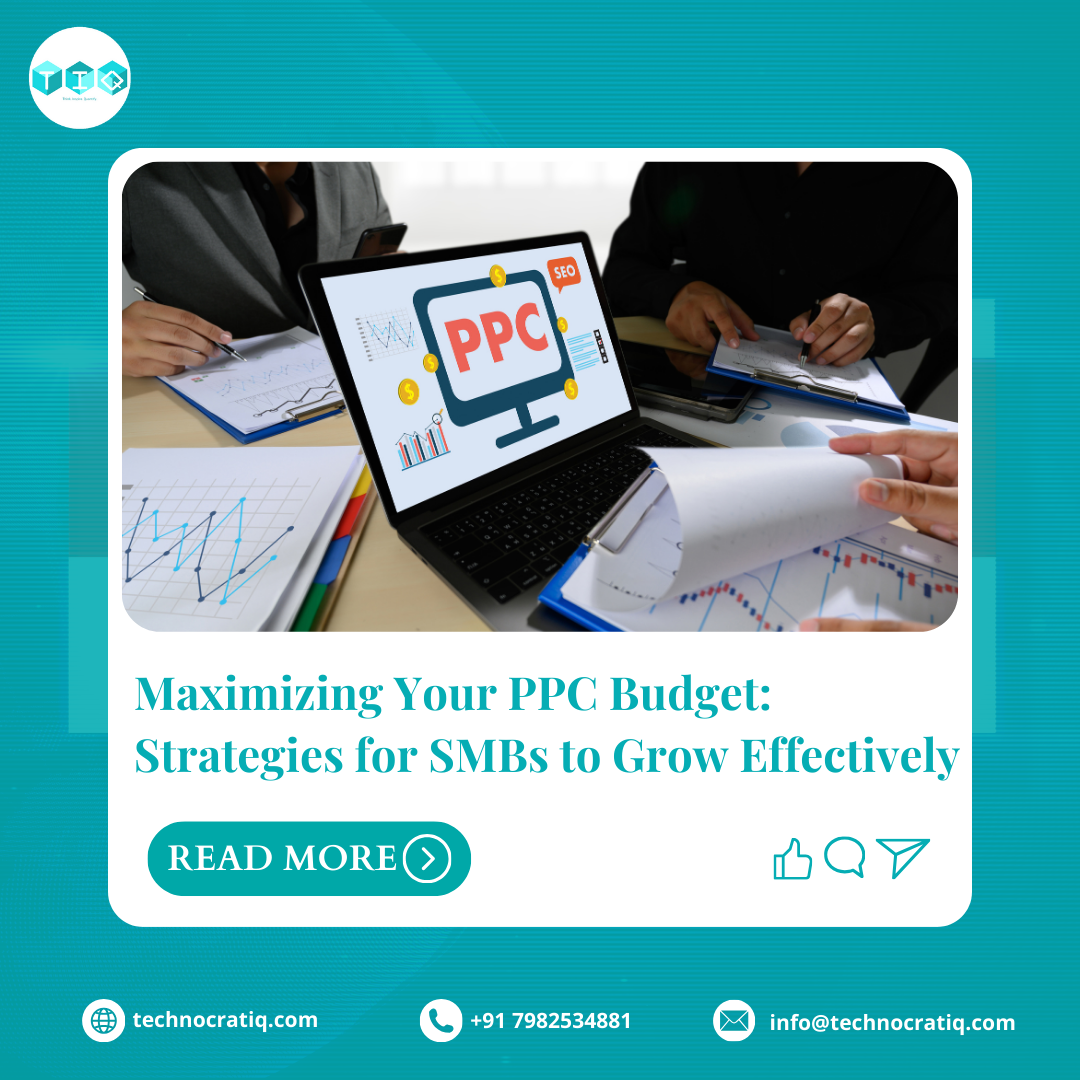
  • Maximizing Your PPC Budget: Strategies for SMBs to Grow Effectively

    Maximizing Your PPC Budget: Strategies for SMBs to Grow Effectively

    Introduction

    For small and medium-sized businesses (SMBs), making the most of every marketing dollar is crucial. Pay-per-click (PPC) advertising offers a powerful way to increase visibility and drive conversions. Still, without the correct strategic approach, it’s easy to exhaust your budget without achieving the desired results. In this blog, we’ll explore effective PPC strategies for SMBs to help you maximize PPC budget and grow your business efficiently.


    Why PPC Advertising is Crucial for SMBs

    PPC advertising provides SMBs the opportunity to compete with larger companies by targeting specific, high-intent audiences. With the right strategy, even businesses with limited budgets can leverage PPC to generate qualified leads, boost sales, and increase brand awareness. PPC allows for flexible budget management, meaning you can scale your investment based on performance. Understanding the key PPC strategies for SMBs can help you make the most out of your campaign spend.


    Setting Clear Objectives for Your PPC Campaign

    To successfully maximize PPC budget, the first step is setting clear and specific campaign objectives. Are you aiming to increase website traffic, boost brand awareness, or drive sales? By defining your goals upfront, you can better allocate your budget and focus your efforts on achieving measurable results.

    For example, if your primary objective is lead generation, you may want to focus on keywords and ad copy that emphasize the benefits of your service, like “affordable marketing solutions for small businesses.” Technocratiq Digital helps SMBs tailor their PPC strategies to align with their business objectives, ensuring every dollar is spent effectively.


    Keyword Research and Targeting

    Effective keyword research is the backbone of a successful PPC campaign. One of the most crucial PPC strategies for SMBs is to focus on long-tail keywords rather than broad, competitive terms. Long-tail keywords are more specific and often have lower competition, which helps you attract high-quality traffic while keeping costs down.

    For instance, instead of targeting a broad keyword like “digital marketing services,” use a more specific phrase like “effective PPC for small businesses.” This approach not only helps maximize your ad spend but also attracts users who are closer to making a purchase decision.


    Leverage Ad Extensions for Enhanced Visibility

    Ad extensions are a great way to increase the visibility and effectiveness of your PPC ads without additional cost. Extensions like site links, callouts, and location information provide extra value to users and increase the likelihood of engagement. Utilizing ad extensions is a key tactic for SMBs looking to get the most out of their budget.

    Technocratiq Digital assists clients in setting up comprehensive ad extensions tailored to their specific needs, helping enhance ad performance and visibility.


    Create High-Converting Landing Pages

    The effectiveness of your PPC ads is not just about getting clicks; it’s about converting those clicks into leads or sales. A well-optimized landing page is essential for achieving this. Your landing page should have a clear call-to-action (CTA), relevant content, and a seamless user experience.

    Aligning your ad copy with the landing page content is one of the most effective PPC strategies for SMBs. Technocratiq Digital specializes in creating optimized landing pages that improve conversion rates, helping you maximize PPC budget and get the best return on investment.


    Utilize Negative Keywords

    Negative keywords are terms that you exclude from your PPC campaigns to prevent your ads from appearing in irrelevant searches. By using negative keywords, you can filter out unqualified traffic, ensuring that your budget is spent only on clicks that are likely to convert.

    For example, if you sell premium products, you might want to add “cheap” or “free” as negative keywords. This strategy helps in effective PPC for small businesses, allowing you to target a more relevant audience and reduce wasted ad spend.


    Monitor, Test, and Adjust Campaigns Regularly

    To truly maximize the PPC budget, you need to actively monitor your campaign performance and make adjustments based on data insights. Regular analysis of key metrics like click-through rates (CTR), conversion rates, and cost-per-click (CPC) will help you identify what’s working and what needs improvement.

    Technocratiq Digital provides continuous campaign optimization, using A/B testing and data analysis to refine ad strategies and ensure better results for SMBs.


    Retargeting for Better ROI

    Retargeting is an effective PPC strategy for SMBs looking to engage potential customers who have already interacted with their brand. By showing targeted ads to users who previously visited your site, you increase the chances of converting these warm leads into paying customers. Retargeting campaigns are a cost-effective way to maximize PPC budget and achieve a higher return on investment.


    Budget and Bidding Strategies

    Setting a realistic PPC budget and choosing the right bidding strategy are crucial steps for SMBs. Start with a manageable budget and gradually increase it as you gather insights on what works best for your business. Consider automated bidding strategies like Target CPA (Cost Per Acquisition) or Maximize Conversions to make the most of your ad spend.

    Technocratiq Digital helps businesses create tailored budget and bidding strategies, optimizing every aspect of their PPC campaigns to drive maximum results.


    How Technocratiq Digital Can Help

    At Technocratiq Digital, we specialize in delivering effective PPC for small businesses by leveraging industry best practices and customized strategies. Our services include keyword research, ad creation, landing page optimization, and continuous performance monitoring. By partnering with us, SMBs can ensure that their PPC efforts are streamlined and focused on achieving growth.


    Conclusion

    PPC advertising is a powerful tool for SMBs looking to grow their business. Implementing these strategies, such as targeted keyword research, optimized landing pages, effective use of ad extensions, and continuous monitoring, can help you make the most of your ad budget. With the right approach and expert guidance from Technocratiq Digital, you can maximize your PPC spend and achieve significant growth.

    Ready to take your PPC campaigns to the next level? Contact Technocratiq Digital today to learn how we can help you develop a customized PPC strategy that aligns with your business goals.

    Get in Touch with Us! 

    Phone: +91 7982534881

    Mobile: +91 99711 50579

    Email: info@technocratiq.com

    Whatsapp Us Now! – 7982534881

    Book Your Free Consultation Slot Today


  • The Power of Content Marketing in 2025: Key Strategies for Success

    The Power of Content Marketing in 2025: Key Strategies for Success

    Introduction

    Content marketing is one of the oldest reigning strategies of the ever-changing world of digital marketing. With some techniques coming and going, while others remain and resurface, yet the importance seems to show more intensely as we are approaching 2025. For a company like Technocratiq Digital which specializes in helping brands grow online, it would be important to understand why content marketing remains king. We will talk about the importance of content marketing in this blog and also provide actionable tips on making quality content that will attract engagement.


    Why Content Marketing Continues to Reign Supreme

    • Consumer-Centric Approach
      Content marketing puts the consumer at its heart. Content marketing does not interrupt, but rather it seeks to educate, inform, and even entertain a consumer. It builds trust, leading to loyalty: those are the two necessary ingredients for a successful, long-term business.

    • Domination of Search Engines
      With Google’s ever-improving algorithms, the quality and relevance of content have never been more important. As search engines favor useful content, businesses that commit to strategic content marketing are more likely to rank higher in the search results. Companies such as Technocratiq Digital use SEO best practices to ensure that their clients’ content is seen and heard by their target audience.

    • Flexibility Across Channels
      Content marketing easily transcends various channels. Blog and podcast content can be re-appropriated and customized for individual preferences on social media and email campaigns. For that reason, it is essential to stay relevant in 2025’s multi-channel environment.

    • Cost-Effectiveness and Long-Lasting
      Compared to paid advertisements, content marketing is much cheaper and shows longer-lasting results. The same well-written blog post or the most captivating video can produce leads long after it’s been published, providing the greatest ROI ever

    • Human Connection in the Age of AI
      There’s no exaggeration that human-centric, empathetic content importance becomes paramount as the significance of AI tools comes increasingly into focus. None at all of the personalization, no storytelling, and relevance happen without human-centric empathetic content in a world more automated every day.


    Key Trends Shaping Content Marketing in 2025

    To remain competitive, one should keep afloat on the trends. Here are a few of the major trends that will define content marketing this year:

    •  Interactive Content
      The name of the game is engagement, and interactive content like quizzes, polls, and infographics will be more eye-catching than the static format.

    • Video Content Supremacy
      By 2025, video will be responsible for 82% of internet traffic. Brands will be well placed to leverage this ground on platforms like YouTube, TikTok, and Instagram Reels with storytelling and engaging, aesthetically appealing content.

    • Voice Search Optimization
      Voice search, the phenomenon of using smart speakers and voice assistants, leaves one little option but to ensure optimization. Keywords in conversation and answers to direct questions boost visibility.

    • Focus on Authenticity
      Authenticity is valued by consumers. Brands need to create content that mirrors their values, is transparent, and builds trust.

    • AI-Enhanced Content Creation
      AI tools can make content creation much easier, but there is a need for human creativity. Businesses like Technocratiq Digital blend the efficiency of AI with human-driven storytelling to produce content that resonates.


    Tips for Creating High-Quality Content That Drives Engagement

    • Know your audience
      Be relevant with your content based on your readers’ needs, preferences, and pain points. Using the analytics tools available, derive insights to further refine the approach.

    • Quality Over Quantity
      Good and engaging content in a few pieces has a higher impact compared to flooding them with bad pieces. Give more attention to depth, accuracy, and relevance.

    • Make use of the best practices in SEO
      Incorporate targeted keywords like “content marketing,” “engagement strategies,” and “digital growth” in a natural manner through your content to boost ranks in search. Avoid keyword stuffing because it can only be 2 percent density as done in this blog.

    • Incorporate Visuals
      Images, videos, and infographics enhance readability and make your content more engaging. Visuals also improve social sharing, increasing reach.

    • Use Strong CTAs (Call-to-Actions)
      Encourage the audience to take action to subscribe to a newsletter or download a guide or call Technocratiq Digital to avail expert digital marketing services

    • Focus on Storytelling
      Stories are emotions and give memories to your audience, sharing real-life examples of your customers or behind-the-scenes of content.

    • Promote Through Channels
      A great piece of content only performs if it is amplified. Use email campaigns, social media, and partnerships to amplify your message.

    • Monitor and Optimize Performance
      Check analytics regularly to see what is working and make adjustments as needed. Content marketing is a dynamic process that benefits from continuous improvement.


    Why Quality Content Matters for Businesses

    Quality content is not only about making a good mark in search engines; it is about doing something relevant for the audience. Businesses invest in quality content with the aim of building authority, gaining more engagement through informative and entertaining content, or even getting conversions as such content addresses consumer needs.


    Technocratiq Digital understands the power of quality content and works with businesses to create strategies that drive engagement, generate leads, and achieve tangible results.


    How TIQ will help 

    TIQ Digital elevates your brand’s content marketing by providing data-driven strategies and engaging content tailored to your target audience. We specialize in creating compelling blogs, social media campaigns, and SEO-optimized content that drives organic traffic and builds brand authority. Our expertise ensures consistent messaging across platforms, enhancing customer engagement and boosting conversions. Advanced analytics help TIQ Digital identify trends and tailor content for maximum impact. Whether you’re looking to build awareness or drive leads, TIQ Digital’s comprehensive content marketing solutions help your brand achieve measurable success. Ready to transform your content strategy? Visit TIQ Digital to get started.


    Conclusion

    As we move into 2025, content marketing would most surely form the basis of every efficient digital strategy. Its communicative power to educate and tempt in this world of fierce competition cannot be measured or even monetized. Tapping trends like video and voice searches and authenticity, along with setting best practice for attention-worthy content creation, is the business edge over competition.


    Technocratiq Digital is the best place for the most experienced advice in navigating the future of content marketing. Our agency creates strategies that help businesses grow and thrive in today’s digital world.

    It’s not the king. It’s the kingdom. Beyond 2025, content marketing is the right investment. The returns would be exponential.


    Get in Touch with Us!

    Phone: +91 7982534881 

    Mobile: +91 99711 50579

    Email: info@technocratiq.com

    Whatsapp Us Now! – 7982534881

    Book Your Free Consultation Slot Today and take the first step towards a brighter, more successful digital future with TIQ Digital.

    Let TIQ Digital help you climb the search engine ranks and establish your business as an industry leader in 2025 and beyond.

  • A Beginner’s Guide to A/B Testing: How to Improve Your Marketing Campaigns

    A Beginner’s Guide to A/B Testing: How to Improve Your Marketing Campaigns

    Introduction

    A/B testing is one of the powerful digital marketing strategies in pushing through data-driven and results-oriented marketing communications. Whether for web optimization, email campaigns, or advertising refinement, A/B testing can provide vital insights into what would work best for your targeted audience.


    This A/B testing guide from Technocratiq Digital is styled to navigate you through the basics of A/B testing, the benefits available, and how to initiate the implementation of A/B testing in your marketing campaigns. At the end of this guide, you will know exactly how to improve marketing with A/B testing and how to boost all your conversions.

    What Is A/B Testing?

    A/B testing, also known as split testing, refers to a process wherein two versions of a marketing asset webpage, an email, or an advertisement are compared to find out which one works better. In other words, A/B testing can test a variable such as a headline, image, or call to action to see which combination yields the highest conversion rates or engagement.

    For instance, in an A/B testing guide, we might compare two variants of a landing page with a red CTA button and one with a blue CTA button by tracking which generates more clicks or sign-ups.

    Technocratiq Digital helps businesses improve marketing with A/B testing by ensuring that every test is structured in such a way that it will yield useful actionable data that will directly influence the performance of their campaigns

    Why A/B Testing is Essential for Your Marketing Strategy

    A/B tests allow making educated business decisions based on data, letting students apply direct actions. No longer wishful thinking determines or shapes marketing campaigns; A/B tests are based on real user behavior.

    Here are four compelling reasons why A/B testing is essential for any business that wants marketing optimization:
    • Data-influenced Decisions: A/B testing enables results-based findings, thus letting you shape your work according to what works instead of what you think works.
    • Higher conversion rate: Testing various elements like headlines, images, and CTAs candidates to understand what could get more conversions.
    • Improved User Satisfaction: A/B tests help you create great experiences by focusing on aspects that are most appealing to users.
    • Cost-Affected Advertising: Aids in guiding you to wisely invest your marketing budget by offering insights into various strategies you can consider, to pick the best performer.

    Through this A/B testing guide, you’ll be on your way to improving marketing with A/B testing and seeing tangible results in your campaigns.

    How to Conduct Effective A/B Testing

    Installing a structured method is essential for ensuring the validity and reproducibility of A/B test results. This is a step-by-step procedure for performing A/B tests:

    1. Outline Clear Goals

    Before any A/B testing can begin, it is crucial to draw up objectives. Would you like to increase your site conversion rate, increase your click rate, or reduce your bounce rate? Clear goals not only guide the testing process but also give you something to measure your success against later.

    For example, one beginner’s guide to A/B testing allowed one of Technocratiq Digital’s clients to improve sign-ups for a webinar by testing different headlines on their landing page. The winning headline led to a 25% increase in sign-ups.


    1. Choose Variables to Be Tested

    The next thing you ought to do is decide which element of the asset you’re going to test. Common variables are:

    Headlines: Evaluate which headline gets more attention and actual traffic.

    Images: Does changing an image increase engagement/conversions?

    CTAs: Test wording, colors, and placements of CTAs.

    In this A/B testing guide, we will recommend you to test only one variable at a time, so you can clearly see its effect on performance.

    1. Build the Two Versions

    Once you have selected your variable to be tested, you will then create two versions of the asset, namely the control (Version A) and the variant (Version B). For instance, if you’re testing a particular CTA button, Version A could read “Sign Up Now,” while Version B reads “Get Started Today.”

    It’s essential that the only difference between the two versions is the tested element. By doing so, any performance differences can be logically attributed to the variable being tested. 

    1. Split  Your Audience

    Just so your test can yield valid results, it is necessary to split your audience randomly. One group sees version A, while the other sees version B. Randomization is what causes external factors such as time or demographics not to affect the results.


    1. Allow Enough Time For Your Test

    The time period of the test depends on your traffic. Make sure you’ve run the test long enough to get useful data with more reliable conclusions. If you conduct your test too short, your results may not be statistically significant.


    1. Analyze  The Results

    After the completion of the test, the next step is to analyze the results. Analysis provides the outcome in favor of version A or B according to your objectives (for example, to find out which one generates more conversions or clicks). You can change to a new domain name once the winner is established.

    Technocratiq Digital has taken this beginner’s guide to A/B testing, and clients have reported measurable improvements. A call-to-action test recently resulted in an 18% increase in clicks for one of our clients.


    1. Implement The Winning Version

    Once you know which version won, put the changes into your entire marketing strategy. A/B testing does not stop here; A/B testing is an ongoing process since you can keep testing out other variables to further optimize your marketing efforts. 

    What is Conversion Rate Optimization (CRO)?

    CRO is nothing but conversion rate optimization. In simple terms, it means increasing the number of visitors to your website who perform an action you desire. That could be purchasing a product, subscribing to the newsletter, or filling out a form. Businesses will A/B test various elements on their website, including headlines, CTAs, and layouts, to see what works best with their audience.

    This Beginner’s Guide to A/B testing will introduce you to the basics and how to apply A/B testing to boost returns for your business.

    Tactic 1: Optimize landing pages with A/B Testing

    Landing Pages are the starting point for all conversion-rate-wide enhancements. Being the key drivers to conversion, it is very important to make landing pages the most effective and conversion-oriented. Here are some ways in which A/B testing can be utilized for landing page optimization:

    • Headlines: This is the first thing that your visitors notice. Just a slight difference in the wording can yield a high conversion rate. Different headlines addressing your audience’s pain points should be tried out.
    • Call to Action: It’s time to test an array of call-to-action buttons, including their color, position, and text to see what gets people active.
    • Visuals: Try out images or videos that captivate your target audience. Visuals significantly affect user engagement.

    With the guidance of this A/B testing, go ahead and run some tests and iterations to find the landing page elements that drive the most conversions. 


    Tactic 2:- Make Content Personal

    Personalization is a highly effective method to boost conversions. By applying behavioral or preference-based approaches to your content, visitors start feeling like they belong. Here is how you can employ A/B testing to make your content personal:

    • Dynamic Content: Display the messages, content, or product suggestions that change depending on the visitor’s location or browsing behavior.
    • Product suggestions: Show tailored suggestions that remind the user of things he or she liked previously.

    When you improve marketing with A/B testing, personalizing content can significantly enhance user engagement and conversion rates.


    Tactic 3: Shorten Forms for Higher Submission Rates

    Forms can refer to anything from signup forms and lead-collection forms to forms requesting donations or volunteering. They are imperative in lead collection, but long, lengthy forms can lead to drop-offs. To improve marketing with A/B testing, try testing:

    • Form length: Lay off your form length, and test the submissions while minimizing fields to key respondents.
    • Form placement: Test where on your page your form performs best, either the header, content, sidebar, or footer of the page.
    • Call-to-action clarity: Write a clear, action-oriented call to action for your form, e.g. “Get my free ebook.”

    With this beginner’s guide to A/B testing, you can learn the actual elements in the conversion forms that capture visitors’ interest. 


    Tactic 4: Build trust and credibility

    Trust is key for conversions. If the user feels that the website is trusted, the chances of him filling up his details or making a purchase increase considerably.

    You can boost trust and credibility aspect with the following A/B test:

    • Customer Testimonials: Display reviews or testimonials that would add credibility to your website. Test the placement and the word content of testimonials for their effectiveness.
    • Trust Badges: Build trust by featuring secure checkout badges, money-back guarantees, or industry certifications.
    • Case Studies: Add case studies that provide evidence of the success of your product or service.

    Once you trial these trust elements via A/B testing, you’re bound to strengthen user trust and have better conversion rates.


    Tactic 5: Testing different user journeys and traffic sources

    Traffic sources make or break conversions. Users who come from different sources (social media, paid ads, or organic search) will have different expectations and behaviors. Use A/B testing to discover what traffic sources or user paths would yield better conversions:

    • Test Traffic Sources: Test multiple traffic sources to discover which traffic sources yield some conversions. Since it’s paid ads or social media, some traffic sources may require different landing pages or offers.
    • Test User Paths: Compare the conversion rates for visitors coming from different paths. Will blog post users convert better by clicking through to a product page or a landing page?

    Testing traffic sources and different user flows will help you improve marketing with A/B testing, which will then assure you of getting the maximum ROI in your marketing efforts.

    Example: HubSpot’s Traffic Source Analysis

    HubSpot conducted an A/B test to discover which converted better, a blog post landing page or a product page, for traffic from organic search. The results show that blog post landing pages converted 22% better than product pages.

    Some examples of what to test:
    • Conversion rates of users from various traffic sources (social media, email campaigns, organic search)
    • User paths-directing users to specific landing pages vs. product pages
    • Custom offers in conjunction with the source of traffic.

    While this is the wake-up call towards businesses in adopting smart analysis, it brings to mind the excerpt from the Beginner’s Guide to A/B Testing regarding the right practices that aid organizations in figuring out on-the-spot strategies to make the best use of the prospects that engage visitors depending on where they entered. 


    Common A/B Testing Mistakes to Avoid

    While A/B testing is a powerful approach, it may have possible pitfalls, such as:

    • Testing too many variables: Focus on testing one thing at a time. Too many variables can confuse results.
    • Not allowing tests to run long enough: Testing for short periods of time can lead to unreliable results. Ensure your tests have enough time to gather sufficient data for a meaningful conclusion.
    • Lack of statistical significance: Ensure your results are statistically significant before deciding on a specific tackle. Otherwise, you will risk changing your policy based on misleading information.

    Technocratiq Digital’s Expertise in A/B Testing

    At Technocratiq Digital, we simplify the A/B testing process to help businesses achieve measurable results. Our approach ensures that every test is not just an experiment but a step towards improved performance and ROI. Here’s how we assist our clients:

    • Strategic Test Design: We identify key variables—whether it’s headlines, CTAs, or visuals—and design tests that deliver actionable insights.
    • Data-Driven Decisions: Our experts analyze results to recommend changes that directly impact your conversion rates and engagement metrics.
    • Continuous Optimization: We go beyond single tests by iterating and refining strategies to ensure sustained growth.
    • Tailored Solutions: By understanding your audience and business objectives, we create customized A/B testing strategies that resonate with your target market.


    Conclusion

    A/B testing is the holy grail of marketers looking to finesse their strategy and achieve better results. This A/B testing guide has demonstrated that, even with small changes, you can achieve big to moderate shifts in engagement and conversions. Following this beginner’s guide to A/B testing gives you the proper confidence to execute tests, analyze results, and make the changes that resonate best with your audience.


    You would either want to boost website performance or performance in terms of advertisement campaigns; A/B testing offers a verified way that develops marketing further into A/B testing. Technocratiq Digital helps companies to leverage these strategies towards measurable growth. Start testing today and see small changes move the needle.

     

    Get in Touch with Us!
  • Effective Paid Ad Strategies: A Guide to Maximizing ROI with Budget-Friendly Tips

    Effective Paid Ad Strategies: A Guide to Maximizing ROI with Budget-Friendly Tips

    Introduction 

    The world of online marketing landscape is competitive. In this sector, a business could either make a profit or a loss if they choose to invest in advertising. The desirability to be able to manage ad spending is key whether it is a new brand or an established one in the market. This guide shows the readers the basic but effective techniques that one can employ to increase ROI on Google or Facebook ads and also suggests techniques to use to bring back people who have in the past expressed interest in the website or the brand through retargeting.

    Being a digital advertising agency, Technocratiq Digital is in the process of innovating ad management technologies that guarantee that each cent being put into an advertisement is used in the most effective way possible. Below is how we exceeded our client’s expectations through the proper execution of paid advertising systems.

    Start with a Clear Goal

    Regardless of how fantastic the advertisement is, its effectiveness depends on accurately identifying and understanding the campaign’s target goals. Some of the possible objectives are as follows:

    Clear goals actually help you develop relevant ads that support your goals: You might have a Facebook campaign aimed at just lead generation using a form-fill ad, or you might have used a Google Ads campaign to drive clicks from targeted keyword terms.


    Optimize Google Ads for ROI

    Google Ads is one powerful tool, but one might quickly blow their budget if it’s not properly optimized. Here are a few budget-friendly tips for maximizing ROI

    1. High-Intent Keywords

    Try to focus on keywords with conversion potential instead of a generic search term. The tools in Google Keyword Planner may be helpful for finding a balance between volume and competition.

    For instance, target “buy running shoes online” rather than simply targeting “shoes” in hopes of having a higher conversion rate.

    2. Utilize Ad Extensions

    Ad extensions, such as site links, callouts, and structured snippets, give users more information and make them click. These add-ons do not cost you extra but can make your ad perform better.

    3. Use Negative Keywords

    Don’t waste clicks by adding negative keywords to your campaigns. For example, if you sell high-end products, avoid words like “cheap” or “free.”

    4. Monitor and Optimize Frequently

    Analyze your ad performance at weekly intervals. Identify failing keywords, adjust bids, and clean up the copy of poor-performing ads to see enhanced CTR and improved conversions.

    Technocratiq Digital ensures that their ongoing campaign management that ensures consistent results for our client Google Ads.


    Make the Most of Facebook Ads

    All this capability for deep targeting of audiences may make Facebook Ads a good fit to really engage specific demographics. The following are effective budget optimization strategies:


    1. Apply Lookalike Audiences.

    Use Facebook Lookalike Audiences. You can engage the users who have the characteristics of your existing customers, and it may skyrocket conversion.

    2. Promote video content

    Video ads make more sense than static images. Create short videos that are interesting and tell the story of your product or describe its benefits.

    3. Establish a daily budget.

    Start from small daily budgets and increment as soon as you see the results. Daily budgets avoid overspending.

    4. Test and Refine

    Conduct A/B testing on various types of advertising creatives, headlines, and calls to action. Testing will help you figure out what works best for your audience.

    Retargeting: Bringing Back Potential Clients

    Not every visitor converts to the customer after the first visit. It is a powerful way to retarget interested users who have looked through your product or service offerings. Here is how to do it:

    1. Install Retargeting Pixels

    Add tracking pixels to the website to collect information about how users behave. Both Facebook and Google offer retargeting options based on pixel data.

    2. Divide Your Audience

    Not everyone is at the same step of the consumer’s journey. Analyze your audience into several segments, for example, cart abandoners, page visitors, and previous buyers, and create ads tailored to each group.

    3. Create Engaging Retargeting Ads

    Use ads that feature what users do. For example:

    • Cart abandoners: Give him a discount to finalize the sale.
    • Page visitors: Elaborate on product benefits or reviews.
    4. Use Dynamic Ads

    Dynamic ads automatically display the product or service viewed by the customer. This generates a great probability of converting.

    Budget-Friendly Tips for Success

    1. Start Little

    Start small, probably with a very modest budget. Track performance. Learn what works and then scale up.

    2. Prioritizing Quality Over Quantity

    A smaller, more targeted audience will often yield better results than a larger, less-targeted campaign.

    3. Use free resources to learn.

    Platforms such as Google Analytics and Facebook Ads Manager offer the most valuable data to optimize your campaigns without any extra cost.

    4. Paid Advertising Combined with Organic Strategies.

    The returns from ads are instant; SEO and content marketing are there to facilitate long-term growth.


    Measure ROI and Refine Your Approach

    Paid Advertisement is a process of success. Monitor your ROI periodically by assessing:

    • Cost per click (CPC)
    • Conversion rates
    • Return on Advertising Spend or ROAS

    For example, if you are running a Google Ads campaign for “budget-friendly tips for maximizing ROI in Google Ads,” establish if the conversions justify the spend.

    We, at Technocratiq Digital, use high analytics to help businesses make informed decisions through hard data, ensuring each campaign attains its intent.

    Common Pitfalls to Avoid

    1. Failure to include/mobilize optimization techniques into the agenda

    Since mobile access to advertising is fast becoming the norm for most clients, ensure the landing pages are optimized for mobile.

    2. Overloading with Information

    Just keep your ads short and sweet. Too much information is cluttering the users, which could lead to a lower number of clicks.

    3. Overlooks retargeting opportunities

    Failure to re-engage would entail the loss of still-usable leads. Retargeting strategies can always win clients back.


    Conclusion

    Paid advertising could be a real game-changer. It has the potential to increase ROI if Google Ads and Facebook Ads are optimized using budget-friendly strategies and retargeting.

    At Technocratiq Digital, we are unwavering in our resolve to ensure your business thrives and prospers within the ever-changing digital landscape as we craft and execute impressively tailored advertising campaigns that actually deliver measurable and impactful results every time. Whether you are just starting down the road with paid ads or are looking to build on and enhance whatever is already in place to achieve far greater return on investment, the depth and scope of our experience in the discipline ensure it will work much harder and get so much more out of your marketing budget for you.

    Want to shift your ad strategy to a higher level? Reach out to Technocratiq Digital now and let’s elevate your campaigns.

    Get in Touch with Us!

    Phone: +91 7982534881

    Mobile: +91 99711 50579

    Email: info@technocratiq.com

    Whatsapp Us Now!

    Book Your Free Consultation Slot Today and take the first step towards a brighter, more successful digital future with TIQ Digital.

    Let TIQ Digital help you climb the search engine ranks and establish your business as an industry leader in 2025 and beyond.

  • Why A/B Testing is Crucial for Maximizing ROI on Paid Ads

    Why A/B Testing is Crucial for Maximizing ROI on Paid Ads

    Introduction

    This is the digital age and every brand must get its advertising maximally spent. They paid advertising in any form, Facebook, and other platforms directing huge pockets of the company’s marketing expenditure. However multiple businesses believe that even after massive investments, they need help to yield good returns. This is why ROI A/B testing comes in and proves to serve as a perfect pillar to enhance paid ad campaign performance.

    Here at Technocratiq Digital, we think that if ROI needs to be maximized through A/B testing, it is best to get aided with pointed data at all steps of one’s campaign for further refinement lest a single functioning element is left unoptimized.

    Let’s get into what A/B testing for ROI means, how A/B testing works, and why it’s the holy grail of ensuring that paid advertisements are an exceptional return on investment. 


    What is A/B Testing?

    A/B testing is a marketing experiment that splits-test multiple versions of the same ad webpage or other marketing content to figure out which one performs better. It’s such a simple yet powerful means of comparing different approaches based on performance metrics like conversion rates and click-through rates to overall ROI.

    However, A/B testing is mostly about testing different versions of an ad against one another that intangible factor being practically anything (but one of your distinguishing features such as the image used in an ad, text size and type, CTA demon).In this strategy, each variation is presented to a part of your audience to help determine which is the better-performing version.

    For instance, suppose you’re running a paid ad campaign for an e-commerce store. You might create two versions of the ad:

    Ad A uses a “50% off” headline with a bright red background.

    Ad B uses a “Buy One Get One Free” headline with a blue background.

    To run both ads simultaneously on similar audience slices and compare which one gets more clicks and conversions should speak to you based on the performance metrics compiled after the two have run their full course. Ideally, this will yield information on whether your audience responds better to discounts versus special offers and which color background grabs their urgency. 


    The Key Benefits of A/B Testing for Paid Ads Optimization

    1. Smart Decision-Making Through Data Analysis

    Never again will your ads be crafted based on intuition. One of the great benefits of A/B testing for ROI is that it will provide precise information about whether or not it works. So instead of going by gut feelings or assumptions, you can describe which ad parts–such as the headline, image, or CTA–worked for your audience.

    Such a precise manner is priceless when it comes down to paid ad optimizations: what causes results opens the door to throwing ad spends behind ads that would generate, thus triggering campaigns effectively.

    2. Understanding Your Audience More Deeply

    A/B testing provides invaluable insight into your audience, with preferences, behaviors, and choices. You’ll know which ad campaign features best appeal to your target market, whether it’s the language used, visuals shown, or value proposition positioned. For example, you may perhaps learn that the audience does favor advertising that speaks to affordability over luxury, or that they should respond more to humor than to formal content.

    The more you learn about your audience through A/B testing for ROI, the more personal and tailored your future ads can become. This improves not just the paid-ads optimization but also helps you establish a deeper connection with the audience for better engagement and conversions. 

    3. These are the principles for MuItimizing Ad Spend Waste.

    If A/B testing is ignored by the enterprises, the enormous amount of advertising budget is wasted on ads that fail to produce results. In most cases, the absence of any testing makes it hard to tell if the ad one has crafted is the best possible version for his company or if there are possibilities with a more efficient way to present the offer.

    Take for example running a campaign without having been tested one ad performed poorly. With this, the advertiser can depart marginally from the reality that he/she is throwing money at an ad that has underperformed. Using A/B testing to maximize ROI utterly destroys this issue, factoring out which ads fall flat well ahead of time so that none of your budget gets wasted upon them. Shifting the finance toward the ad variation that is outperforming helps in ensuring that each dollar is doing its job properly in driving conversions. 


    Key Elements to Test in Paid Ads

    Many elements of your ad campaigns can be effectively measured during A/B testing when establishing ROI. Every single aspect contributes to the overall effectiveness of the ad. By testing any components to provide a more in-depth understanding of what peculiarities speak with your audience, you can refine your ad for the very best outcome. Below is a narrowed-down view of common elements that you can monitor.


    1. Headlines

    Your ad’s headline is often the very first thing that stands the chance to attract attention. A headline that is unique and gripping is a game changer in the conversion rate. It does work, and you just might see a wholly different interpretation of your audience when you play around with some variants in tone, structure, or messaging in the same headline.

    Just to make some points clear, do test if you can see headlines with discounting strategies (“50% Off—For a Limited Time Only”) versus something more on limited exclusivity (“Limited Time Offer”).


    2. Photos or Video

    Imagery is particularly attention-grabbing, as well as being engaging visually. Images that work for one audience outright don’t work for another. Varying color schemes, subjects of visuals, or even videos you use just might give you a more satisfactory engagement.

    Comparing a product photo with lifestyle images will reveal which kind of visual your audience resonates with.


    3. Call-to-Action

    The call to action is that significant driver of conversions. Trying different CTAs can significantly change whether a prospect clicks through to your website or buys something. A few points of distinction might be tested:

    • “Shop Now” vs. “Learn More.”
    • “Claim Your Discount” vs. “Get Started Today.”
    • “Sign Up for Free” vs. “Join Us Now.”

    Each CTA variation can have a subtle influence on how users perceive an offer, hence why you should test to determine which wording factor works the best.


    4. Ad copy

    The voice and tone of your ad copies should be that of your audience. Testing different styles—formal versus informal, emotional versus logical—can tell you what resonates more with your target customers.

    For example, does your audience connect better with ads emphasizing cost savings, or would they prefer messaging that leans into convenience?


    5. Landing Pages

    Besides testing elements within the ad itself, it is also important to test landing pages. After all, your ad is supposed to attract users to an action on a landing page. Any number of things could be tested on your landing pages, including the heading, length of the form, or overall look. You can have an improved conversion rate and maximize your ROI using A/B testing. 


    Advanced A/B Testing Strategies to Maximize ROI

    1. Multi-variant Testing

    While the basic A/B test compares only two versions of an advertisement, the multi-variant test allows you to test multiple values all at once. The testing of multiple attributes of an ad, such as headline, picture, and CTA, can be tackled as a whole. Always, remember that whereas Multi-Variant testing affords simultaneous testing, it requires a bigger audience sample for statistically reliable results.


    2. Segment-Specific Testing

    Your audience is anything but homogeneous and what works for one might not work for another. Segment-specific testing consists of testing different versions of an ad for the audience’s various segments; therefore, depending on such demographics as age, gender, location, or behavior, ads may be optimized.

    For instance, certain headlines may work well with younger audiences, while an entirely different one appeals to older segments. This may allow advertising strategies to be fine-tuned based on data segmentation, thus maximizing optimization of paid ads and improving overall campaign performance. 


    The Role of A/B Testing in Scaling Paid Ads Campaigns

    Once you have performed conclusive A/B testing for ROI and have pinpointed the most efficacious ad elements, scaling up the campaign should commence with all-seeing confidence. Whether it implies increasing budgets or expanding ad distribution, scaling comes only after confirming the optimum production of ad components through testing.

    Technocratiq Digital understands that scaling campaigns without testing is simply a waste of budget and an ocean of missed opportunities. A/B tests will serve as the touchstone in continually improving your ads for you to safely put down more money towards some of the winning strategies and gain consistent returns thereafter. 


    Conclusion

    Also referred to as split testing, A/B testing is one of the key performance marketing tools that a business can employ to maximize its ROI with paid ads. It sets aside the guesswork, enabling an organized, data-driven process to reveal what appeals most to your audience. The continued testing and optimization of such critical areas as titles, pictures, and CTAs set your advertising budget for the most efficient generation of results possible. With A/B testing for ROI, minimizing waste, optimizing performance, and maximizing campaign efficacy things to secure an advantage amidst overcrowded digital territory today.

    Technocratiq Digital helps traditional businesses wield A/B testing in transforming their paid ads, increasing conversion rates, and consequently improving revenues for those willing to strengthen their paid advertising and guarantee maximum return on investments. Its team is there to help out with strategies for such an enhancement.

    You may reach out to us:-  

    • Phone: +91 7982534881,
    • Email: info@technocratiq.com
    • website: Technocratiq Digital 
  • How We Cut Our Bounce Rate by 35% with Simple Website Tweaks?

    How We Cut Our Bounce Rate by 35% with Simple Website Tweaks?

    Introduction 

    A high bounce rate could drive potential customers away before they even have a chance to engage with your website. According to recent studies, almost 70% of visitors leave a website within seconds after failing to draw attention to it. That makes an important question for many businesses today: how do we keep the visitors’ interest long enough to convert them into customers? This pinned it right on the head, we needed to confront this problem since we were seeing how much bounces could be influencing our online presence and sales as a whole. Studying our website’s performance and analyzing user behavior, we found several causes for our high bounce rates. We made several simple yet powerful changes that enhanced our user experience, which significantly increased our engagement.

    In this blog, we’ll present our experiences with how simple website tweaks helped reduce our bounce rate by a whopping 35%. Discover our strategies, from optimizing page loading speed to refining content and navigation. Whether you’re a small business owner, a marketer, or just a website owner aiming to boost visitor engagement, we have valuable insights for you.


    Understanding Bounce Rates and Why They Matter

    What is a Bounce Rate?

    A bounce rate is the percentage of visitors to your website that leave or bounce away from the site without further engagement, usually after viewing only one page. To put it simply, if 100 visitors come to your site and 50 leave without clicking on any other pages, your bounce rate would be 50%.

    This is a really important metric because it measures how attractive or unattractive your website is in engaging users. A high bounce rate may mean that your visitors are not getting what they want-whatever that may be, be it terrible content, slow loading times, or confusing navigation. So, this makes it helpful to understand and interpret your bounce rate. It is going to give you some valuable information regarding the behavior of your users and help you note the areas for improvement.


    Why Reduce Bounce Rates?

    Following are some of the reasons to reduce the website’s bounce rate:

    1. SEO Rankings: Search engines like Google pay attention to user engagement metrics in ranking the web page. In case the bounce rate is very high, this might be a signal to search engines that the content on your website is not as relevant or useful to them, and hence, this impacts negative rankings for your site. By improving user engagement and lowering bounces, you raise the credibility of your website as far as it is seen by search engines and probably raise it with visibility and traffic.
    2. Conversion Rates: A high bounce rate often tends to overlap with poor conversion rates. It means the more frequently visitors explore your site, is less likely they will take desired actions like subscribing to a newsletter, making a purchase, or filling out a contact form-things that are critical in growing your business. It is, therefore, very important to get your audience to participate and interact with your site to realize such an increase in conversions and subsequent sales.
    3. User Experience: A high bounce rate is a sign of poor user experience. The quick exit of users implies dissatisfaction with what they are seeing. Improving your bounce rate, which helps visitors stick around, fosters trust and goodwill with the audience. Helping a visitor meet expectations increases loyalty and repeat traffic from that source.

    In other words, knowing your bounce rate and how to lower it truly forms a fundamental base of optimization both for search engines and for users. One of the major foundational aspects of creating a successful online presence is the chance not only to attract visitors but also to convert visitors into loyal customers.


    Key Drivers of High Bounce Rate

    Understanding the main causes of high bounce rates will help you get rid of the problem. Below are three major elements that mostly cause visitors to leave your site unnecessarily.


    Long Time for Pages to Load

    Folks don’t have much patience for slow-loading websites in this fast digital world. Research studies reveal that a one-second delay in webpage load time can result in a 7% loss in conversion. 

    Many reasons may be linked to your page slowing down due to massive files of images too many scripts, or even badly optimized code. Server response times and hosting quality can all be external contributors. Your site must therefore load fast, not just because it will catch the eye of your visitors but also because faster-loading sites tend to rank better in search engines and are generally more successful overall.

    Bad User Experience (UX)

    Your site must therefore load fast, not just because it will catch the eye of your visitors but also because faster-loading sites tend to rank better in search engines and are generally more successful overall.

    1. Unclear Navigation: When users find it difficult to navigate your site, they are likely to lose interest and leave rather than continue searching for the information they need. When the navigation menu is logical, labels are clear, and organization is intuitive, users will navigate your site seamlessly.
    2. Intrusive Pop-ups: The sometimes useful pop-up for capturing leads can become antagonistic if done excessively or at the worst of times. Imagine a visitor who arrives and then faces pop-ups before they even engage with your content. They’re probably gone.

    To be honest, responsive design is the most vital, considering an increasing number of users accessing their sites from their devices. If your site doesn’t respond well to various browsers and different screen sizes, it will get the user a hard time trying to move around, increasing bounce rates.

    In short, terrible user experiences will exile your visitors; they will not navigate more but instead leave your site faster.

    Irrelevant Content or Lack of Engagement Triggers

    The focal point of any website is its content, which fails to resonate with the audience and will quickly drive them away. This includes:

    1. Content Mismatches: If your content doesn’t align with what a visitor expected when they clicked through to your site, you can expect them to leave quickly. For example, if the title of the blog promises some insightful tips on the topic but delivers rather generic information, users will likely feel betrayed and leave.

    However, lack of engagement triggers on such websites, that is where the theme of call to action, interactive features, or visuals are not well communicated, will necessarily fail to make one spend more time on them. Such engaging content may present itself in compelling storytelling, informative videos, and even well-placed CTAs, which invite one to explore the webpage instead of moving away.

    Overall, relevance, interest, and most of all relevance to the visitor’s interests all contribute to a reduction in bounce rates. All these factors addressed can help make your online experience very inviting and engaging for your visitors to stay longer and interact more with your site.

    The Simple Website Tweaks We Did to Lower the Bounce Rate

    To lower the bounce rate didn’t require a full website revamp, all we did was implement simple tweaks that had already done the job of reducing the rates. Let’s take a closer look at the changes we made and the measurable impacts they had.

    Improving the page download speed

    Some of the Website improvements for lower bounce rates that were done to enhance the loading speed on the page include:

    1. Optimized Images: We minimized the file size of our images without sacrificing quality. We made a significant reduction in file size so that images load faster.
    2. Minified code: We would get rid of unnecessary characters, spaces, and comments in our HTML, CSS, and JavaScript files to make code neat, which helped speed up the loading time even more with this contribution.
    3. Leveraged Caching: We added caching to browsers so that the content, once accessed frequently, is saved locally on a user’s device. Subsequently, when a page is loaded it saves on page load time.

    These changes reduced our page-load time by 2 seconds and this was what instantly pushed our bounce rate down by 15%. Because users loved fast access to content, they stayed on the site for longer periods.

    Mobile Responsiveness

    We knew that mobile browsing was going to be on the rise, so our website had to be fully responsive:

    1. Responsive Design: This also implied mobile-first techniques whereby our site should ideally respond to all screen sizes, rescale images, and lay them out with full functionality and aesthetic appeal on smaller screens.
    2. Cross-Device Testing: This is where we’d test our website on several devices from different browsers and see if we had any problems and then adjust accordingly.

    We then optimized for mobile, and we saw an instant decrease in bounce rate by 10% on our mobile. Visitors found our content easy to navigate and interact with on their smartphones and tablets. 

    Refined Content and Targeting

    To engage our audience better, we looked at the content of our website in much more detail:

    1. Relevant content optimization: We redrafted our existing content to best suit user intent, and we only put worthy value into it. In doing this process, we use data-driven insights to identify what our target is searching for.
    2. Headlines That Pop and Clear Calls to Action: We created a more compelling and persuasive headline and clear calls-to-action with directions from the next step for the user.

    These content enhancements made visitors spend 30 percent more time on our landing pages. This was because we provided relevant information and showed them a way to engage that moved them further into our website.

    Simplified Navigation

    Enhancing navigation was crucial to improving the user experience:

    1. Fewer Menu Items and Logical Organization: We removed unnecessary menu options and organized the remaining ones in a clear, logical order, making it easier for users to quickly find what they needed.”
    2. Less Clutter: We rid our pages of the extraneous items, which had kept users’ eyes on the important content and CTAs we’d like them to focus on.

    By cleaning up our navigation, internal page visits jumped by 20%. Simplifying how users can find more of our content generally improved how they experience our website.

    Fewer Pop-Ups and Ads

    We’d finally banished those intrusive pop-ups and ads that were getting in our way.

    1. Fewer Intrusive Pop-ups: We reduced the number of pop-ups and their frequency and instead used non-intrusive, such as exit-intent pop-ups that would only open when people tried to leave.

    The bounce rate decreased by another 5% as these users appreciated the smoother experience while browsing and were more engaged with the site.

    Results and Key Takeaways

    Summarize Success

    After a string of targeted, simple changes made to our website, we reduced our bounce rate by 35%. All the tweaks-from bounce rate optimization of the site for page loads to content refinement and simplification of navigation-went towards this success. These enhancements keep visitors on our site longer and convince them to explore more pages, interact with our content, and take meaningful actions.

    The obvious impact is that our website now become friendly to visitors, mobile responsive, and more relevant to visitor expectations. This is how we determined a significant website improvement for a lower bounce rate in several user engagement metrics, such as time on site, internal page visits, and conversion numbers. That is how even slight differences might make all the difference between keeping users and cutting down the bounce rates.

    Emphasize the Need for Continuous Optimization

    Though we love the outcome, note that optimizing your website is an ongoing process. The user’s preferences and behavior will change over time; what was great today will not be tomorrow. The testing and feedback loops will always be necessary to keep and improve your efforts to bounce away.

    1. A/B Testing: This is to test different versions of your site’s elements to ascertain what is most impactful to users, whether it’s a headline against another headline, a call-to-action against another, layouts, etc.
    2. User Feedback: Gets feedback from the users about how hard or wasn’t it easy enough to get something done, which were the pain points, or the kind of areas where the experience could be improved.
    3. Analytics Monitoring: Tracks the website analytics to catch trends and anomalies that may eventually point to areas that need further optimization.

    Having refined it through small iterative improvements and continuous responsiveness to the response of its users, you may carry the momentum, which you built up so far forward and continue fine-tuning things to improve it for the betterment of your overall user experience.

    Is your website experiencing a high bounce rate? You don’t have to completely renovate your website to achieve meaningful results. As we showed, small, targeted changes can produce large effects.

    A couple of minor changes like optimizing page speed, optimizing navigation, and honing your content strategy might be all it takes to get your engagement and performance back on track.

    Call-to-Action

    Take the first step to reduce your bounce rate and boost user engagement by getting a comprehensive website audit today. Email us at info@technocratiq.com. Don’t miss out subscribe to our digital newsletter for regular updates and insights, along with tips on how to identify key areas for improvement. By implementing just a few simple changes, you can achieve remarkable results.

  • How to Reduce Google Ads Costs While Increasing Conversions

    How to Reduce Google Ads Costs While Increasing Conversions

    Introduction

    Google Ads is a powerful tool to drive targeted traffic to your website, increase brand awareness, and eventually convert prospective buyers into paying customers. In fact, it is a powerful multi-functional advertising platform, however, the right strategy must be in place or your advertising cost could quickly become an overwhelming spend without much to show for it. Ultimately a balance between Google Ads spending down, and conversion up must be achieved and implemented going an optimization way with data whenever possible for strategies such as targeting, ad copy, and smart bid strategies. Below is a review of the various techniques for spending less of Google Ads budget, and conversions in Google Ads, and help remember every dollar spent is even more meaningful ROI.


    1. Long Tail Keywords – Precise Targeting

    • Long-tail keywords are the true leader of your Google Ads spend. Compared to broad and general keywords which sound glamorous because of their reach, costs can be high and conversion rates very low, so long-tail keywords are much better.
    • Long-tail Keywords are simply more specific phrases with much lower search volume but higher intent. 
    • For example:- if you can’t target the keyword “laptops” because of high competition and high spending, then you can target “affordable gaming laptops under $1,000,” which targets users farther in the buying cycle.
    • This both cuts costs and increases the likelihood of conversion. As an added opportunity with long-tail keywords, they will be less competitive, therefore your CPC will also be lower, and the user is most likely further down the buying cycle. Using long-tail keywords is an important method of optimizing your Google Ads spending and driving better-quality traffic to your website.

    2. Block low-quality, unwanted traffic using negative keywords:

    • One of the most frequently overlooked aspects of many Google Ads campaigns is the negative keyword. Negative keywords prevent your ad from appearing in searches with irrelevant words, saving your ad budget on queries that won’t lead to conversions.
    • For example:- if you’re selling luxury handbags, you wouldn’t want your ads showing for people searching for “cheap handbags.” By making “cheap” a negative keyword, you ensure your ads are shown only to those more likely to convert.
    • This tactic can help reduce Google Ads costs, improve conversion rates, and eliminate irrelevant traffic. The more precise your targeting with both positive and negative keywords, the better your chances of turning ad spending into real leads or sales.
    • Using negative keywords effectively can also boost your Quality Score, which impacts ad performance and CPC, so it’s crucial to implement them efficiently.

    3. Optimize Ad Spend with Ad Scheduling

    • Ad scheduling, or dayparting, enables advertisers to select the precise time that their ad is displayed. The time of day and days of the week will dictate the ad’s schedule depending on which days or hours are generally the most profitable for your business.
    • Ad scheduling allows an advertiser to do a historical analysis of the day and time that their ad was successful compared to other hours or days that led to no clicks or conversions. 
    • For example:- an advertiser may analyze that their ad converts mostly on weekdays during business hours, and thus schedule their ad budget to display based on the day and times to maximize the lowest cost per click during business hours and days, saving during the non-performing weekends or hours.
    • In addition to scheduling ads to save on ad spend, ad scheduling will help to reduce clicks on Google Ads that are not likely to convert. This allows advertisers to stop paying for clicks when the users would be less inclined to convert. Ad scheduling can also help to maximize Google Ads conversions by allocating the budget to specific days and times that have the greatest opportunity to generate sales or leads.

    4. Raise Your Quality Score to Lower Your CPC 

    A Quality Score is a measure of the relevance of your ads, keywords, and landing pages. It determines what your ad placement will be and your cost-per-click. The higher the Quality Score tells you the better performance your ad will have and the lower the cost-per-click you’ll pay. To improve your quality score, consider:

    1. Relevance of an ad: Your ad copy should strongly match the intent of the keywords you’re bidding on. The closer your ads match what users want when they make that query the higher your quality score will be.
    2. Landing page experience: Landing pages should be an easy transition, user-friendly experience, and fit well with ad copy. Fast-loading, mobile-friendly with a clear call to action will drive your quality score up.
    3. Expected Click-through rate (CTR): Your ad copy must be compelling enough that users will want to click on it. The higher the CT is on your ad the more favorable Google will be toward your ad.

    Not only would you see savings on Google Ads costs, but you’ll also create an opportunity for your ads to be placed higher through an improved quality score, which will have incremental effects on Google Ad conversions as well. 


    5. Geographic Targeting

    • Geo-targeting, a highly complex and powerful feature, allows businesses to use Google Ads to focus their advertising budgets on specific users in a specific location. If your business is geared toward a particular local or region-based audience, advertising to users outside your area will often represent wasted media and wasted clicks.
    • For example:- a small bakery in New York does not want to drive advertising to people living in Los Angeles, as they are outside of the area the bakery serves.
    • Targeting specifically based on geographic areas will allow you to optimize Google Ads spending in such a way that every click is that much closer to conversion. With geo-targeting, you can decrease wasted clicks on Google Ads from users outside the tailored audience who may be clicking on your advertisements.
    • Consider geo-targeting as a means to tighten your focus on the best target audience to maximize both click-through rates and conversion.

    6. Ad Extensions: More than What Meets the Eye

    • Ad extensions offer a way to boost visibility and click-through rates without extra costs. Google provides several types of ad extensions, such as site link extensions, callout extensions, and location extensions, among others.
    • These extensions give users who have already shown interest in your product or service more information about your business and additional ways to connect and inquire.
    • For example:- site link extensions allow you to add links that direct users to specific pages of your website, while callout extensions highlight key features or benefits of your product or service.
    • When used effectively, ad extensions make ads more appealing and useful to consumers, typically leading to a higher Quality Score, lower CPC, and improved conversions with Google Ads.

    7. Continuous Improvement with A/B Testing

    • An A/B test, also known as split testing, continues to be one of the core components of an effective digital marketing campaign. To further elaborate, A/B testing takes two versions of the ad or landing page and tries to determine which ad or landing page performs the best. A/B testing can be done around any element of your campaign, like your ad copy, headlines, images, or calls to action.
    • By regularly testing various versions of your ads, you’d get to see which version produces the most number of conversions for the lowest cost. Then, you could anticipate keeping your Google ads down to a minimum, by deleting ads that were not performing well to add additional funds to the successful advertisements. In essence, A/B tests could optimize your campaign holistically over time, and therefore optimize Google Ads conversion, by optimizing your ads, and your landing pages, consistently. 

    8. Intelligent Bidding Strategies

    • Google Ads has numerous, automated bidding strategies to assist you with your advertising goals. Smart Bidding employs machine learning to continually assess and optimize your bids in real-time to get the most value for your ad spend. With methods like Target CPA (Cost-Per-Acquisition) or Target ROAS (Return on Ad Spend), you will Aim to maximize your conversions and keep your spending preserved.
    • The Smart Bidding options within Google Ads will optimize your ad spending, as Google will automatically adjust the bids to obtain the highest output. Overall this keeps your ad spending lower, without excessive bidding or underbidding, while still leading to additional conversions. 

    9. Landing Page Improvements to Increase Conversion

    All the best campaigns in the world will fail if your landing page is not optimized for conversion. A poorly designed landing page may correlate to higher bounce rates, lower engagement, and ultimately wasted ad dollars. If your goal is to get your landing pages to do their job, then it is obviously best that they create a smooth experience.

    • Clear and Relevant Content: Make sure the content of your landing page is aligned with your ad copy. Users should be able to find what they are looking for quickly and easily.
    • Loading Time: A slow-loading page will drive users away, thus converting more losses and increasing bounce rates.
    • Call to Action: A strong, well-placed, enticing CTA can make all the difference between converting and not converting.

    Optimizing landing pages maximizes not only Google Ad conversions but also reduces costs in Google Ads as a result of better quality scores and not wasting clicks.


    10. Tracking and Adjusting Campaigns Frequently

    • Google Ads is a fairly dynamic space, and what works one day may not work the next. What is important is to continue to monitor, and keep adjusting your campaigns based on performance. Monitoring key metrics such as CPC, conversion rate, and quality score in an area where you see room for improvement, could go a long way for optimization.
    • Consistency optimization of your campaigns means you are always maximizing campaign effectiveness, but also can minimize wasting on spending on Google Ads for better results. With adjustments regularly, you can try new strategies and always keep ahead of your competitors. 

    Conclusion: 

    • It is essential to maximize profits from your AdWords campaign while minimizing costs and achieving high conversions. You can do this by planning and optimizing the use of long-tail keywords, utilizing negative keywords to ensure your ad shows only in relevant contexts, and improving your Quality Score to deliver actual value without excessive spending. Additional tools like geo-targeting, ad scheduling, and smart bidding can all contribute to adjusting your campaigns to maximize ROI.
    • By implementing the strategies described earlier, your Google Ads expenditure will decrease alongside your conversion rate, ensuring that every dollar spent on your advertisements is accounted for positively and systematically.
    • Regardless of your business size or needs, experts at Technocratiq Digital (TIQ) are here to assist you. We offer targeted strategies tailored specifically for your business and help promote performance efficiencies to achieve all your objectives with your next Google Ads campaign.
    Contact us today to get started!
    • Email: info@technocratiq.com
    • Mobile: +91 99711 50579 
  • The Importance of Data-Driven Marketing in Healthcare

    The Importance of Data-Driven Marketing in Healthcare

    Introduction

    The rise of data-driven approaches is revolutionizing the healthcare sector, promising to revolutionize patient outcomes, boost clinical decision-making, and cut costs. Across the healthcare landscape, organizations are embracing data-driven strategies to inform decisions, enhance performance, and shape business strategies. In this blog post, we’ll delve into the world of data-driven healthcare, examining how it operates, the advantages it brings, and the hurdles it faces. Let’s explore how data is reshaping the future of healthcare.

    Understanding Data-Driven Healthcare

    Data-driven healthcare is all about harnessing the power of data to make informed decisions. When a healthcare organization adopts a data-driven approach, it relies on data it has collected and analyzed to guide its actions. This means using concrete facts and advanced data analysis tools to gain insights into various aspects of operations and patient behavior.

    For instance, let’s take the case of a dental clinic, ABC, where patients are complaining about long wait times. To address this issue, ABC collects data on the busiest times at the clinic and discovers that most patients arrive between 4 p.m. and 6 p.m. Armed with this data, ABC can then make a data-driven decision. They might opt to bring in an additional dentist during peak hours or suggest alternative appointment times to patients who prefer coming in during those busy periods.

    In essence, being data-driven in healthcare involves leveraging data to optimize processes, improve patient experiences, and ultimately deliver better outcomes.

    Benefits of Data-Driven Marketing in Healthcare

    1. Improved Patient Targeting and Segmentation

    Data analytics revolutionize how healthcare providers identify and reach their target audience. By analyzing patient data such as demographics, medical history, and behavior patterns, providers can personalize marketing messages and interventions. This targeted approach ensures that marketing efforts resonate with specific patient segments, leading to higher engagement and conversion rates. For example, a hospital can use data-driven insights to tailor promotional campaigns for specific services based on patient’s medical needs and preferences.

    1. Enhanced Patient Engagement

    Data-driven marketing plays a crucial role in fostering meaningful interactions between patients and healthcare providers. By leveraging patient data and analytics, providers can deliver personalized communication and educational content that empowers patients to take an active role in their healthcare journey. This approach not only strengthens patient-provider relationships but also promotes health literacy and encourages patients to make informed decisions about their health. For instance, a health system may use data-driven marketing to send targeted reminders for preventive screenings or medication adherence, ultimately improving patient outcomes.

    1. Increased Efficiency and Cost-Effectiveness

    Data-driven marketing enables healthcare organizations to optimize resource allocation and marketing spend, leading to greater efficiency and cost-effectiveness. By analyzing data on patient preferences, engagement metrics, and return on investment (ROI), providers can identify the most effective marketing channels and tactics for reaching their target audience. This data-driven approach allows organizations to allocate their marketing budget more strategically, focusing on initiatives that yield the highest ROI. Additionally, data analytics help identify areas for process improvement and optimization, further enhancing efficiency across marketing operations.

    How data is changing the healthcare sector

    Only a few years ago, 97% of data generated by hospitals remained unused. 

    Today, the majority of organizations are taking advantage of the wide variety of data produced by patients, medical devices, insurance claims, studies, and other sources and using them to improve medical technologies and performances.

    Let’s take a closer look at how data is revolutionizing healthcare, with some real-world examples:

    1. X-Ray Data: X-rays are a quick and painless way to create images of the inside of the body, commonly used to diagnose various medical conditions. After analyzing their X-ray data, a team of clinicians in the U.S. discovered a high rejection rate of around 25%. This led to the development of software that pinpointed the root causes of rejected images, such as poor image quality or patient positioning, reducing manual work, and improving image accuracy.

    2.  Electronic Health Records (EHRs): EHRs serve as digital health records for individuals, allowing convenient access to comprehensive medical information across different healthcare facilities. In a recent study, researchers analyzed EHR data from patients who underwent knee joint replacement surgery. By studying lifestyle factors recorded in EHRs, researchers identified patterns associated with the risk of reoperation after surgery, paving the way for personalized recommendations to support patient and physician decision-making. This innovative approach demonstrates how real-world EHR data can inform healthcare decisions and improve patient outcomes.

    Checklist on How to Transform into a Data-Driven Healthcare Organization

    Transitioning into a data-driven healthcare organization is crucial for harnessing the immense potential of data and seizing revenue-generating opportunities.

    Here’s a simple checklist to kickstart your journey toward becoming a successful, data-driven healthcare organization:

    1. Define Your Data Goals: Start by clearly outlining your organization’s objectives and goals related to data utilization. Determine what you aim to achieve by leveraging data in your operations and decision-making processes.
    • Action Item:
      • Clearly outline your organization’s objectives and goals related to data utilization.
      • Determine what you aim to achieve by leveraging data in your operations and decision-making processes.
    • Tools and Websites:
      • Aha!: A product roadmap software to define and visualize your goals.Aha!
      • Trello: For project management and tracking your goals.Trello
    1. Assess Your Current Data Usage: Evaluate the extent to which your organization currently leverages data. Identify areas where data is being underutilized or overlooked, as well as any existing challenges or limitations.
    • Action Item:
        • Evaluate the extent to which your organization currently leverages data.
        • Identify areas where data is being underutilized or overlooked.
        • Identify any existing challenges or limitations.
    • Tools and Websites:
      • Google Analytics: To assess data usage and identify gaps.Google Analytics
      • Power BI: For visualizing and assessing current data usage.Power BI
    1. Identify Relevant Data Sources: Identify the types of data that are most relevant to your organization’s goals and objectives. This may include patient data, clinical data, operational data, financial data, and more.
    • Action Item:
      • Identify the types of data that are most relevant to your organization’s goals and objectives.
      • This may include patient data, clinical data, operational data, financial data, and more.
    • Tools and Websites:
      • Django: A high-level Python web framework that encourages rapid development and clean, pragmatic design.Django
      • FHIR (Fast Healthcare Interoperability Resources): To identify and use relevant healthcare data standards. FHIR
    1. Review Your Data Infrastructure: Take a close look at your organization’s existing data infrastructure, including data sources, storage systems, and analytics tools. Assess whether your current infrastructure is equipped to handle the volume and complexity of data you plan to work with.
    • Action Item:
        • Take a close look at your organization’s existing data infrastructure.
        • Evaluate data sources, storage systems, and analytics tools.
        • Assess whether your current infrastructure is equipped to handle the volume and complexity of data you plan to work with.
    • Tools and Websites:
      • Amazon Web Services (AWS): For cloud data storage and infrastructure.AWS
      • Apache Hadoop: For scalable storage and processing of large data sets. Apache Hadoop

    5. Integrate High-Quality Data Sources: Ensure that you have access to high-quality, reliable data sources that provide accurate and timely information. Integrate these data sources into your existing infrastructure to enrich your analytics capabilities.

    • Action Item:
      • Ensure access to high-quality, reliable data sources that provide accurate and timely information.
      • Integrate these data sources into your existing infrastructure to enrich your analytics capabilities.
    • Tools and Websites:
      • Snowflake: A cloud data platform for integrating high-quality data sources. Snowflake
      • Talend: For data integration and data integrity.Talend
    1. Break Down Data Silos: Identify and eliminate any data silos or barriers that may exist within your organization. Facilitate seamless data sharing and collaboration across departments and teams to maximize the value of your data assets.
    • Action Item:
        • Identify and eliminate any data silos or barriers that may exist within your organization.
        • Facilitate seamless data sharing and collaboration across departments and teams.
    • Tools and Websites:
      • MuleSoft: To connect applications, data, and devices.MuleSoft
      • Microsoft Azure: For seamless data integration and breaking down silos.Microsoft Azure
    1. Foster a Data-Driven Culture: Cultivate a work environment that values and promotes data-driven decision-making. Encourage employees to embrace data analytics and incorporate data insights into their day-to-day operations.
    • Action Item:
        • Cultivate a work environment that values and promotes data-driven decision-making.
        • Encourage employees to embrace data analytics and incorporate data insights into their day-to-day operations.
    • Tools and Websites:
      • Tableau: To visualize data and foster a data-driven culture.Tableau
      • Coursera: For training and professional development in data analytics.Coursera

    Becoming a data-driven healthcare organization requires a holistic approach and may involve reimagining various business processes.

    By adopting the right strategies and tools, your organization can gain a competitive edge and work towards achieving both local and global healthcare objectives.

    Ethical Considerations and Data Privacy in Healthcare Marketing

    Ensuring patient privacy and confidentiality is paramount in data-driven marketing within the healthcare sector. Patients entrust sensitive personal information to healthcare providers, and any breach of this trust can have severe consequences, including reputational damage and legal liabilities. Therefore, healthcare organizations must adhere to strict ethical guidelines and regulatory frameworks to safeguard patient data.

    Aspect Description Best Practices
    Patient Privacy and Confidentiality Ensuring patient privacy and confidentiality is paramount in data-driven marketing within the healthcare sector. Patients entrust sensitive personal information to healthcare providers, and any breach of this trust can have severe consequences, including reputational damage and legal liabilities. – Implement stringent data protection protocols

    – Limit access to patient data to authorized personnel only

    Regulatory Frameworks Regulatory frameworks such as HIPAA in the United States and GDPR in the EU set stringent standards for the collection, storage, and usage of patient data. – Stay compliant with HIPAA, GDPR, and other relevant regulations

    – Regularly update policies to reflect changes in law

    HIPAA Compliance HIPAA mandates the protection of patient health information and establishes guidelines for its secure handling by healthcare providers and their business associates. – Encrypt data in transit and at rest

    – Conduct regular risk assessments and audits

    GDPR Compliance GDPR imposes strict requirements on the processing and protection of personal data, including healthcare data, within the EU and beyond. – Obtain explicit consent for data processing

    – Provide patients with access to their data and the right to be forgotten

    Informed Consent Obtaining informed consent from patients before collecting their data is crucial to uphold ethical standards. – Use clear, concise language in consent forms

    – Ensure patients understand what they are consenting to

    Data Security Measures Implementing robust security measures to protect data from unauthorized access or breaches is essential. – Use multi-factor authentication (MFA)

    – Regularly update and patch systems to fix vulnerabilities

    Transparency in Data Usage Ensuring transparency in how patient data is used for marketing purposes builds trust with patients. – Provide clear privacy notices

    – Regularly communicate data usage policies to patients

    Minimization of Data Collection Collecting only the data necessary for marketing purposes minimizes the risk of data breaches and misuse. – Perform data audits to eliminate unnecessary data

    – Anonymize data where possible

    Third-Party Data Sharing Sharing patient data with third parties requires careful consideration to avoid breaches of confidentiality and compliance issues. – Vet third-party vendors for compliance

    – Use data-sharing agreements to enforce privacy obligations

    Continuous Monitoring and Improvement Continuously monitoring and improving data protection practices helps maintain high ethical standards. – Implement ongoing training programs for staff

    – Use advanced analytics to detect and respond to potential data breaches

    How you can take action NOW.

    While navigating the complexities of data-driven healthcare, it’s essential to prioritize ethical considerations and patient privacy, adhering to regulatory standards and best practices.

    At TIQ Digital, we stand as the #1 Healthcare Growth Catalysts, committed to empowering healthcare organizations with tailored solutions and unwavering support. Trust us to be your partner in success as we pave the way for a brighter, data-driven future in healthcare.

    Contact us now to schedule a consultation and discover how Technocratiq Digital can help you achieve your marketing goals. Together, let’s create a winning strategy that sets your firm apart and drives success in the digital world.

    Talk to our expert: Call Now

    WhatsApp for a quick response: Chat Now

    Send email query: info@technocratiq.com

    Book a slot as per your availability: Book Now 

    PS: You can also request for a quote directly using this form: RFQ Form

    Subscribe to our mailing list to stay updated!

    Chat on WhatsApp Chat Now!
    Connect with Us via Email Today!