Author: TIQ Team

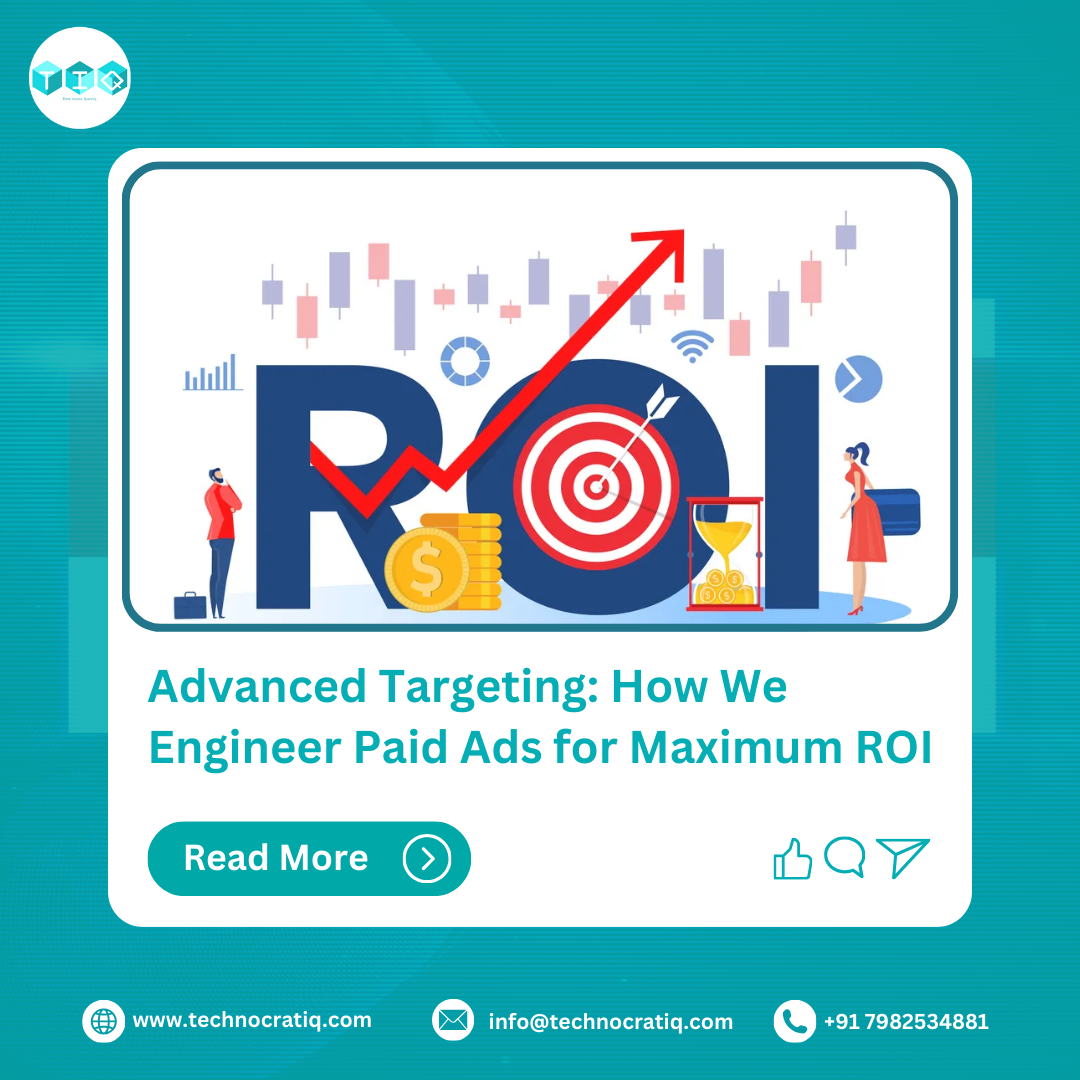
  • Advanced Targeting: How We Engineer Paid Ads for Maximum ROI

    Advanced Targeting: How We Engineer Paid Ads for Maximum ROI

    STOP launching ad campaigns without PRECISE TARGETTING!! 

    STOP wasting budget and missing essential opportunities!! 


    In an era where digital ad spending is projected to surpass $700 billion globally by 2025, businesses must leverage cutting-edge targeting strategies to maximize return on investment (ROI) in paid advertising. 

    Advanced targeting methods, powered by AI and real-time analytics, are transforming the way advertisers connect with their audiences, enabling personalized, data-driven campaigns. 

    Studies indicate that personalized ads can lead to a 20% higher engagement rate and a 10% increase in conversions, underscoring the value of precision targeting in a competitive marketplace. We combine sophisticated audience segmentation, intent analysis, and adaptive bidding strategies to engineer ad campaigns that deliver measurable results and align with future market trends. 

    Advanced targeting techniques help ensure your ads connect with the right audience, at the right time, and with the right message.

    Let’s delve into how advanced targeting transforms your paid ad campaigns and drives unparalleled ROI.


    Why Advanced Targeting Is the Future of Paid Advertising

    Generic, one-size-fits-all ads no longer resonate with today’s consumers. Audiences expect personalized, relevant messaging that aligns with their interests and values. Advanced targeting empowers businesses to deliver this, resulting in:

    • Boosted ROI: Minimize ad spend on uninterested audiences and focus on high-value prospects.
    • Enhanced Personalization: Build stronger customer relationships through highly tailored messaging.
    • Optimized Ad Spend: Every dollar is strategically allocated for maximum impact.
    • Seamless Campaign Scaling: Replicate success across different audience segments efficiently.

    With advanced targeting, businesses experience higher engagement and better conversion rates, leading to a more significant return on investment.


    Advanced Targeting Strategies for Paid Ads

    Crafting effective ad campaigns requires a multi-faceted approach to targeting. Below are some of the most impactful strategies:


    1. Demographic Targeting

    Demographic targeting allows businesses to narrow their audience based on key characteristics such as:

    • Age
    • Gender
    • Education
    • Occupation
    • Income level

    This approach ensures that the ad content is relevant to the intended audience, increasing the likelihood of engagement and conversions. For instance, businesses can segment ads for specific age groups or tailor campaigns to align with distinct income levels for luxury products or services.


    2. Behavioral Targeting

    Behavioral targeting focuses on users’ online activity, enabling businesses to reach audiences based on:

    • Website interactions
    • Social media engagement
    • Purchase history

    This strategy allows brands to refine their messaging to match user behavior, fostering a deeper connection with potential customers. Businesses can also retarget users who visited a website but didn’t convert, offering customized incentives to encourage them to take action.


    3. Geographic Targeting

    Geographic targeting ensures ads are delivered to users in specific locations, making it particularly effective for businesses that operate locally or target region-specific markets. Campaigns can be customized for:

    • Cities
    • States
    • Neighborhoods

    This level of granularity enables businesses to tailor promotions to local markets or expand into new territories strategically. Geographic targeting is especially beneficial for brands promoting location-specific services or seasonal offers.


    4. Psychographic Targeting

    Psychographic targeting dives deeper into audience preferences by analyzing their:

    • Values
    • Interests
    • Lifestyles

    This method helps brands connect with audiences on an emotional level. Ads that reflect the audience’s personality, aspirations, or beliefs are more likely to inspire loyalty and trust. This type of targeting is commonly used by brands that prioritize customer alignment with their mission or vision.


    Essential Tools for Advanced Ad Targeting

    The tools and platforms used to implement advanced targeting play a crucial role in achieving success. Below are some of the industry-leading platforms we leverage for paid advertising campaigns:


    1. Google Ads

    Google Ads offers robust targeting options, such as:

    • Custom Intent Audiences: Allows businesses to target users actively searching for products or services similar to theirs.
    • In-Market Audiences: Focuses on users who are ready to purchase, maximizing conversion potential.

    Google’s algorithms make it easy to identify and engage with high-intent users, ensuring maximum ROI.


    2. Meta Ads (Facebook & Instagram)

    Meta Ads provides comprehensive targeting features, including:

    • Interest-based targeting for precise audience segmentation.
    • Retargeting for users who have interacted with your website or social media profiles.
    • Lookalike Audiences to expand your reach by targeting individuals similar to your existing customers.

    Meta Ads excels at fostering brand visibility while driving meaningful engagements.


    3. LinkedIn Ads

    LinkedIn Ads is a powerful platform for B2B marketers, offering advanced targeting based on:

    • Job roles
    • Industries
    • Company sizes

    For businesses looking to connect with professionals and decision-makers, LinkedIn provides the tools necessary to drive lead generation and brand recognition.


    Steps to Maximize ROI with Paid Ads

    To achieve exceptional ROI, advanced targeting should be complemented by continuous optimization and analysis. Below are steps to ensure your campaigns perform at their peak:


    1. Leverage First-Party Data

    First-party data, such as email lists and purchase histories, is invaluable for personalizing campaigns. By analyzing this data, businesses can create highly targeted ads that appeal directly to their existing and potential customers.


    2. Employ Dynamic Creative Optimization (DCO)

    Dynamic Creative Optimization automatically adjusts ad creatives based on audience insights, ensuring users see content most relevant to their preferences. This technique reduces the manual workload while increasing campaign efficiency.


    3. Conduct A/B Testing Regularly

    Testing different ad elements—headlines, images, CTAs, and ad copy—helps identify which combination resonates best with your target audience. Continuous A/B testing refines campaigns over time, improving their effectiveness.


    4. Optimize Ad Placements

    Understanding which platforms and formats yield the best results is essential. For instance:

    • Visual platforms like Instagram are ideal for image and video ads.
    • Text-heavy ads perform better on platforms like Google Search.

    Analyzing platform performance ensures your ad spend is concentrated on the most impactful channels.


    Measuring the Success of Advanced Targeting

    Tracking key performance indicators (KPIs) is essential to evaluate campaign performance and identify opportunities for improvement. Metrics to monitor include:

    • Click-Through Rate (CTR): Indicates how many users click on your ads.
    • Cost Per Acquisition (CPA): Tracks the cost associated with acquiring a new customer.
    • Conversion Rate: Reflects the percentage of users completing a desired action.
    • Return on Ad Spend (ROAS): Shows revenue earned for every dollar spent on advertising.

    By continuously analyzing these metrics, businesses can make informed decisions to optimize their campaigns and achieve their goals.


    FAQ Section

    1. What is advanced targeting in paid advertising?
      Advanced targeting involves leveraging data and analytics to define and reach specific audience segments based on demographics, behavior, interests, and online activity, ensuring highly relevant and personalized ad delivery.
    2. How does advanced targeting improve ROI?
      By focusing on specific audience segments, advanced targeting minimizes ad spend on uninterested users, improving engagement, click-through rates (CTR), and conversions while reducing cost per acquisition (CPA).
    3. What tools are used for advanced targeting?
      Key tools include Google Ads’ audience targeting, Facebook Ads Manager for interest-based segmentation, programmatic advertising platforms, and AI-driven analytics tools like Google Analytics 4.
    4. How do AI and machine learning enhance ad targeting?
      AI and machine learning analyze vast datasets to predict user behavior, optimize bidding strategies, and identify patterns that help in real-time ad delivery adjustments for higher effectiveness.
    5. Can advanced targeting be used across all advertising platforms?
      Yes, most digital platforms like Google, Meta, LinkedIn, and programmatic platforms offer advanced targeting options, but strategies must be customized to suit platform-specific algorithms and audience behavior.
    6. What is intent-based targeting, and why is it effective?
      Intent-based targeting focuses on reaching users who are actively searching for products or services, such as through keywords in search engines. This strategy captures high-conversion potential leads.
    7. How does retargeting fit into advanced targeting?
      Retargeting engages users who have previously interacted with a brand but did not convert, reminding them of the offering and improving conversion chances with tailored messaging.
    8. What are the future trends in advanced targeting?
      Trends include the rise of cookieless targeting, increased use of AI for predictive analytics, greater reliance on first-party data, and growth in interactive and video ad targeting formats.


    The future of advanced targeting in paid advertising is evolving rapidly, with global digital ad spending projected to grow at a CAGR of 9.1%, reaching nearly $876 billion by 2026​ who embrace emerging technologies, prioritize data privacy, and adapt to audience-centric strategies will remain ahead of the curve. By combining cutting-edge tools, predictive analytics, and innovative audience engagement methods, our approach to advanced targeting ensures that every ad dollar is optimized for maximum ROI in an ever-competitive digital landscape.


    Why Choose Technocratiq Digital for Paid Ads ROI?

    At Technocratiq Digital, we combine advanced targeting techniques with data-driven strategies to deliver measurable results. Our approach includes:

    • Customized Campaign Strategies: Tailored solutions that align with your business objectives.
    • Expert Analytics: Detailed insights to identify and target high-value audiences.
    • Ongoing Campaign Refinement: Continuous optimization to maximize performance.
    • Transparent Reporting: Regular updates on campaign performance to ensure complete visibility.

    Ready to Maximize Your Paid Ads ROI?

    Advanced targeting can transform your paid advertising efforts, ensuring your ad spend delivers unparalleled returns. Partner with Technocratiq Digital to take your campaigns to the next level.

    Schedule a Free Strategy Session with Technocratiq Digital Today!

    • Keywords Used: Advanced targeting ads, Paid ads ROI, Maximize ROI with paid ads.
    • Meta Description: Discover how advanced targeting strategies in paid ads can help maximize ROI and boost campaign performance. 
    Get in Touch with Us!

    Book Your Free Consultation Slot Today and take the first step towards a brighter, more successful digital future with TIQ Digital.

    Let TIQ Digital help you climb the search engine ranks and establish your business as an industry leader in 2025 and beyond.
  • How to Optimize for Voice Search: The Future of SEO

    How to Optimize for Voice Search: The Future of SEO

    Voice search is no longer a futuristic novelty; it is rapidly becoming an essential part of how people interact with technology and access information online. 

    By 2025, it is projected that 75% of households in the United States will have a smart speaker, and the global market for voice assistants is expected to grow by 33% year-over-year, driven by AI advancements and increased accessibility to affordable devices​ (National University, LSA College). This growing reliance on voice search has significant implications for SEO strategies, pushing businesses to rethink how they optimize content for natural, conversational queries.

    With the increasing popularity of voice assistants like Siri, Alexa, and Google Assistant, it’s clear that SEO for voice search is the future. If you want your business to stay relevant in 2025 and beyond, it’s time to rethink your approach and optimize for voice search.


    Why You Should Care About Voice Search SEO

    Voice search isn’t just a passing trend—it’s here to stay. Currently, nearly half of all searches are voice-based. People love the convenience of speaking their queries rather than typing them out. This shift means that businesses need to adapt their SEO strategies to keep up with changing user behavior. Ignoring this trend could mean missing out on a huge chunk of traffic, so it’s vital to start optimizing for voice search now.


    Understanding the Difference: Text Search vs. Voice Search

    To effectively optimize for voice search, you need to understand how it differs from traditional text-based search. When users type a query, it’s usually short and to the point, like “best pizza near me.” However, with voice search, the queries are longer and more conversational. A voice search user might ask, “What’s the best pizza place to eat nearby?

    The takeaway here? 

    Your content needs to mirror this conversational tone. Instead of focusing on short, generic keywords, target long-tail keywords and phrases that match the natural way people speak. This approach will help your website rank better in SEO for voice search results.


    How to Optimize Your Website for Voice Search

    1. Focus on Conversational Keywords

    When people use voice search, they ask complete questions rather than typing fragmented phrases. It’s crucial to update your keyword strategy and include long-tail keywords like “How can I optimize my website for voice search?” or “What are the best ways to improve voice search SEO?”

    By doing this, you’re aligning your content with the actual questions users are asking, which increases your chances of appearing in voice search results. It’s not just about keyword stuffing—it’s about providing value and answering users’ questions in a natural way.


    2. Optimize for Featured Snippets

    If you want to succeed in SEO trends 2025, you need to pay special attention to featured snippets. These are the brief answers that appear at the top of Google’s search results and are often read aloud by voice assistants. Structuring your content to answer common questions clearly and concisely will increase your chances of being featured.

    How can you do SEO for voice search? We are helping businesses create content that’s more likely to appear as a featured snippet. This not only boosts your visibility but also establishes your brand as a trusted source of information. Contact us today.


    3. Enhance Website Speed and Mobile Optimization

    Most voice searches are done on mobile devices, so your site must be mobile-friendly and load quickly. Google prioritizes fast, responsive websites, especially for voice search SEO. If your site is slow, you’ll likely lose out on potential traffic, and your rankings will suffer.

    Improving your website’s speed and making it mobile-responsive will not only help with SEO trends in 2025 but will also enhance the overall user experience. Partnering with a digital marketing agency like ours can ensure your site is up to speed and ready for voice search.


    4. Leverage Structured Data and Schema Markup

    Schema markup helps search engines understand the context of your content, which is key for voice search SEO. By using structured data, you’re giving search engines extra details that can help them provide more accurate answers to user queries. This is especially important for voice searches, where users expect direct and relevant answers.

    Implementing schema markup can be a bit technical, but the results are worth it. It can help you rank better, increase your chances of being featured in snippets, and improve your visibility in SEO trends 2025.


    5. Don’t Forget About Local SEO

    A large portion of voice search queries are local. Users often ask questions like, “Where is the nearest coffee shop?” or “Find a gym near me”. To capture this traffic, focus on local SEO and ensure your business information is accurate across all platforms, especially on Google My Business.

    We can help you optimize your local listings, ensuring your business appears in local voice search results. This boosts your visibility and helps you connect with nearby customers looking for your services.


    What’s Next in SEO Trends 2025?

    The future of SEO trends 2025 will be shaped by advancements in AI and natural language processing, making voice search SEO more important than ever. As voice search continues to grow, businesses that adapt early will have a competitive edge.

    Voice search isn’t just a cool new feature; it’s a fundamental change in how people use the internet. By optimizing your website for voice search now, you’re setting yourself up for success in the coming years.

    Incorporating voice search SEO into your digital marketing strategy is no longer optional—it’s a necessity. Focus on conversational keywords, aim for featured snippets, improve site speed, use structured data, and prioritize local SEO to ensure your website is ready for the future. Technocratiq Digital offers expert services to help businesses navigate these changes and build an effective voice search strategy.

    The world of SEO for voice search is rapidly evolving. Make sure your business stays ahead of the curve and reaps the benefits of this exciting trend. 


    FAQ 

    1. What is voice search, and why is it important for SEO?
      Voice search refers to technology that allows users to search online using voice commands instead of typing. It’s important for SEO because it’s changing how users phrase queries, prioritizing conversational and natural language.
    2. How does voice search differ from traditional text search in terms of optimization?
      Voice search focuses on long-tail, conversational keywords and often includes questions. SEO for voice also emphasizes local results and quick answers.
    3. What are some key strategies to optimize content for voice search?
      Include structured data, create FAQ pages, target conversational keywords, prioritize mobile optimization, and ensure fast page loading times.
    4. Why is local SEO important for voice search?
      Many voice searches are location-specific, such as “near me” queries. Optimizing for local SEO ensures your business appears in results when users search for nearby services or products.
    5. What role does schema markup play in voice search optimization?
      Schema markup helps search engines understand your content better, increasing the chances of being featured in voice-activated search results or snippets.
    6. How does mobile optimization affect voice search rankings?
      Since most voice searches are conducted on mobile devices, having a mobile-friendly website is crucial for better rankings in voice search results.
    7. What industries benefit the most from voice search optimization?
      Local businesses, e-commerce, healthcare, and service-based industries benefit significantly as users frequently use voice commands to find nearby services or quick solutions.
    8. What tools can help in optimizing for voice search?
      Tools like Google Analytics, SEMrush, AnswerThePublic, and Google’s Structured Data Markup Helper can assist in identifying voice search trends and optimizing your content.

    Voice search is redefining the SEO landscape, offering businesses an unprecedented opportunity to connect with their audience in an increasingly conversational and accessible way. 

    By adopting voice search optimization strategies—like targeting natural language queries, leveraging structured data, and focusing on mobile and local SEO—businesses can stay ahead of the curve. 

    As voice-activated devices continue to grow in popularity, preparing for this shift will not only enhance visibility but also foster meaningful engagement with tech-savvy, on-the-go consumers. 

    Embrace the future of SEO today to ensure your business thrives in the voice-first Ai era!


    Get in Touch with Us!

    Book Your Free Consultation Slot Today and take the first step towards a brighter, more successful digital future with TIQ Digital.

    Let TIQ Digital help you climb the search engine ranks and establish your business as an industry leader in 2025 and beyond.

  • How We Improved a Client’s CTR by 25% with Small Changes

    How We Improved a Client’s CTR by 25% with Small Changes

    Introduction 

    To drive a car you DON’T need to REINVENT the WHEEL, similarly to GROW the business you DON’T need a MAJOR upgrade.
    Sometimes SMALL changes make a BIG difference!!


    Global studies predict that the average CTR for search ads will reach 3.17% in 2025, driven by increased personalization and targeted ad placements. 

    In a recent campaign, we implemented strategic yet simple tweaks to a client’s ads, resulting in a remarkable 25% increase in their CTR. 

    This case study underscores the value of optimization, supported by industry projections indicating that companies focusing on incremental ad performance enhancements could see up to 30% higher ROI by 2026. 

    Let’s explore the strategies and insights behind these impactful results.

    We undertook a challenge, did a thorough analysis, performed direct testing, and ad performance optimization to boost CTR with A/B testing, and improved campaigns! Let’s dig in deeper.

    The CTR Challenge…

    An e-commerce retailer, our client was running the paid campaigns at a poor CTR. They had a competitive product range, yet did not seem to catch the audience’s attention or prompt them into taking action. We were approached with an unsatisfied owner facing the issue of driving sales even after spending on ads and hiring multiple agencies. His expectation – improve CTR with small changes to help without devastatingly increasing their ad funds!!

    We did some digging and found that some of their main challenges were really simple:

    • The ads themselves did not speak to the audience.
    • CTAs that performed poorly and did not instigate action.
    • Very weak strategies for audience segmentation.

    And so, the path was clear to us. Our Voila Moment!

    The Solution: Small Changes, Big Results

    We devised a three-pronged approach to systematically boost CTR with A/B testing and make relevant changes.

    1. New, Improved Ad Copy for Higher CTRs with little Changes:

    To improve CTR with small changes, we tweaked the advertising copy to put benefits over features. Moving from generic messaging to something more tasteful via emotional triggers and more defined value propositions. For example:

    • Original: Affordable Home Decor.
    • New: Revamp Your Space – Enjoy Big Savings with Chic Decor!

    The new copy was not only more in line with user intent but also directly increased CTRs.

    1. Strengthened Calls To Action

    A compelling CTA is a must to boost CTR with A/B testing. We tried “Grab the Deal” and “Shop Now to Save” against the original “Learn More.” This change made a significant difference in engaging us and eventually increased CTR and other punchy changes.

    1. Optimization for Visuals

    High-quality, relevant visual content plays a prime role in grabbing attention. We tested ads with lifestyle images showing decor in real settings in order to increase click-through rates. This promoted a stronger emotional connection to the audience.

    1. Cultivated Audience Segmentation

    Rather than broad targeting, the audience was refined, and users were divided into segments based on buying behavior and preferences. This provided an opportunity for tailored messaging that further ensured that the changes would boost CTR with A/B testing.

    The Results: 25% Increase in CTR and effective sales!!

    Our iterative process to boost CTR with A/B tests yielded impressive results over a 4-week period:

    • CTR: Increase of 25 percent from 2.8% to 3.5%.
    • Conversion Rate: Increased by 30 percent to tell us the audience found the ads more compelling.
    • ROAS: Increase by 25 percent to showcase the campaign’s success.

    By focusing on improving CTR with small changes, we not only met but exceeded the client’s expectations.

    Summary: How Small Changes Made a Big Impact

    Over four weeks, we monitored campaign performance, refined strategies based on A/B testing, and optimized the best-performing elements. The outcomes were impressive:

    Metric

    Before Changes

    After Changes

    Improvement

    Click-Through Rate (CTR)

    2.8%

    3.5%

    +25%

    Conversion Rate

    4.0%

    5.2%

    +30%

    Return on Ad Spend (ROAS)

    3.2

    4.0

    +25%

    By focusing on simplifying the message and boosting CTR with A/B testing, we achieved measurable success while staying within the client’s budget.

    Lessons Learned

    This case study shows how small adjustments can yield big results:

    1. Ad Copy Optimization: A proper message will be a great improvement in its click-throughs.
    2. Test Everything: Regular A/B testing ensures each change is based on data.
    3. CTA Refinement: Actionable CTAs invariably raise CTR in small changes.
    4. Leverage on Visuals: Quality images enhance the overall appeal of the campaign.
    5. Audience Segmentation: Tailored messaging is key to increasing CTR with A/B testing more effectively. 

    How We Can Help You?

    We are an agency that specializes in helping businesses optimize their digital marketing strategies. From A/B testing to enhance CTR, to media management to improve ads performance, we deliver solutions based on individual goals. Contact us if you would like a little tweak here and there to boost CTR and translate this into some measure of success.

    Conclusion

    We believe that it is the little things that make for the greatest difference. Through strategic tweaks and ongoing data testing, we enabled our client to increase their sales —a fine accomplishment to speak to the power of optimization. Continuous improvement and careful execution are key to this, be it fine-tuning ad copy, improving graphics, or defining audience segmentation.

    If you want to improve your marketing performance, you have to remember: YOU may not need to change everything at once. Small meaningful steps can lead to success sometimes.

    If you are facing the same problem, we can help you step up this journey of improving CTR and unleashing the fullest potential of the campaign. Together, we shall turn your objectives into measurable success stories. 

    Get in Touch with Us!

    Book Your Free Consultation Slot Today

  • Understanding the November 2024 Google Broad Core Algorithm Update and Its Impact on SEO

    Understanding the November 2024 Google Broad Core Algorithm Update and Its Impact on SEO

    Introduction 

    In November 2024, Google rolled out a Broad Core Algorithm Update, a move that continues to reshape the SEO landscape for websites worldwide. 

    This update underscores Google’s ongoing commitment to improving search quality, with a focus on delivering more relevant and valuable content to users. 

    Broad core updates impact core ranking factors, including content relevance, site authority, and user experience, requiring businesses and marketers to reevaluate and adapt their SEO strategies. 

    As the global SEO services market is projected to grow from $51.74 billion in 2023 to $107.24 billion by 2030, with a CAGR of 10.2% understanding these updates is critical. 

    This article dives deep into the implications of the November 2024 update. Why they’re essential, and how the latest update is impacting websites. Additionally, we’ll cover strategies to help website owners adapt effectively.

    What Is a Google Broad Core Algorithm Update?

    A broad core algorithm update from Google is a sweeping adjustment that affects the core of Google’s search ranking algorithm. Unlike targeted updates that focus on specific issues (like content spam or link quality), broad core updates adjust many ranking factors simultaneously. These updates generally impact a range of website attributes, including content quality, relevance, and authority, to ensure that search results align with user needs.

    Broad core updates do not penalize sites but rather reevaluate them in the context of updated criteria. This re-evaluation may cause ranking shifts for some sites, which could either rise or fall based on how well their content aligns with Google’s refined standards. These updates play a crucial role in Google’s mission to present users with the most reliable and useful information possible.


    Highlights of the November 2024 Update

    While Google rarely shares specific details about the exact changes made in a broad core update, SEO experts have noticed several key trends in the November 2024 update:

    1. Content Quality and E-A-T Emphasis: This update places a stronger focus on content that meets high standards of Expertise, Authoritativeness, and Trustworthiness (E-A-T). Websites with clear author credentials, credible sources, and authoritative content have generally performed better, reflecting Google’s push to improve content quality.
    2. Enhanced User Experience Signals: Google continues to prioritize sites that offer a good user experience, including fast loading times, mobile-friendliness, and low bounce rates. These elements indicate a smooth user experience, which Google values highly as it strives to satisfy users’ needs more effectively.
    3. Reassessment of Content Relevance and Freshness: The update favors content that is both highly relevant and up-to-date. Websites that regularly update their content to reflect current trends and information may see an improvement in search visibility.
    4. Authority Signals in Specific Niches: Sites covering specialized or sensitive topics, such as health or finance, have seen changes as well. In these areas, Google’s algorithm tends to prioritize content created by certified experts or reputable institutions, aligning with its goal of delivering reliable information on critical subjects.


    How Broad Core Updates Affect Websites and Rankings

    The effects of a broad core update can be substantial, with impacts varying significantly across different types of websites. Below are some typical outcomes and considerations for site owners:

    1. Ranking Fluctuations: During and shortly after a core update, websites may experience noticeable ranking shifts, with some moving up and others dropping. These fluctuations aren’t penalties but a realignment based on Google’s updated understanding of high-quality content.
    2. Dynamic Content Needs: Content that was previously ranking well may lose visibility if it no longer aligns with Google’s updated signals. Similarly, newly relevant or improved content may see a ranking boost. Regularly reviewing and updating content can help sites stay aligned with changing search criteria.
    3. Shifts in SEO Focus: Core updates often prompt SEO professionals to re-evaluate their strategies, shifting from short-term tactics to long-term improvements such as producing valuable content, enhancing website usability, and bolstering technical SEO elements.


    Adapting Your SEO Strategy Post-Update: Key Practices

    In response to a core update, Google advises focusing on providing the best possible content and user experience rather than making drastic changes. Here are some actionable steps to align with Google’s updated ranking factors:

    1. Improve Content Quality and Depth: Focus on creating content that provides value, is well-researched, and answers user queries thoroughly. Google’s E-A-T guidelines (Expertise, Authoritativeness, and Trustworthiness) are particularly relevant, so aim for content that demonstrates your authority and knowledge in the field.

    2. Regularly Update and Optimize Existing Content: Updating old content with fresh information can help maintain relevance. Additionally, adding new insights or expanding on popular topics can improve user engagement and potentially boost rankings.

    3. Enhance Site Usability and User Experience: Google’s focus on user experience means that technical aspects like page speed, mobile optimization, and navigability are critical. Site owners may want to prioritize load speed, minimize clutter, and ensure that the site performs well on all devices.

    4. Establish Credibility Through Author Transparency: Clearly displaying author credentials and linking to authoritative sources improves user trust and aligns with Google’s E-A-T emphasis. This practice is especially vital for content in fields like healthcare, finance, or legal advice.

    5. Monitor Analytics and Adapt Strategically: By tracking analytics post-update, site owners can gain insights into how user engagement and traffic patterns are changing. This information helps identify areas needing improvement, enabling informed decisions on where to adjust content or technical aspects.


    Industry Reactions and Observations

    • SEO experts and webmasters have shared various observations about the November 2024 update, noting changes in traffic patterns and ranking visibility
    • Some sites, particularly those with consistently high-quality, authoritative content, reported positive results, with increased visibility in relevant searches. 
    • Conversely, sites with less optimized or outdated content experienced a drop in rankings.
    • These mixed impacts reflect the broad nature of core updates, as they assess a multitude of factors without targeting specific “problem areas.” 
    • Website owners are advised to observe the update’s effects for a few weeks, as rankings often fluctuate while the changes fully roll out.


    Key Factors, Problems, and Strategies for the November 2024 Google Broad Core Algorithm Update

    Key Factor

    Problem

    Best Strategy to Follow

    Content Quality

    Thin or outdated content may be devalued, impacting rankings.

    Perform a comprehensive content audit, update outdated pieces, and create in-depth, user-centric content that aligns with current search intent. Use tools like SurferSEO for optimization insights.

    E-E-A-T Principles

    Poor signals of Experience, Expertise, Authoritativeness, or Trustworthiness can hurt visibility.

    Highlight author credentials, include expert reviews, and ensure content is factually accurate. Add trust signals like SSL certificates and privacy policies.

    Semantic Search Compatibility

    Websites with vague or unfocused topical content may lose rankings due to refined semantic algorithms.

    Use tools like Google’s Natural Language API to analyze content relevancy. Focus on clear topic clusters and internal linking to enhance semantic understanding.

    Backlink Quality

    Low-quality or irrelevant backlinks can result in a rankings drop.

    Focus on earning high-authority, relevant backlinks through guest posting, partnerships, and PR campaigns. Avoid spammy or manipulative link schemes.

    Page Experience

    Poor user experience due to slow loading speeds or non-mobile-friendly design can affect rankings.

    Optimize Core Web Vitals using tools like Google PageSpeed Insights. Ensure your site is mobile-friendly, loads quickly, and offers intuitive navigation.

    Local SEO

    Lack of focus on local SEO strategies can limit visibility for location-specific queries.

    Update your Google Business Profile, add localized content, and encourage positive local reviews. Leverage tools like Moz Local for managing local SEO campaigns.

    AI-Generated Content

    Overuse or low-quality AI-generated content can violate quality standards.

    Ensure AI content is reviewed and edited for accuracy, relevance, and originality. Prioritize human oversight to align AI-generated material with Google’s E-E-A-T standards.

    User Intent Alignment

    Mismatch between content and user search intent can reduce rankings.

    Use tools like SEMrush and Ahrefs to analyze keyword intent. Tailor content to meet informational, navigational, or transactional intent based on target audience needs.

    Structured Data Usage

    Lack of structured data can result in missed opportunities for rich snippets.

    Implement schema markup for content types like articles, FAQs, and reviews. Test using Google’s Rich Results Test to ensure proper implementation.

    These strategies are aligned with expert analysis and SEO tools to mitigate potential problems caused by the algorithm update. By proactively addressing these factors, businesses can maintain or improve their online visibility and ranking performance.


    FAQ: Understanding the November 2024 Google Broad Core Algorithm Update

    1. What is a Broad Core Algorithm Update?
      A Broad Core Algorithm Update refers to comprehensive changes made by Google to its core ranking algorithm. These updates aim to refine how Google evaluates and ranks web content, ensuring more relevant and high-quality results for users.
    2. What makes the November 2024 update unique?
      This update emphasizes semantic search, user intent alignment, and website E-E-A-T (Experience, Expertise, Authoritativeness, Trustworthiness). It also introduces advanced machine learning models to better understand user behavior and preferences.
    3. Who is most affected by this update?
      Websites with outdated or thin content, poor user experience, or unclear topical focus may see a drop in rankings. Conversely, sites with well-structured, authoritative, and user-centric content could see improved visibility.
    4. How can businesses adapt to this update?
      Businesses should conduct content audits, focus on creating high-quality, in-depth content, enhance page loading speeds, and ensure mobile-friendliness. It’s also vital to update older content to align with current search intent.
    5. Are backlinks still important after this update?
      Yes, but their quality matters more than quantity. Google continues to prioritize natural, authoritative backlinks that signal trustworthiness over mass link-building strategies.
    6. How does this update impact local SEO?
      Local SEO strategies need to emphasize localized, relevant content and maintain updated business profiles on platforms like Google Business Profile. The update rewards businesses that offer a seamless user experience for local queries.
    7. How long will it take to see the impact of this update?
      While some sites may notice changes immediately, it typically takes weeks or even months to see the full impact, as Google re-evaluates content and rankings globally.
    8. What role does AI-generated content play in this update?
      AI-generated content is acceptable if it meets Google’s quality standards. However, human oversight is critical to ensure relevance, originality, and adherence to E-E-A-T principles.

    Final Thoughts

    The November 2024 Broad Core Algorithm Update signals a significant evolution in how Google ranks content, placing a renewed focus on quality, relevance, and user satisfaction. 

    With the global digital ad spending market reaching $645 billion in 2024, up from $531 billion in 2022, the stakes for SEO and online visibility have never been higher​ that adapt quickly—by creating meaningful, user-centric content and optimizing their sites for performance—will stay ahead in this competitive digital landscape. 

    This update underscores the need for websites to align with Google’s E-A-T principles and continually deliver valuable content that addresses user intent. By focusing on these core elements, websites can not only recover from ranking fluctuations but also lay the groundwork for sustainable, long-term growth in an evolving search landscape.

    At this juncture, understanding and implementing these changes isn’t just about surviving—it’s about thriving in the ever-evolving world of search.


    Ready to elevate your SEO strategy and achieve remarkable results? 

    Let’s partner together to turn your vision into reality. Contact us today and discover how we can help you leverage AI and other innovative solutions to propel your business forward.

    Get in Touch with Us!

    Book Your Free Consultation Slot Today and take the first step towards a brighter, more successful digital future with TIQ Digital.

    Let TIQ Digital help you climb the search engine ranks and establish your business as an industry leader in 2025 and beyond.
  • From Zero to Viral: Growing a Local Business’s Social Media Following by 500% in Half a Year

    From Zero to Viral: Growing a Local Business’s Social Media Following by 500% in Half a Year

    Introduction 

    Any local business looking to expand their reach in their community today has to have an extremely strong social media presence. For Technocratiq Digital, this was a no-brainer: How do we help a local business not just build a social media presence from the ground up, but get it growing exponentially? The following is a case study of how we contributed to increasing a local business’s social media following from zero to 500 percent in six months.

    The Challenge: A Local Business with Minimum Online Presence. A small local business approached us at Technocratiq Digital. This firm’s presence on social media was extremely poor, the firm was followed by far fewer accounts, and in turn had hardly enough time, money, or the needed expertise to make those rounds and engage in efficient manners. The business just couldn’t reach people through a virtual platform to fill up the gap in its overall marketing endeavors.

    Opening Statistics:

    Followers: Less than 200 on all the social media platforms

    • Engagement Rate: Less than 1%
    • Less than five postings per month: Random posting
    • Target Market Local community, by age, interest, and location.

    The company was very strong offline because it had customers who kept on coming back and also a community connection. The strength did not translate in the online space. Knowing this, Technocratiq Digital aimed to create an elaborate growth social media strategy for increasing followers for local businesses that not only build followers but also encourage engagement and conversion.

    Step 1: Understanding the Audience

    Understanding the target audience of the local business was critical before tactics. Who are they trying to reach? What types of social media are most relevant and resonate with their market? This research phase set the ground for the social media strategy for local businesses. We conducted questionnaires and analyzed their current customer base to profile the ideal follower.  Primarily young adults aged 25–45 years and interested in lifestyle products. I used Facebook and Instagram the most often of all the social media sites.

    • Content Preference: Fans liked the photo and video posts more than the wordy ones.

    That valuable information helped them come up with a strategy good enough to be felt by target audiences and eventually grow through social media.

    Step 2: Setting SMART Goals

    At Technocratiq Digital, we believe in using SMART goals to track one’s progress and ensure one achieves the set goals. For this campaign, the following objectives were set.

    • Increase followers for local businesses by 500% in six months.
    • Engage at least 5% of your audience by the end of Month 4.
    • Posting is frequent, with at least 4 good posts per week.
    • Deliver at least 100 new website visitors per week from social media by Month 6.

    Along with objectives, we were able to come up with a well-focused path that led us to success.

    Step 3: Crafting the Content Strategy

    Any growing social media following campaign depends on content. Here, for this local firm, Technocratiq Digital developed a very interesting content calendar. There were three types of content used here in this campaign:

    • We placed local events, influencers, and customer stories under the spotlight to build the brand on the back of a community.
    • Product Showcases: Hauls A high-quality picture and video of what the company sells was posted regularly. Each of these posts is optimized with meaningful hashes and geotags to get discovered easily.
    • Interactive Content: Surveys, Q&A sessions, and giveaways were added to the strategy to create interaction and maximize engagement rates.
    • Hashtags and geotags
      We optimized the posts using location-based hashtags and geotags to further expand the social media following. This attracted local followers who were most likely to visit the physical store. We used trending hashtags relevant to the local market for increased visibility of the posts.
    • User-Generated Content
      Users creating content is what would mostly make this platform successful for trust and authenticity building. We encourage the customer to post his experience under the branded hashtag, including the tag of the business. All those posts will be shared to the business’s social media page.

    Step 4: Paid Social Media Advertising

    • Organic growth is needed. But paid advertising can expedite the process much faster. Technocratiq Digital harnessed Facebook and Instagram ads, advertising events, and promotions in the neighborhood, using the following advert strategies:
    • Lookalike Audiences: We created lookalike audiences using existing customer data targeting people with similar demographics and interests, ensuring our ads were relevant to potential followers.
    • Engagement Ads Engagements were ads aimed at promoting like, comment, and share actions, thus increasing the visibility of the business’s social media pages.
    • Lead Generation Ads: The lead generation ads led more traffic to the website while helping capture leads for follow-through in the future.

    Step 5: Consistent Engagement and Community Building

    • Building a loyal community is just as important as increasing the follower count. Technocratiq Digital ensured that the local business interacted consistently with its audience by:
    • Responding to every comment and message.
    • Engaging with local influencers and collaborating on social media takeovers.
    • Sharing behind-the-scenes content that gave followers a glimpse into the business’s day-to-day operations.

    By actively participating in conversations, we humanized the brand, making it more approachable and relatable. This fostered a community of loyal followers who not only engaged with content but also became brand advocates.

    Step 6: Tracking and Optimization

    No social media strategy for local businesses can be said to be full without tracking results and optimizing based on performance. It used tools such as Google Analytics, Facebook Insights, and Instagram Analytics for performance monitoring in real-time. It tracked metrics like:

    • Follower Growth: Followers increase month on month.
    • Engagement Rate: Likes, comments, shares, and interactions per post.
    • Website Traffic: Number of visitors driven to the business’s website from social media.
    • Conversion Rate: Percentage of social media followers who became paying customers.

    Through ongoing analysis, we refined our strategy, focusing more on what worked (e.g., interactive content, and product showcases) and minimizing what didn’t perform as well.

    The Results: Exceeding Expectations

    After six months of executing our growing social media following strategy for local businesses, the results were impressive:

    • Follower Growth: We increased the business’s social media following by 500%, from under 200 to over 1,200 highly engaged followers.
    • Engagement Rate: The engagement rate skyrocketed to 7%, exceeding our initial 5% goal.
    • Website Traffic: Social media alone drove the biggest traffic averages of 150 new weekly visitors.
    • Conversion Rate: Footfall in the store was up by 25% and additionally through online sales; now that is what one would call engagement and converting.

    Key Takeaways

    • Understanding your audience is crucial for creating relevant content and targeting the right people. The more you know about your followers, the better you can tailor your social media strategy for local businesses.
    • Consistency and quality content go hand in hand. Posting regularly and ensuring that each post is engaging and adds value is essential for organic growth.
    • Paid ads can accelerate growth, especially when paired with well-defined audience targeting. Even a modest advertising budget can yield significant results.
    • Community building is key. Engaging with followers, responding to comments, and encouraging user-generated content foster a loyal community that supports your brand long-term.

    Conclusion: Going from Zero to Viral

    For example, through a more research-intensive and strategic plan for six months, Technocratiq Digital grew the small local business’s followers to 500%. With relevant combined content, paid adverts, and community engagement, for me, we changed the languid presence on social media into a virtual society that is active.


    If you’re looking for ways to increase the size of your social media following and reach new customers, then a customized approach designed for your business is paramount. Technocratiq Digital has the experience and resources to help increase followers for local businesses to thrive online. Contact us today to see how we can take your social media to the next level!

    Get in Touch with Us! – link it to the free quote page

    Phone: +91 7982534881 

    Mobile: +91 99711 50579

    Email: info@technocratiq.com

    Whatsapp Us Now! – 7982534881

    Book Your Free Consultation Slot Today – https://calendly.com/technocratiq/60min


  • 5 Advanced SEO Techniques to Rank Your Website on Google’s Page 1

    5 Advanced SEO Techniques to Rank Your Website on Google’s Page 1

    Introduction

    With search engine algorithms getting more complex, getting to page 1 on Google gets more challenging. As of 2025, successfully doing SEO is an amalgamation of old hat rules with modern updates to fit current trends and changes. For any business aiming to prosper in a competitive online market, understanding these advanced tactics is important.

    Here at Technocratiq Digital, we are specialized in implementing dynamic and innovative SEO techniques for our clients to achieve excellent results. Let’s look at 5 advanced techniques that could drive high-impact SEO results and hope you will see your site start to rise to the top in 2025. 


    1. Optimize the Core Web Vitals and Improve UX

    These days, Google’s Core Web vitals and user experience metrics have advanced to become significant factors in determining how well a website can rank. The Core Web Vitals have focused on three important areas:

    • LCP: Largest Contentful Paint is a measure of loading performance, which takes time to load the main content within 2.5 seconds.
    • FID: The first input delay is the indicator of interaction. The FID is perfect when it’s under 100 milliseconds since it provides a very fast and responsive interaction.
    • CLS: Cumulative layout shift refers to visual stability, which forewarns users about the coming layout shifts, with a perfect score being below 0.1.

    High metrics are favorable to Google’s scoring and boost consumer experience by reducing bounce rate and raising user retention.


    Optimizing Core Web Vitals:
    • Optimization of Image-Compress images to some extent and change to faster formats like WebP or AVIF.
    • Lazy Loading-Lazy load images and video, as well as anything that appears off-screen.
    • Minify-The CSS, JS-the JavaScript, and HTML must have minification to speed up load time and response time.
    • Use a CDN-Content Delivery Network means it’s served from the nearest server so as to reduce the time to load.

    At Technocratiq Digital, we work with enterprises to optimize their websites for these metrics and set their pages to rank on Google without compromising visitor experience. 


    2. Leverage Semantic SEO and Topic Clusters to Build Authority

    In the context of SEO, exact-match keywords alone are never enough in the modern-day. Google now takes semantic SEO and topic clustering into account, which works to build highly authoritative content on a certain theme, showcasing to search engines that your website genuinely knows an entire subject.


    How Do Semantic SEO and Topic Clusters Work?
    • Pillar content: Compose an all-inclusive guide about the primary topic. This will serve as the whole jump-off point for related content.
    • Cluster pages: Create several full articles about the subtopics that link back to the pillar content.
    • Internal linking strategy: Invest in a program to internally link cluster pages to the pillar content and vice versa.

    Spotlessly, suppose your business is immersed in the subject of SEO; your pillar page will most probably read, “The Advanced Techniques of SEO.” The cluster content will cover topics such as “Explaining Semantic SEO,” “Optimizing Core Web Vitals,” and “Techniques to Build a Link.” Such a schema will show the wide range of your expertise in a generic topic. This will enable you to rank for yet another keyword and probably pull through a higher ranking on Google. 


    Well-conceived, cohesive builds under ill-resented topics cluster semantic SEO benefits as follows:
    • Increased Relevance: Through an understanding of how topics are related, Google helps rank both main and related keywords.
    • Enhanced User Experience: Visitors find a related article of easy navigation and thus determine its engagement and visit duration.
    • Increased Authority: By covering a topic comprehensively and in-depth, your website becomes a trusted site, which enhances the overall E-E-A-T (Experience, Expertise, Authoritativeness, and Trustworthiness).

    Technocratiq Digital helps clients set up strong content clusters and creates pillar pages that strengthen the website’s authority and relevance for better visibility in search results. 


    3. Embrace AI-powered SEO Tools for Enhanced Content Optimization

    AI is changing the way SEO is done, from writing content to detailed data analysis. AI-powered SEO tools should be used, above all, by companies keen to amplify their SEO efforts in 2025. Functions of these tools include keyword analysis, content optimization, predictive trend prediction, and much more.


    Top AI-Powered SEO Tools and How They Help:
    • Content Optimizers: Tools like Clearscope, SurferSEO, or MarketMuse analyze top-ranking pages for a keyword, offering insights into content gaps, readability, or word-count suggestions. This way, your content becomes optimized and via-the-buck competition for the heart of search engines.
    • Keyword Research Tools: AI-enhanced tools such as Ahrefs and Semrush now deploy machine learning to suggest keywords that get high search volume with low competition, outlining for businesses the best targets for ranking on Google.
    • Predictive Analysis: With historical data and trends to analyze, AI-powered tools can predict which keywords or topics will become popular, giving businesses a head start against their competition.

    At Technocratiq Digital, we leverage these tools for the fine articulation of our client’s content with the aim of a higher ranking, asserting that our SEO strategies are contemporary, data-driven, and workable. 


    The advantages of AI in SEO include:
    • Time Efficiency: AI tools do blitzes indeed reduce the time for keyword research, content ideation, and competition analysis.
    • Higher Accuracy: AI-based tools deal with vast amounts of data, making the results accurate on many fronts.
    • Proactive strategy: The usefulness of predictive analytics renders it possible for businesses to anticipate events and trends and focus more on them as opposed to aiming for keywords that are presently trending.

    With the adoption of AI SEO tools in the strategy, the business can be responsive to changes in the market as well as accommodate the changes that going on the spectrum of SEO. 

    4. Prioritize E-E-A-T (Experience, Expertise, Authoritativeness, Trustworthiness)

    Google is most concerned about high-quality content, especially in high-stakes verticals like finance, health, and legal. Following an E-E-A-T principle gives businesses credibility and helps improve search ranking.

    How to build E-E-A-T:
    • Author Information: Content should be written or reviewed by credible experts. Any bios and qualifications of a writer should be explicitly displayed in the blog post and articles.
    • Show Experience and Expertise: Support industry knowledge and experience by testimonials, case studies, and genuinely occurring examples.
    • Source High-Quality Data: Make sure to link to trustworthy external sources when supporting claims and statistics in your content.
    • Website Security: Ensure that a website uses HTTPS for security to earn the trust of Google and the audience.

    Google assigns E-E-A-T assistance through this, which in return assesses the absolute trust a search engine places in certain results and results pages, and along with this, gives those elements thorough consideration that influence user confidence and visibility in search which are critical for the SEO of high-stakes businesses.


    5. Use Advanced Link-Building Strategies to Strengthen Domain Authority

    While on-page SEO is quite important, link-building is one of the most powerful signals of SEO. High-quality backlinks received from credible sources signal that your domain is authoritative and trustworthy. Yet not all backlinks are similar; thus far, various advanced link-building targets should be looked into by anyone considering serious outcomes.

    Advanced Link Building Techniques:
    • Digital PR and Content Marketing: Produce content worthy of high-quality backlinks from authoritative sites, such as data studies, industry reports, or expert insights. Then utilize digital PR to reach out to the target audience.
    • Broken Link Building: Scan through relevant websites to find broken links and offer your content as a replacement. These types of opportunities provide an excellent means to earn backlinks while helping other webmasters keep their sites user-friendly.
    • Guest Blogging for High Authority Sites: Writing guest articles for worthy institutions in the industry you want to keep backlinks from helps you target a broader audience.
    • The Skyscraper Technique: First, find popular content in your niche, similarly create a more detailed version, and reach out to all of the sites linking to the original piece instead of your own.

    These approaches need the organized rigor and relationship-making approach, but they work extremely well for firms focused on getting on page 1 of Google. 


    Some tips regarding link building:
    • Relevance and Quality: Backlinks from relevant, high-authority sites in your industry are far greater in value than a bunch of low-quality, spammy links.
    • Focus on Link-worthy Content: Allocate your resources to content like guides, industry stats, and unique insights designed to attract links organically.
    • Build Relationships: Attract the attention of industry influencers and websites to build relationships that lead to natural backlinks.

    Technocratiq Digital helps clients gain high domain authority and top search positions with backlinks that genuinely matter to their SEO profiles by employing such advanced link-building techniques. 


    Conclusion: Elevate Your SEO Strategy with Technocratiq Digital

    With constant changes in algorithms, landing on Google’s first page and maintaining that position is no longer an easy task.  In 2025, it won’t just be about SEO anymore; it’s all about advanced and targeted processes aimed at the latest ranking factors brought forth by the search engine giant. Using such strategies as Core Web Vitals optimization, semantic SEO, AI-based content tools, E-E-A-T, and advanced link-building, your business will reach high rankings in search results while attracting the right audience and translating that traffic into conversions.

    Partnering with a dedicated team like Technocratiq means that you maintain the lead on the latest SEO trends and can compete globally in the rapidly changing digital space. With a data-driven approach and extensive knowledge of the latest SEO strategies, our team walks with you hand-in-hand to implement tailored solutions that yield real results.

    As we, the experts, see, SEO does not mean one-size-fits-all. Your unique business goals, industry, and audience are gauged in formulating a strategy that aligns with your vision and therefore grabs the best growth opportunities. Be it rising in ranks at the local level or targeting a global market, Technocratiq offers you this receptacle of knowledge, tools, and several other facets of support to nail sustainable SEO success.

    When you are ready to take the next step with your SEO strategy, contact us today, and we will share our insights on taking your web performance, visibility, and rankings to the next level. 

    Get in Touch with Us!

    Book Your Free Consultation Slot Today and take the first step towards a brighter, more successful digital future with TIQ Digital.

    Let Technocratiq Digital help you climb the search engine ranks and establish your business as an industry leader in 2025 and beyond.

  • The UX impact on SEO: What Businesses Often Overlook

    The UX impact on SEO: What Businesses Often Overlook

    Introduction

    The world of business sees growing relationships between search engine optimization (SEO) and user experience (UX) amidst a rapidly digital modern setting. Even as other businesses coil up on keywords, backlinks, and technical SEO aspects to enhance search engine ranking positively, whether due to lack of knowledge or negligence, they tend to overlook the big influence that UX has on SEO. UX impact on SEO performance. This blog shall therefore discuss how UX shapes SEO and unveil some of the more overlooked factors with actionable recommendations on how to improve SEO with UX.

    The Connection Between SEO and UX Design

    To ground the interplay between the UX and SEO with a fair command, remember that the search engines are always in search of companies to bring as high-quality results as possible for their users, and so aesthetic attributes such as page speed, mobile-friendliness, easy navigation, and readability feed into search rankings directly.


    Technocratiq Digital favors the rhetoric that SEO and UX design have synergies between them. Businesses never chord briefly on the merit of looking into UX features: great opportunities missed to climb rankings. Let us discuss UX factors that shape an SEO feature:

    1. Page Speed: the foundation of good SEO and UX design

    Page speed undoubtedly plays a major role in advancing both SEO and UX design. If the site is slow, users find it exasperating and make to leave. Note that Google ranks websites using page speed as one of the ranking factors. Studies in that area show that one one-second delay in page response will kill conversion rates. Quick sites provide a better user experience and are favored by search engines.


    Tools like Google PageSpeed Insights can be engaged to improve a page’s speed. Optimize images, use browser caching, and decrease server response times. Working on speed is twofold: UX impact on SEO and also the performance. The end result is time spent online engaging users and search engines.


    2. Mobile-Friendliness: A UX Priority That Matters for SEO

    Mobile searches have now exceeded desktop searches. Therefore, mobile-optimized websites are now non-negotiable. Since Google recently moved to mobile-first indexing, your website on mobile is the priority for ranking. If your site is not mobile-optimized, it results in poor UX and high squeeze rates.


    Mobile-friendly aspects serve as a long-standing backbone of UX design that affects SEO. Ensure all the content can be easily accessed, with text clearly legible without zooming in on mobile and smoothly navigable on smaller screens. The Mobile-Friendly Test from Google provides an evaluation of your site’s mobile performance. Better mobile experience augments SEO countenance with regard to UX and user-friendliness.


    3. User-Friendly Navigation Modes: A Schmear for Search Rankings

    Once users land on your site, they should find what they are looking for without hassle. Complicated site navigation frustrates users and drives them off the site. High bounce rates and low dwell times inform search engines that your site may not be relevant, which is detrimental to ranking.


    The Technocratiq Digital Company builds SEO-friendly SEO and UX design with navigation that would encourage clear comprehension. This includes sensible site hierarchy, clear headings, and accessible menus. Internal linking also creates paths for users to walk through your site and shows search engines which pages are of prime importance.


    Improving SEO with UX begins with placing the user first. If visitors can navigate your site easily with good information retention, then they will likely engage, return, and influence overall SEO results positively. 


    4. Readability of content: Ensuring active reader engagement

    While content is still the king of SEO, it is not just about keywords. The UX impact on SEO is clear in how users read your content; if it is poorly formatted or lacks white space, users will just leave. Search engines have an eye for this, affecting their ranks.


    Readability can be improved via structure-brevity, bulleted representation, and illustrations. Better the formatting, lower the bounce rates, and thereafter SEO performance also.


    At Technocratiq Digital, we advocate for writing content that resonates with the audience. Use short sentences, an active voice, and a conversational tone. Such content resonating with readers will perform well in search engines by satisfying SEO and UX design goals.


    5.Close Call: CTA Optimization-Improving Engagement-Cum-SEO Optimization

    CTAs are a crucial element in ushering users through the process on a website, thereby allowing action to be taken-follow up with a newsletter or contact you. A great UX design allows proper placement and visual stimuli of CTAs.


    The ideal CTA affects SEO through reduced bounce rate and also improves SEO with UX also improved engagement metrics, like dwell time. When users interact with CTAs, it sends a signal to search engines that the content is worth their time.

    Technocratiq Digital believes that a clear and concise CTA is in the picture of the target intent behind their action or behavior is kept in mind. Be it a “Learn More” button or a “Get Started” link, CTAs have to enhance both SEO and UX design.


    6. Structured Data and Accessibility: Improve SEO with UX

    Structured data or schema markup allows a search engine to better understand the contents of your website. Structured data does not directly influence your ranking, but it does enhance the display of your content in search results, thereby increasing your click-through rates (CTR). For instance, rich snippets and star ratings enhance UX by offering upfront useful data.


    Accessibility is an issue seldom factored in the SEO and UX design. Ensuring that one has an accessible site is good for SEO and represents an equal opportunity for experience. It will attract a wider audience and may cause a rank boost.

    At Technocratiq Digital, we help businesses with the implementation of structured data and accessibility features to benefit both SEO and UX design, such as adding alt text to images, optimizing for voice search, and making websites suitable for screen readers.


    7. Engagement Metrics: How User Behavior Is Affecting Rankings

    Search engines track how users behave while they are on the web as measurements of quality or relevance for a site. Breaches in intentions can be gathered from metrics such as bounces, dwell time, and CTR revealing basic information about how engaging a site is. Good UX improves these metrics through a seamless experience.


    An interesting case would be, for example, an appealing website that loads swiftly, adapting to mobile requirements. The longer people stay on these sites, the greater the dwell time and, conversely, a reduction in the bounce rate. The contrary is particularly true if a site has a bad design that is slow to load and frustrates its users-affecting the quality of SEO.

    At Technocratiq Digital, we analyze user engagement metrics to further enhance SEO and UX design and consequently better search engine visibility. 


    8. Core Web Vitals in the Critical Intersection of SEO and UX Design


    Core Web Vitals measure the user experience in the following aspects:

    Largest Contentful Paint (LCP): Loading performance completion time from the moment of loading. It is meant to show how quickly the largest element appears.


    First Input Delay (FID): Measures interactivity, that is, the time between when the user first interacts with the page and when the page browser responds to that interaction.

    Cumulative Layout Shift (CLS): Measure of how visually stable content is loaded, to keep a URL layout from jumping around unexpectedly.


    Any of these elements harm the user experience, causing them to bounce away and spend less time on the page kiss of death to your ranking. Improving Core Web Vitals is an essential part of delivering optimal SEO and user experience.

    We at Technocratiq Digital analyze Core Web Vitals, suggest corrective measures, and help firms in tuning their websites and producing results in better site performance. You get a seamless experience across all devices, and this improves your ranking in search results.


    9. User Intent: Align UX With SEO To Give Users What They Are Looking For

    Understanding and addressing user intent is a critical area in improving SEO with UX. When your users hit your website, they will have something (objectives) in mind. It could be consumables or information. So the content and design must be in-transform-act in support of these needs.

    Optimal user intent Maintenance means that your content will quickly niggle within user queries and answer those queries clearly. Well-structured information, intuitive readings, and layouts should guide users to fulfilling their outcomes. Keyword research helps identify user intent and focuses content toward meeting expectations.


    By merging the UX impact on SEO with user intent, we’ll have a much more satisfying experience. This invokes sticking around and bettering SEO results. Technocratiq Digital focuses on decoding user intent to improve SEO with UX design. 


    10. A/B Testing: A Technique to Use in Bettering UX for Optimum SEO Results

    An A/B test is a method or technique to enhance either user experience (UX) or search engine optimization (SEO). For example, if we compare two different versions of a webpage, we can determine which performs better in terms of user engagement and conversion rates and several elements of SEO, such as dwell time.


    A/B testing enables businesses to experiment with different variables like button placement or headline wording to ascertain how best to resonate with audiences. Repeated testing serves to meet user needs alongside better search engine rankings.

    At Technocratiq Digital, we employ A/B testing to implement data-based iterations resulting in definitive advances in SEO and UX design.


    Conclusion

    To summarize, UX has a profound effect and is often underestimated by businesses aspiring to rank higher. Thus, working on these key areas of UX, such as page speed, mobile-friendliness, navigability, readability, and engagement, could effectively ensure SEO via UX.


    At Technocratiq Digital, we recognize how SEO and user experience design work hand in glove, and the great way to use this to rank higher on search engines. Thus, focusing on UX brings about results such that an appealing and seamless experience is built for returning customers.


    Want to take your website to the top by building up your SEO and UX design


    Ready to elevate your SEO strategy and achieve remarkable results? 

    Let’s partner together to turn your vision into reality. Contact us today and discover how we can help you leverage AI and other innovative solutions to propel your business forward.

    Get in Touch with Us!

    Book Your Free Consultation Slot Today and take the first step towards a brighter, more successful digital future with TIQ Digital.

  • Why A/B Testing is Crucial for Maximizing ROI on Paid Ads

    Why A/B Testing is Crucial for Maximizing ROI on Paid Ads

    Introduction

    This is the digital age and every brand must get its advertising maximally spent. They paid advertising in any form, Facebook, and other platforms directing huge pockets of the company’s marketing expenditure. However multiple businesses believe that even after massive investments, they need help to yield good returns. This is why ROI A/B testing comes in and proves to serve as a perfect pillar to enhance paid ad campaign performance.

    Here at Technocratiq Digital, we think that if ROI needs to be maximized through A/B testing, it is best to get aided with pointed data at all steps of one’s campaign for further refinement lest a single functioning element is left unoptimized.

    Let’s get into what A/B testing for ROI means, how A/B testing works, and why it’s the holy grail of ensuring that paid advertisements are an exceptional return on investment. 


    What is A/B Testing?

    A/B testing is a marketing experiment that splits-test multiple versions of the same ad webpage or other marketing content to figure out which one performs better. It’s such a simple yet powerful means of comparing different approaches based on performance metrics like conversion rates and click-through rates to overall ROI.

    However, A/B testing is mostly about testing different versions of an ad against one another that intangible factor being practically anything (but one of your distinguishing features such as the image used in an ad, text size and type, CTA demon).In this strategy, each variation is presented to a part of your audience to help determine which is the better-performing version.

    For instance, suppose you’re running a paid ad campaign for an e-commerce store. You might create two versions of the ad:

    Ad A uses a “50% off” headline with a bright red background.

    Ad B uses a “Buy One Get One Free” headline with a blue background.

    To run both ads simultaneously on similar audience slices and compare which one gets more clicks and conversions should speak to you based on the performance metrics compiled after the two have run their full course. Ideally, this will yield information on whether your audience responds better to discounts versus special offers and which color background grabs their urgency. 


    The Key Benefits of A/B Testing for Paid Ads Optimization

    1. Smart Decision-Making Through Data Analysis

    Never again will your ads be crafted based on intuition. One of the great benefits of A/B testing for ROI is that it will provide precise information about whether or not it works. So instead of going by gut feelings or assumptions, you can describe which ad parts–such as the headline, image, or CTA–worked for your audience.

    Such a precise manner is priceless when it comes down to paid ad optimizations: what causes results opens the door to throwing ad spends behind ads that would generate, thus triggering campaigns effectively.

    2. Understanding Your Audience More Deeply

    A/B testing provides invaluable insight into your audience, with preferences, behaviors, and choices. You’ll know which ad campaign features best appeal to your target market, whether it’s the language used, visuals shown, or value proposition positioned. For example, you may perhaps learn that the audience does favor advertising that speaks to affordability over luxury, or that they should respond more to humor than to formal content.

    The more you learn about your audience through A/B testing for ROI, the more personal and tailored your future ads can become. This improves not just the paid-ads optimization but also helps you establish a deeper connection with the audience for better engagement and conversions. 

    3. These are the principles for MuItimizing Ad Spend Waste.

    If A/B testing is ignored by the enterprises, the enormous amount of advertising budget is wasted on ads that fail to produce results. In most cases, the absence of any testing makes it hard to tell if the ad one has crafted is the best possible version for his company or if there are possibilities with a more efficient way to present the offer.

    Take for example running a campaign without having been tested one ad performed poorly. With this, the advertiser can depart marginally from the reality that he/she is throwing money at an ad that has underperformed. Using A/B testing to maximize ROI utterly destroys this issue, factoring out which ads fall flat well ahead of time so that none of your budget gets wasted upon them. Shifting the finance toward the ad variation that is outperforming helps in ensuring that each dollar is doing its job properly in driving conversions. 


    Key Elements to Test in Paid Ads

    Many elements of your ad campaigns can be effectively measured during A/B testing when establishing ROI. Every single aspect contributes to the overall effectiveness of the ad. By testing any components to provide a more in-depth understanding of what peculiarities speak with your audience, you can refine your ad for the very best outcome. Below is a narrowed-down view of common elements that you can monitor.


    1. Headlines

    Your ad’s headline is often the very first thing that stands the chance to attract attention. A headline that is unique and gripping is a game changer in the conversion rate. It does work, and you just might see a wholly different interpretation of your audience when you play around with some variants in tone, structure, or messaging in the same headline.

    Just to make some points clear, do test if you can see headlines with discounting strategies (“50% Off—For a Limited Time Only”) versus something more on limited exclusivity (“Limited Time Offer”).


    2. Photos or Video

    Imagery is particularly attention-grabbing, as well as being engaging visually. Images that work for one audience outright don’t work for another. Varying color schemes, subjects of visuals, or even videos you use just might give you a more satisfactory engagement.

    Comparing a product photo with lifestyle images will reveal which kind of visual your audience resonates with.


    3. Call-to-Action

    The call to action is that significant driver of conversions. Trying different CTAs can significantly change whether a prospect clicks through to your website or buys something. A few points of distinction might be tested:

    • “Shop Now” vs. “Learn More.”
    • “Claim Your Discount” vs. “Get Started Today.”
    • “Sign Up for Free” vs. “Join Us Now.”

    Each CTA variation can have a subtle influence on how users perceive an offer, hence why you should test to determine which wording factor works the best.


    4. Ad copy

    The voice and tone of your ad copies should be that of your audience. Testing different styles—formal versus informal, emotional versus logical—can tell you what resonates more with your target customers.

    For example, does your audience connect better with ads emphasizing cost savings, or would they prefer messaging that leans into convenience?


    5. Landing Pages

    Besides testing elements within the ad itself, it is also important to test landing pages. After all, your ad is supposed to attract users to an action on a landing page. Any number of things could be tested on your landing pages, including the heading, length of the form, or overall look. You can have an improved conversion rate and maximize your ROI using A/B testing. 


    Advanced A/B Testing Strategies to Maximize ROI

    1. Multi-variant Testing

    While the basic A/B test compares only two versions of an advertisement, the multi-variant test allows you to test multiple values all at once. The testing of multiple attributes of an ad, such as headline, picture, and CTA, can be tackled as a whole. Always, remember that whereas Multi-Variant testing affords simultaneous testing, it requires a bigger audience sample for statistically reliable results.


    2. Segment-Specific Testing

    Your audience is anything but homogeneous and what works for one might not work for another. Segment-specific testing consists of testing different versions of an ad for the audience’s various segments; therefore, depending on such demographics as age, gender, location, or behavior, ads may be optimized.

    For instance, certain headlines may work well with younger audiences, while an entirely different one appeals to older segments. This may allow advertising strategies to be fine-tuned based on data segmentation, thus maximizing optimization of paid ads and improving overall campaign performance. 


    The Role of A/B Testing in Scaling Paid Ads Campaigns

    Once you have performed conclusive A/B testing for ROI and have pinpointed the most efficacious ad elements, scaling up the campaign should commence with all-seeing confidence. Whether it implies increasing budgets or expanding ad distribution, scaling comes only after confirming the optimum production of ad components through testing.

    Technocratiq Digital understands that scaling campaigns without testing is simply a waste of budget and an ocean of missed opportunities. A/B tests will serve as the touchstone in continually improving your ads for you to safely put down more money towards some of the winning strategies and gain consistent returns thereafter. 


    Conclusion

    Also referred to as split testing, A/B testing is one of the key performance marketing tools that a business can employ to maximize its ROI with paid ads. It sets aside the guesswork, enabling an organized, data-driven process to reveal what appeals most to your audience. The continued testing and optimization of such critical areas as titles, pictures, and CTAs set your advertising budget for the most efficient generation of results possible. With A/B testing for ROI, minimizing waste, optimizing performance, and maximizing campaign efficacy things to secure an advantage amidst overcrowded digital territory today.

    Technocratiq Digital helps traditional businesses wield A/B testing in transforming their paid ads, increasing conversion rates, and consequently improving revenues for those willing to strengthen their paid advertising and guarantee maximum return on investments. Its team is there to help out with strategies for such an enhancement.

    You may reach out to us:-  

    • Phone: +91 7982534881,
    • Email: info@technocratiq.com
    • website: Technocratiq Digital 
  • 5 Quick Tips to Improve Your Website Speed in Under 5 Minutes

    5 Quick Tips to Improve Your Website Speed in Under 5 Minutes

    Introduction

    In today’s digital world, every second counts. When it comes to website performance, even a few milliseconds can mean the difference between a visitor staying or leaving your page. Fast-loading websites improve user experience, boost SEO rankings, and increase engagement. Here’s a breakdown of five actionable website speed tips you can implement in minutes for an instant speed boost.

    1. Optimize Your Images for Speed and Quality

    Large, unoptimized images are one of the leading causes of slow-loading sites. Compressing images reduces file size without sacrificing quality, making a huge difference in load time. Free tools like TinyPNG or ImageOptim are simple and quick ways to compress images before uploading them to your site.

    • Action Tip: Compress all images before uploading, or consider a WordPress plugin like Smush for automated optimization. This will prevent large images from slowing down your site.
    • Pro Tip: Resize images to match their on-page display dimensions. For instance, if your site displays a banner image at 1200×600 pixels, avoid uploading a much larger file size, as it unnecessarily consumes bandwidth and increases load time. Using an appropriate file format also matters: choose JPEG for photographs and PNG for graphics with transparency.

    Adding these optimizations can lead to noticeable improvements in speed, especially on image-heavy pages, while also enhancing the overall appearance on various devices.

    2. Enable Browser Caching for Faster Repeat Visits

    With caching enabled, your website loads faster on repeat visits by storing common files (like images and CSS) on the user’s browser. This means that returning visitors don’t have to reload all elements, resulting in a smoother experience.

    • Action Tip: Add caching headers to your .htaccess file or activate a caching plugin like WP Rocket if you’re on WordPress. These headers define how long elements should be cached, making repeat visits much faster.
    • Pro Tip: Set expiration times for frequently used static assets—like logos and stylesheet files—to around a month or more. This allows a more efficient experience for users, who won’t have to re-download these assets each time they visit your site. Browser caching also helps reduce server strain, allowing it to handle more visitors smoothly.

    Caching is a foundational speed optimization technique and can make a substantial difference in loading times, especially for regular visitors.

    3. Minify CSS, JavaScript, and HTML for a Leaner Site

    Minifying your code removes unnecessary spaces, line breaks, and comments from your files, keeping your site lean and fast. Smaller file sizes mean faster load times and less bandwidth usage, especially important for mobile users.

    • Action Tip: Use free tools like MinifyCode or a plugin like Autoptimize to automatically minify files, removing excess data that can slow down your website.
    • Pro Tip: If using WordPress, some caching plugins offer minification. Enable this feature to save time and streamline your code effortlessly. You can also minify files manually if you prefer more control, using text editors or development tools.

    This is a straightforward improvement that typically has an immediate impact on page load speed, especially on resource-heavy websites.

    4. Limit Redirects to Boost Speed and Simplify Navigation

    Redirects are often necessary to manage site changes, but they create additional HTTP requests, slowing down load times. Reducing unnecessary redirects, especially chains (where one redirect leads to another), can improve overall performance.

    • Action Tip: Use a tool like Screaming Frog or Ahrefs to audit your redirects and eliminate any unnecessary chains. These tools can help you quickly locate redirect chains or loops that may be impacting speed.
    • Pro Tip: For key pages like your homepage, ensure the URL redirects are minimal—e.g., skip lengthy redirects and use “https://example.com” directly. Be mindful of maintaining an updated sitemap to prevent unintentional redirects due to outdated page links.

    By keeping redirect paths clean, you reduce the need for unnecessary server processing, which keeps your site fast and responsive.

    5. Enable Gzip Compression for Smaller, Faster Files

    Gzip compression allows your server to send compressed files to the user’s browser, reducing the size of your HTML, CSS, and JavaScript files for faster delivery. Most hosting providers support Gzip, so activating it should be straightforward.

    • Action Tip: Enable Gzip compression through your hosting provider or by adding a code snippet to your .htaccess file. If using WordPress, certain performance plugins also offer easy Gzip compression settings.
    • Pro Tip: Double-check your setup with Check Gzip Compression to confirm it’s active and effective. Enabling Gzip can reduce file sizes by up to 70%, significantly lowering loading times, especially for mobile users or those with slower internet connections.

    Gzip compression is a quick, effective way to deliver optimized content with minimal effort.

    Why Speed Optimization Matters

    A fast website is essential for SEO, user retention, and even your conversion rates. With Google placing high importance on Core Web Vitals, a quick-loading website can set you apart in search rankings, helping you engage visitors and keep them coming back. Implementing these quick, effective tips will get you closer to a high-performance site in minutes.

    Looking for More Advanced Optimization?

    At Technocratiq Digital, we specialize in on-page SEO and website performance. Whether you’re after in-depth audits, expert speed enhancements, or custom optimization, we’re here to help you reach your site’s peak potential.

    Contact us to get started and make every second count!

  • How We Cut Our Bounce Rate by 35% with Simple Website Tweaks?

    How We Cut Our Bounce Rate by 35% with Simple Website Tweaks?

    Introduction 

    A high bounce rate could drive potential customers away before they even have a chance to engage with your website. According to recent studies, almost 70% of visitors leave a website within seconds after failing to draw attention to it. That makes an important question for many businesses today: how do we keep the visitors’ interest long enough to convert them into customers? This pinned it right on the head, we needed to confront this problem since we were seeing how much bounces could be influencing our online presence and sales as a whole. Studying our website’s performance and analyzing user behavior, we found several causes for our high bounce rates. We made several simple yet powerful changes that enhanced our user experience, which significantly increased our engagement.

    In this blog, we’ll present our experiences with how simple website tweaks helped reduce our bounce rate by a whopping 35%. Discover our strategies, from optimizing page loading speed to refining content and navigation. Whether you’re a small business owner, a marketer, or just a website owner aiming to boost visitor engagement, we have valuable insights for you.


    Understanding Bounce Rates and Why They Matter

    What is a Bounce Rate?

    A bounce rate is the percentage of visitors to your website that leave or bounce away from the site without further engagement, usually after viewing only one page. To put it simply, if 100 visitors come to your site and 50 leave without clicking on any other pages, your bounce rate would be 50%.

    This is a really important metric because it measures how attractive or unattractive your website is in engaging users. A high bounce rate may mean that your visitors are not getting what they want-whatever that may be, be it terrible content, slow loading times, or confusing navigation. So, this makes it helpful to understand and interpret your bounce rate. It is going to give you some valuable information regarding the behavior of your users and help you note the areas for improvement.


    Why Reduce Bounce Rates?

    Following are some of the reasons to reduce the website’s bounce rate:

    1. SEO Rankings: Search engines like Google pay attention to user engagement metrics in ranking the web page. In case the bounce rate is very high, this might be a signal to search engines that the content on your website is not as relevant or useful to them, and hence, this impacts negative rankings for your site. By improving user engagement and lowering bounces, you raise the credibility of your website as far as it is seen by search engines and probably raise it with visibility and traffic.
    2. Conversion Rates: A high bounce rate often tends to overlap with poor conversion rates. It means the more frequently visitors explore your site, is less likely they will take desired actions like subscribing to a newsletter, making a purchase, or filling out a contact form-things that are critical in growing your business. It is, therefore, very important to get your audience to participate and interact with your site to realize such an increase in conversions and subsequent sales.
    3. User Experience: A high bounce rate is a sign of poor user experience. The quick exit of users implies dissatisfaction with what they are seeing. Improving your bounce rate, which helps visitors stick around, fosters trust and goodwill with the audience. Helping a visitor meet expectations increases loyalty and repeat traffic from that source.

    In other words, knowing your bounce rate and how to lower it truly forms a fundamental base of optimization both for search engines and for users. One of the major foundational aspects of creating a successful online presence is the chance not only to attract visitors but also to convert visitors into loyal customers.


    Key Drivers of High Bounce Rate

    Understanding the main causes of high bounce rates will help you get rid of the problem. Below are three major elements that mostly cause visitors to leave your site unnecessarily.


    Long Time for Pages to Load

    Folks don’t have much patience for slow-loading websites in this fast digital world. Research studies reveal that a one-second delay in webpage load time can result in a 7% loss in conversion. 

    Many reasons may be linked to your page slowing down due to massive files of images too many scripts, or even badly optimized code. Server response times and hosting quality can all be external contributors. Your site must therefore load fast, not just because it will catch the eye of your visitors but also because faster-loading sites tend to rank better in search engines and are generally more successful overall.

    Bad User Experience (UX)

    Your site must therefore load fast, not just because it will catch the eye of your visitors but also because faster-loading sites tend to rank better in search engines and are generally more successful overall.

    1. Unclear Navigation: When users find it difficult to navigate your site, they are likely to lose interest and leave rather than continue searching for the information they need. When the navigation menu is logical, labels are clear, and organization is intuitive, users will navigate your site seamlessly.
    2. Intrusive Pop-ups: The sometimes useful pop-up for capturing leads can become antagonistic if done excessively or at the worst of times. Imagine a visitor who arrives and then faces pop-ups before they even engage with your content. They’re probably gone.

    To be honest, responsive design is the most vital, considering an increasing number of users accessing their sites from their devices. If your site doesn’t respond well to various browsers and different screen sizes, it will get the user a hard time trying to move around, increasing bounce rates.

    In short, terrible user experiences will exile your visitors; they will not navigate more but instead leave your site faster.

    Irrelevant Content or Lack of Engagement Triggers

    The focal point of any website is its content, which fails to resonate with the audience and will quickly drive them away. This includes:

    1. Content Mismatches: If your content doesn’t align with what a visitor expected when they clicked through to your site, you can expect them to leave quickly. For example, if the title of the blog promises some insightful tips on the topic but delivers rather generic information, users will likely feel betrayed and leave.

    However, lack of engagement triggers on such websites, that is where the theme of call to action, interactive features, or visuals are not well communicated, will necessarily fail to make one spend more time on them. Such engaging content may present itself in compelling storytelling, informative videos, and even well-placed CTAs, which invite one to explore the webpage instead of moving away.

    Overall, relevance, interest, and most of all relevance to the visitor’s interests all contribute to a reduction in bounce rates. All these factors addressed can help make your online experience very inviting and engaging for your visitors to stay longer and interact more with your site.

    The Simple Website Tweaks We Did to Lower the Bounce Rate

    To lower the bounce rate didn’t require a full website revamp, all we did was implement simple tweaks that had already done the job of reducing the rates. Let’s take a closer look at the changes we made and the measurable impacts they had.

    Improving the page download speed

    Some of the Website improvements for lower bounce rates that were done to enhance the loading speed on the page include:

    1. Optimized Images: We minimized the file size of our images without sacrificing quality. We made a significant reduction in file size so that images load faster.
    2. Minified code: We would get rid of unnecessary characters, spaces, and comments in our HTML, CSS, and JavaScript files to make code neat, which helped speed up the loading time even more with this contribution.
    3. Leveraged Caching: We added caching to browsers so that the content, once accessed frequently, is saved locally on a user’s device. Subsequently, when a page is loaded it saves on page load time.

    These changes reduced our page-load time by 2 seconds and this was what instantly pushed our bounce rate down by 15%. Because users loved fast access to content, they stayed on the site for longer periods.

    Mobile Responsiveness

    We knew that mobile browsing was going to be on the rise, so our website had to be fully responsive:

    1. Responsive Design: This also implied mobile-first techniques whereby our site should ideally respond to all screen sizes, rescale images, and lay them out with full functionality and aesthetic appeal on smaller screens.
    2. Cross-Device Testing: This is where we’d test our website on several devices from different browsers and see if we had any problems and then adjust accordingly.

    We then optimized for mobile, and we saw an instant decrease in bounce rate by 10% on our mobile. Visitors found our content easy to navigate and interact with on their smartphones and tablets. 

    Refined Content and Targeting

    To engage our audience better, we looked at the content of our website in much more detail:

    1. Relevant content optimization: We redrafted our existing content to best suit user intent, and we only put worthy value into it. In doing this process, we use data-driven insights to identify what our target is searching for.
    2. Headlines That Pop and Clear Calls to Action: We created a more compelling and persuasive headline and clear calls-to-action with directions from the next step for the user.

    These content enhancements made visitors spend 30 percent more time on our landing pages. This was because we provided relevant information and showed them a way to engage that moved them further into our website.

    Simplified Navigation

    Enhancing navigation was crucial to improving the user experience:

    1. Fewer Menu Items and Logical Organization: We removed unnecessary menu options and organized the remaining ones in a clear, logical order, making it easier for users to quickly find what they needed.”
    2. Less Clutter: We rid our pages of the extraneous items, which had kept users’ eyes on the important content and CTAs we’d like them to focus on.

    By cleaning up our navigation, internal page visits jumped by 20%. Simplifying how users can find more of our content generally improved how they experience our website.

    Fewer Pop-Ups and Ads

    We’d finally banished those intrusive pop-ups and ads that were getting in our way.

    1. Fewer Intrusive Pop-ups: We reduced the number of pop-ups and their frequency and instead used non-intrusive, such as exit-intent pop-ups that would only open when people tried to leave.

    The bounce rate decreased by another 5% as these users appreciated the smoother experience while browsing and were more engaged with the site.

    Results and Key Takeaways

    Summarize Success

    After a string of targeted, simple changes made to our website, we reduced our bounce rate by 35%. All the tweaks-from bounce rate optimization of the site for page loads to content refinement and simplification of navigation-went towards this success. These enhancements keep visitors on our site longer and convince them to explore more pages, interact with our content, and take meaningful actions.

    The obvious impact is that our website now become friendly to visitors, mobile responsive, and more relevant to visitor expectations. This is how we determined a significant website improvement for a lower bounce rate in several user engagement metrics, such as time on site, internal page visits, and conversion numbers. That is how even slight differences might make all the difference between keeping users and cutting down the bounce rates.

    Emphasize the Need for Continuous Optimization

    Though we love the outcome, note that optimizing your website is an ongoing process. The user’s preferences and behavior will change over time; what was great today will not be tomorrow. The testing and feedback loops will always be necessary to keep and improve your efforts to bounce away.

    1. A/B Testing: This is to test different versions of your site’s elements to ascertain what is most impactful to users, whether it’s a headline against another headline, a call-to-action against another, layouts, etc.
    2. User Feedback: Gets feedback from the users about how hard or wasn’t it easy enough to get something done, which were the pain points, or the kind of areas where the experience could be improved.
    3. Analytics Monitoring: Tracks the website analytics to catch trends and anomalies that may eventually point to areas that need further optimization.

    Having refined it through small iterative improvements and continuous responsiveness to the response of its users, you may carry the momentum, which you built up so far forward and continue fine-tuning things to improve it for the betterment of your overall user experience.

    Is your website experiencing a high bounce rate? You don’t have to completely renovate your website to achieve meaningful results. As we showed, small, targeted changes can produce large effects.

    A couple of minor changes like optimizing page speed, optimizing navigation, and honing your content strategy might be all it takes to get your engagement and performance back on track.

    Call-to-Action

    Take the first step to reduce your bounce rate and boost user engagement by getting a comprehensive website audit today. Email us at info@technocratiq.com. Don’t miss out subscribe to our digital newsletter for regular updates and insights, along with tips on how to identify key areas for improvement. By implementing just a few simple changes, you can achieve remarkable results.