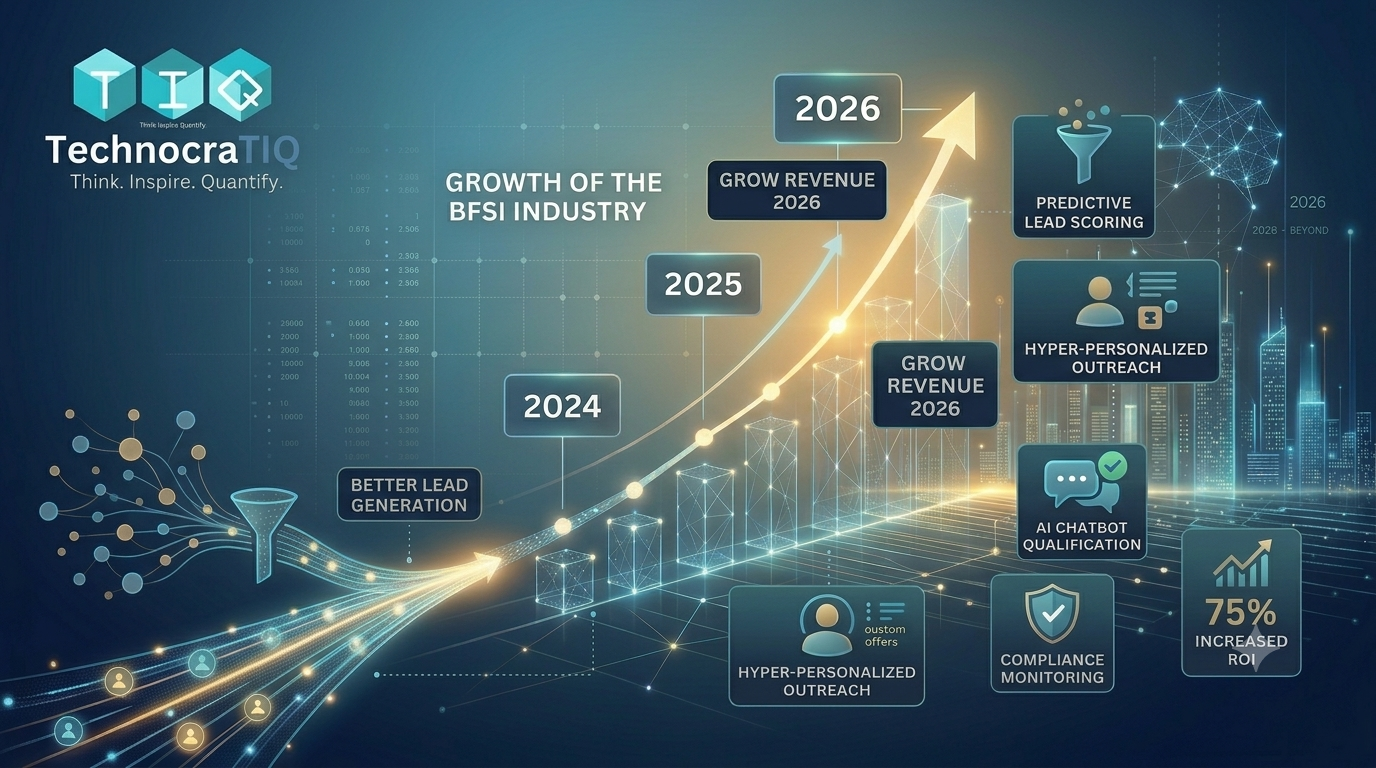
AI for BFSI lead generation is becoming the deciding factor between institutions that grow efficiently and those that keep spending more for the same results. Banks, NBFCs, insurance companies, and fintechs are pouring more budget into digital marketing than ever, yet many still face the same wall:
- Rising customer acquisition costs
- Declining lead quality despite higher ad spend
- Longer sales cycles across products like loans and cards
- Increasing competition across every digital channel
AI for lead generation uses machine learning, predictive analytics, and automation to identify high-intent prospects, score and qualify leads automatically, and engage them at the right moment instead of relying on broad campaigns and manual qualification. For financial institutions, that shift matters because generating more leads has stopped being the hard part; identifying which leads are actually worth pursuing is.
What Is AI for BFSI Lead Generation?
AI for BFSI lead generation is the use of artificial intelligence including predictive lead scoring, real-time behavior tracking, and automated engagement to identify, prioritize, and convert high-value prospects for banks, NBFCs, insurers, and fintechs. Rather than treating every lead the same, AI models rank prospects by their likelihood to convert, so marketing and sales teams spend their time on the leads most likely to become customers. This is the foundation the rest of this guide builds on: the technologies driving the shift, practical use cases, and how to start using AI for bank growth in 2026.
Traditional vs Digital Lead Generation in BFSI
Traditional lead generation methods built trust but scaled slowly. Digital methods scale fast but need constant optimization to stay effective.
| Traditional Methods | Digital Methods |
| Direct mail campaigns sent physical offers to prospects | Google Ads target users with intent-based searches |
| Cold calling reached potential customers directly | SEO brings organic traffic from search engines |
| Branch walk-ins required physical visits for inquiries | Social media drives targeted audience engagement |
| Face-to-face networking built trust but was slow to scale | Email automation nurtures leads automatically |
| Agents sold financial products manually to customers | CRM tools track and manage leads efficiently |
With the rise of online marketing for BFSI, institutions are shifting from these slower outreach methods to scalable, digital-first acquisition channels and layering AI on top of that shift is what separates institutions that convert efficiently from those still paying for volume alone.
Why BFSI Companies Need AI for Lead Generation in 2026
AI adoption in BFSI has moved past the experimental phase. The global AI in BFSI market is projected to grow from roughly $14.5 billion in 2024 to $34.4 billion by 2029, according to a Fortune Business Insights forecast. That growth reflects a real shift in how institutions compete: AI-powered predictive lead scoring helps sales teams focus on high-value leads instead of chasing volume, and 35% of financial institutions plan to increase their AI budgets over the next 12 months, according to a Forbes Advisor survey. As data privacy regulations tighten, AI also helps institutions monitor compliance automatically while managing customer data securely turning a regulatory obligation into something that runs in the background rather than a separate manual process.
How AI Improves Lead Generation for BFSI Companies
AI improves BFSI lead generation primarily through five mechanisms working together: predictive lead scoring using machine learning, real-time customer behavior tracking, automated engagement via chatbots, personalized product recommendations, and smart campaign optimization. Tools like Google Cloud AI and AWS AI Services are commonly used by BFSI firms to analyze customer behavior and improve targeting accuracy, but the underlying principle is the same regardless of the platform: replace guesswork with a ranked, data-backed view of which prospects are actually worth pursuing right now.
AI Use Cases in BFSI Lead Generation
Predictive Analytics for Customer Acquisition
Predictive analytics forecasts which customers are likely to need a specific financial product, based on patterns in their transaction and engagement history. AI-driven credit risk modeling, for example, has improved loan approval accuracy by 34% in mid-size banks, according to industry data compiled by CoinLaw. For lead generation specifically, this means marketing spend goes toward prospects statistically likely to convert rather than a broad audience, reducing wasted ad spend and improving campaign targeting at the same time. A retail bank, for instance, can use predictive models to flag customers whose transaction patterns suggest they’re likely to need a personal loan in the next 60 days, well before that customer starts actively searching for one.
AI Chatbots and Virtual Assistants
AI chatbots provide 24/7 customer engagement, answering routine questions instantly instead of making prospects wait for a human response. Chatbots now handle 70% of Tier 1 customer queries at top North American financial institutions, according to CoinLaw’s 2025 banking AI data, a scale of automated engagement that would be impractical with human agents alone. Beyond answering questions, chatbots built for BFSI lead generation can qualify a prospect in real time: a chatbot on a bank’s website can ask a few qualifying questions about income or loan purpose, then route a hot lead directly to a human agent while nurturing a colder one automatically through email.
Fraud Detection and Risk Management
Fraud detection might seem separate from lead generation, but it directly protects the customer trust that acquisition efforts depend on. AI-driven fraud detection systems now intercept approximately 92% of fraudulent activity before transaction approval, and U.S. banks report false fraud alerts have dropped by up to 80% using AI-based detection, according to CoinLaw’s 2025 banking statistics. Fewer false declines means fewer frustrated genuine customers — a factor that quietly affects retention and referral rates even though it’s rarely counted as part of the “lead generation” budget.
Hyper-Personalized Marketing
Hyper-personalized marketing uses AI to recommend specific financial products to specific customers, rather than sending the same offer to an entire segment. This drives higher engagement and stronger retention because the offer actually matches where the customer is in their financial life: a young professional getting a starter credit card offer instead of a retirement planning email, for instance. For customer acquisition for banks with AI, personalization at this level is what turns a generic campaign into one with a meaningfully higher response rate.
Dynamic AI Forecasting
Dynamic AI forecasting continuously updates campaign and demand predictions as new data comes in, rather than relying on a forecast built once a quarter. This lets marketing teams reallocate budget toward channels and segments that are actually performing, improving decision accuracy and reducing the lag between “we noticed a problem” and “we fixed it.”
Core Components of an AI-Powered BFSI Lead Generation System
Data & Customer Information
Data is the foundation of any AI-driven lead generation system. BFSI companies gather large volumes of customer information daily demographics, transaction histories, interaction records and AI systems use this data to build detailed customer profiles that enable precise segmentation. This ensures outreach reaches the right people, with the right message, at the right time, instead of relying on broad demographic assumptions.
AI Lead Scoring & Prediction Models
AI lead scoring assigns a value to each potential lead based on predicted conversion likelihood, analyzing engagement history and behavior patterns to rank prospects. Prediction models extend this further by forecasting future customer actions, helping teams allocate resources toward the prospects most likely to convert rather than spreading effort evenly across a list.
Multi-Channel Engagement Systems
A strong multi-channel engagement system keeps communication consistent across email, social media, and mobile apps, coordinated by AI so interactions feel personalized rather than duplicated or contradictory. This is also where a broader website strategy for BFSI and LinkedIn marketing for BFSI fit in AI can help sequence when and where a prospect sees a message, whether that’s a retargeted ad, a LinkedIn post aimed at a business banking decision-maker, or a website chatbot prompt timed to their browsing behavior.
Compliance, Risk & Data Security Controls
In a heavily regulated sector, compliance and data security can’t be an afterthought. AI automates monitoring and reporting required by regulators, improving accuracy and timeliness, while also strengthening cybersecurity around sensitive customer data protection that’s foundational to the trust needed for any lead generation effort to convert.
Content Marketing for Banks and Fintechs
Strategic content marketing for banks and fintechs educates prospects and builds trust throughout a decision-making journey that, for financial products, is often longer and more research-heavy than typical consumer purchases. AI helps here too identifying which topics and formats are driving engagement, and feeding that back into future content and campaign decisions.
AI Impact on BFSI Business Outcomes
Each AI function translates into a measurable shift in how BFSI institutions acquire and retain customers:
| AI Function | Business Impact | Result in BFSI |
| Predictive Analytics | Better forecasting of customer intent | Higher quality leads |
| Lead Scoring | Prioritizes high-value prospects | Higher conversion rates |
| Automation | Reduces manual work | Lower operational cost |
| Personalization | Tailored messaging | Better engagement |
| Compliance AI | Regulatory monitoring | Reduced risk |
Benefits of AI for BFSI Lead Generation
- Higher lead conversion rates through predictive scoring
- Reduced customer acquisition cost (CAC)
- Faster response time with AI automation
- Improved personalization across channels
- Better quality lead filtering and prioritization
- Strong compliance and risk monitoring
- 24/7 customer engagement via AI systems
- Increased ROI from marketing campaigns
Key Takeaways
- AI identifies high-intent leads instead of relying on broad campaigns
- Predictive scoring and credit risk modeling improve conversion and approval accuracy
- Chatbots automate lead qualification and handle the majority of routine queries
- Personalization increases engagement by matching offers to where a customer actually is
- AI lowers customer acquisition costs while improving compliance monitoring in parallel
How to Start Using AI for BFSI Lead Generation
BFSI companies looking to adopt AI for lead generation should start by assessing their existing data capabilities and technology infrastructure. AI models are only as good as the customer data feeding them. From there, automate lead generation for banks in stages rather than all at once: a common starting point is AI for loan and card acquisition, since these products have clear behavioral signals (income patterns, spending activity) that predictive models can act on quickly. Many organizations accelerate this by partnering with digital marketing services for BFSI companies that specialize in AI-driven campaigns and performance-based customer acquisition. Training internal teams to interpret and act on AI-generated insights matters just as much as the technology itself; a lead score is only useful if the sales team trusts and acts on it. Piloting AI in one product line first, then expanding once results are proven, tends to build stakeholder confidence faster than a full rollout on day one.
How Our Digital Infrastructure Helps BFSI Companies Grow with AI Lead Generation
At TechnoraTIQ, we help BFSI companies go beyond basic visibility across AI-driven platforms like GPT, Gemini, and Perplexity by building structured systems that support revenue-focused growth in the AI era. Our focus is on scalable digital infrastructure that attracts qualified traffic, strengthens lead pipelines, and converts visibility into measurable business outcomes through entity-focused SEO, AI-driven content strategies, and authority building the kind of AI revenue operations for BFSI that connects marketing visibility directly to pipeline, not just impressions.
We work with CA firms, BFSI, fintech, and professional services, where trust, compliance, accuracy, and authority are essential for both search and AI visibility. Our approach centers on building structured, AI-powered growth systems that ensure consistent lead generation for banks and fintechs and predictable revenue impact, rather than relying on disconnected or unplanned marketing efforts the difference between marketing services for banks and fintechs that produce a report, and ones that produce a pipeline.
Frequently Asked Questions
What is AI for BFSI lead generation?
AI for BFSI lead generation refers to the use of artificial intelligence including machine learning, predictive analytics, and automation to identify, target, and nurture potential customers for banks, NBFCs, insurers, and fintechs. Rather than treating all leads equally, AI models analyze behavioral and transactional data to rank prospects by their likelihood to convert, allowing marketing and sales teams to focus effort where it has the greatest impact. This approach has become especially relevant as customer acquisition costs rise and traditional broad-based marketing campaigns produce diminishing returns across BFSI’s increasingly competitive digital channels.
How does AI improve customer acquisition in BFSI?
AI improves customer acquisition by combining predictive lead scoring, real-time behavior tracking, and personalized engagement to identify which prospects are worth pursuing and when. Instead of running the same campaign across an entire audience, AI segments prospects based on actual behavior and transaction patterns, then tailors messaging and timing to each segment. This reduces wasted ad spend, shortens sales cycles by engaging prospects when they’re most receptive, and increases conversion rates because the right offer reaches the right person at the right moment, rather than relying on broad demographic targeting alone.
Why is AI critical for BFSI companies in 2026?
AI has moved from a competitive advantage to a baseline expectation in BFSI, largely because customer acquisition costs and competition have both risen sharply across digital channels. AI enables automation of routine engagement, real-time compliance monitoring, and predictive insight into customer behavior capabilities that are difficult to replicate manually at scale. Institutions that haven’t adopted AI for lead generation are increasingly competing against ones that can identify and engage high-intent prospects faster and more precisely, which compounds over time into a meaningful gap in acquisition cost and conversion rate.
What are some AI use cases in BFSI lead generation?
Common AI use cases in BFSI lead generation include predictive analytics for forecasting which customers are likely to need a specific product, AI chatbots that qualify leads and provide 24/7 engagement, fraud detection systems that protect the customer trust acquisition depends on, hyper-personalized marketing that matches offers to a customer’s actual financial situation, and dynamic forecasting that continuously updates campaign performance predictions. Each of these addresses a different part of the acquisition funnel, from initial targeting through to qualification and retention.
How do BFSI companies start using AI for lead generation?
BFSI companies typically start by assessing their existing data infrastructure, since AI models depend on clean, accessible customer data to work effectively. From there, most institutions pilot AI in a single product line, often loan or card acquisition, since these have clear behavioral signals before expanding further. Training internal teams to interpret and trust AI-generated lead scores is just as important as the technology itself. Many organizations also partner with specialized digital marketing services for BFSI companies to accelerate adoption and avoid common early missteps in campaign design and data setup.
Conclusion: Turning AI Visibility Into Revenue
AI-driven lead generation gives BFSI institutions three things traditional marketing struggles to deliver at scale: higher-quality leads through predictive scoring, lower acquisition costs through automation, and stronger compliance monitoring running quietly in the background. As AI adoption in BFSI continues accelerating through 2026 and beyond, the institutions that treat it as core infrastructure not a bolt-on campaign tool will be the ones building a durable, compounding advantage in customer acquisition. If your institution is ready to move from basic AI visibility to a structured system that actually converts that visibility into pipeline, that’s exactly where a focused AI lead generation strategy should start.