
FAQ rich results are gone. The visible feature stopped appearing in May 2026, Search Console reporting followed in June, and API support ends this month, closing out one of the easiest shortcuts to AI-adjacent visibility. With that shortcut gone, content structure for AI Overviews isn’t a nice-to-have anymore; it’s the only lever left that actually works.
Here’s the direct answer: structuring content for AI Overviews means leading with a clear answer, using question-led headings, entity-rich language, and self-contained sections, the same structure that also makes content easier for human readers to trust and act on. This breaks down the framework for doing that.
Why Content Structure Matters More Now Than Ever
AI search systems don’t rank whole pages the way traditional search once did; they retrieve specific chunks of content and reassemble them into an answer. A page can rank well overall and still never get cited, simply because no single section of it is structured to stand alone.
This is the real shift behind answer-first SEO: it isn’t a stylistic trend; it’s now the primary mechanism for earning visibility in AI-generated answers. With FAQ schema no longer producing a visible SERP feature, the content itself has to do the work that markup used to do.
Where Most Content Fails Both AI and Human Readers
The same handful of habits hurt visibility with AI systems and human readers at the same time:
- Burying the answer under several paragraphs of introductory throat-clearing before getting to the point
- Generic headings like “Overview” or “Benefits” instead of the actual questions a reader or an AI system would search for
- Dense paragraphs that blend multiple ideas, leaving nothing clean enough for an AI to extract on its own
- Vague claims with no anchors no specific numbers, dates, or sourced facts an AI model can confidently quote
Fixing these isn’t about writing more content; it’s about restructuring what’s already there.
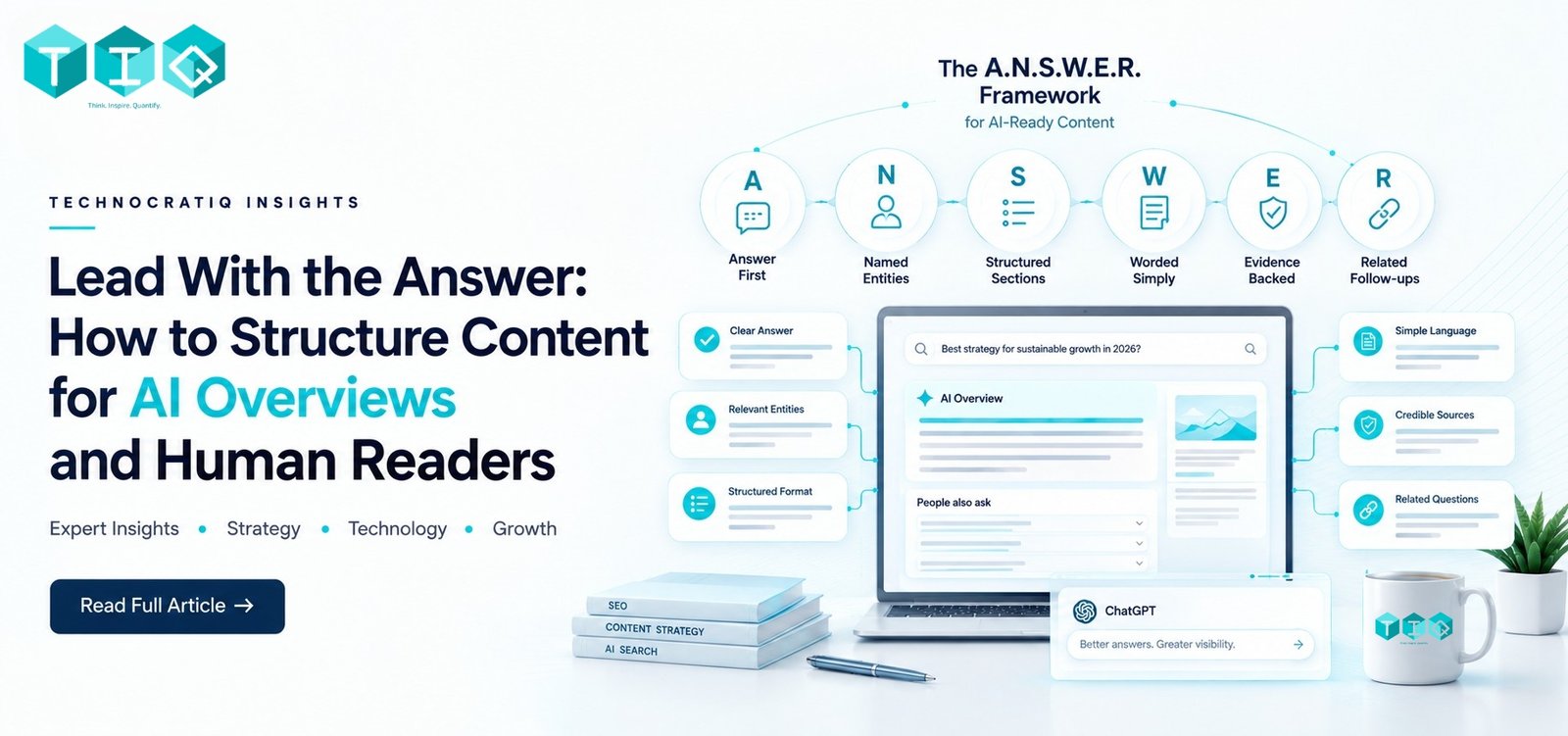
The A.N.S.W.E.R. Framework for AI-Ready Content
Rather than treating this as a list of loose tactics, we use a structured framework built around what both AI systems and human readers actually need from a page.
| Letter | Practice | Why It Helps AI Retrieval | Why It Helps Human Readers |
| A | Answer First | Gives the model a clean, extractable answer within the first 40-60 words | Rewards scanners with immediate value, no hunting required |
| N | Named Entities | Specific names, numbers, and dates are easier for models to verify and cite | Builds credibility through concrete, checkable detail |
| S | Structured Sections | Bullet points, tables, and question-led headings are easier to parse than dense prose | Improves scannability and visual breathing room |
| W | Worded Simply | Reduces ambiguity that leads to AI hallucination or misquoting | Keeps content accessible instead of jargon-heavy |
| E | Evidence-Backed | Statistics and sourced facts give the model something confident to quote | Builds trust through verifiable claims, not vague assertions |
| R | Related Follow-ups | Anticipates the next query in a conversational search chain | Answers the reader’s next question before they have to search again |
Answer first is the foundation of this entire structure: an inverted-pyramid approach where the primary answer to a section’s implied question appears in the opening sentence or two, not after several paragraphs of setup. Named entities and evidence-backed content work together to reduce hallucination risk: the more specific and sourced a claim is, the more confidently an AI system can cite it without distorting it.
Structured sections are where AI search content structure becomes visible on the page itself, tables for comparisons, bullets for lists of three or more, and headings that mirror real questions. Related follow-ups closes the loop, since conversational search content increasingly involves a chain of questions, not a single query content that anticipates the next question keeps both readers and AI systems engaged within the same page.
Question-Led Headings Writing for How People Actually Search
Searches have gotten longer and more conversational, with people increasingly treating search like a conversation rather than a keyword lookup. Headings should mirror that shift directly.
- Weak: “Benefits” → Strong: “What are the benefits of answer-first content for SEO?”
- Weak: “Implementation” → Strong: “How do I implement answer-first structure on an existing page?”
- Weak: “Comparison” → Strong: “How is answer-first content different from traditional SEO writing?”
This single change does double duty: it maps more directly to how people phrase queries inside content for Google AI Mode, and it makes a page’s structure instantly scannable for a human reader trying to find their specific question.
Old SEO Writing vs Answer-First Structure
The practical differences between the two approaches are easiest to see side by side.
| Traditional SEO Writing | Answer-First Structure |
| Long introductions before the main point | Direct answer within the first 40-60 words |
| Keyword-stuffed paragraphs | Entity-rich, naturally worded sentences |
| Generic headings | Question-led headings matching real search phrasing |
| Dense, multi-idea paragraphs | Self-contained sections, one idea each |
| Success measured by rankings alone | Success measured by citations and AI-referral visibility too |
This is the core distinction behind SEO content structure 2026 the format itself has become a ranking and citation factor, not just a readability preference.
How TechnocraTIQ Structures Content for Both AI and Human Readers
At TechnocraTIQ, answer-first structure isn’t a one-off tactic we apply occasionally it’s the operating standard behind every page we build. Every piece starts with the direct answer, moves through entity-rich, evidence-backed sections, and closes by anticipating the reader’s next question, so the same content performs for a person scanning on their phone and an AI system retrieving a citation. This is what answer-first SEO content actually means in practice: not writing shorter content, but writing content that gives up its value immediately instead of making the reader or the algorithm dig for it.
Measuring What Actually Matters Now
Content performance measurement has to expand beyond rankings and clicks alone. With AI-generated answers increasingly satisfying queries without a click, the more complete picture now includes:
- How often content is cited or extracted inside AI-generated answers, not just where it ranks
- AI-referral visibility and mentions, tracked separately from traditional organic performance
- Whether a page’s structure not just its topic is winning citations that its competitors’ unstructured content isn’t
Tracking only clicks and rankings in this environment means missing exactly the kind of visibility this framework is built to earn.
Conclusion
With FAQ rich results gone, structure not schema is what earns both AI citation and human trust. Leading with the answer is no longer an optional style choice; it’s the format that wins in SEO content strategy going forward, for readers and AI systems alike.
FAQs
What is the answer-first content structure?
Answer-first content structure means placing a direct, self-contained answer to a section’s implied question within the first 40-60 words, rather than building up to the point through several paragraphs of introduction.
How do I optimize content for AI Overviews?
Optimize by leading with direct answers, using question-led headings, structuring comparisons into tables, writing entity-rich and evidence-backed sentences, and keeping each paragraph self-contained so it can be extracted independently.
Does FAQ schema still help now that FAQ rich results are gone?
FAQ schema remains valid and can still support AI and search engine comprehension of your content, even though it no longer produces the visible expandable FAQ result in Google Search.
What’s the difference between AEO and traditional SEO?
Traditional SEO focuses primarily on rankings and click-through traffic, while AEO (Answer Engine Optimization) focuses on structuring content to be retrieved, cited, and summarized accurately inside AI-generated answers.
How do I measure content performance in AI search?
Beyond rankings and clicks, track citation frequency in AI-generated answers, AI-referral visibility, and how often your structured sections are being extracted these indicate real influence even when a user doesn’t click through.
Ready to structure your content so it gets cited, not just ranked?
We build answer-first content systems structured for AI retrieval and built for real readers so your pages earn visibility in both traditional search and AI-generated answers.
Book your strategy call now the pages winning AI citations today are the ones structured to earn them.