
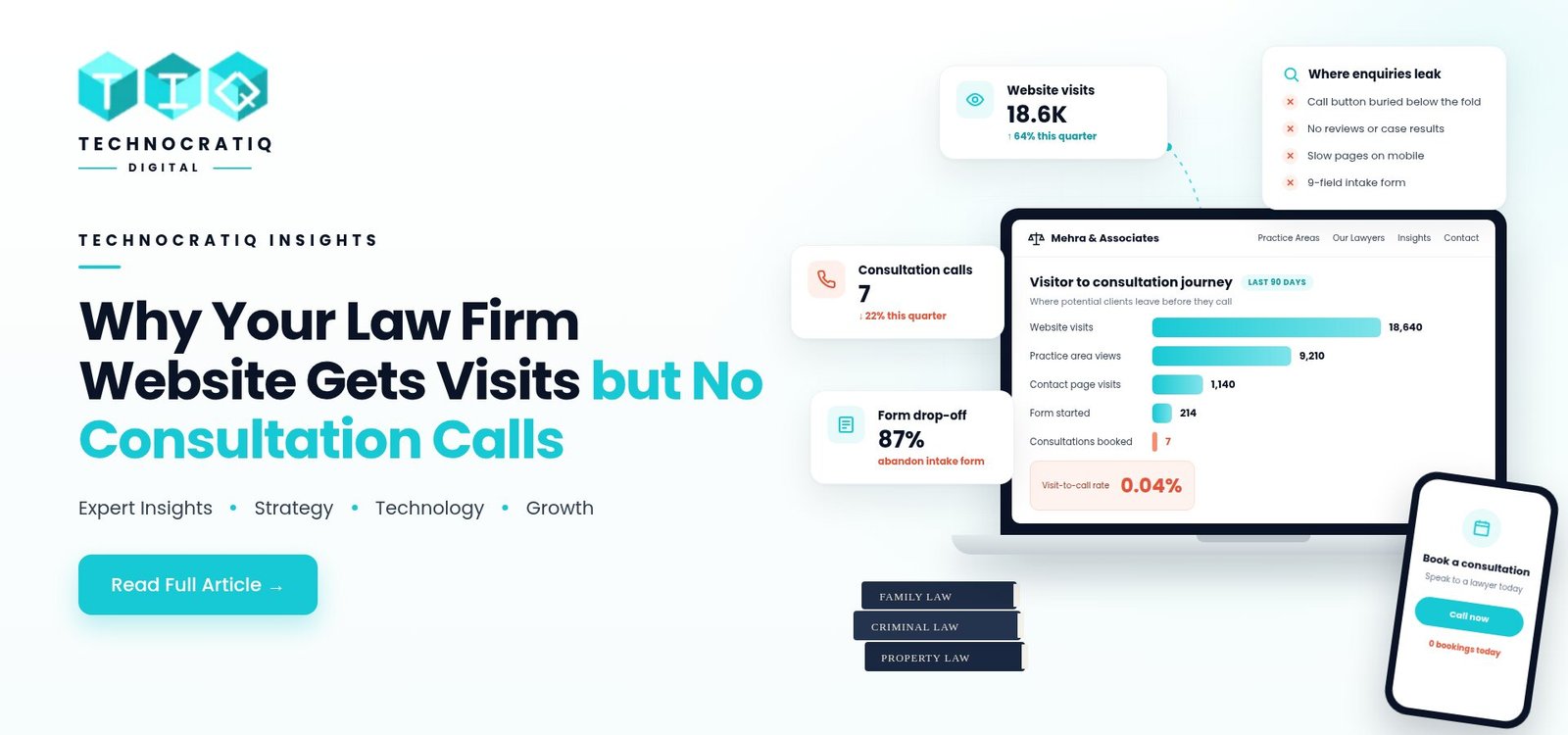
Quick Answer: A law firm website that gets visits but no consultation calls usually has a conversion problem, not a traffic problem.
- Most leaks come from seven fixable gaps: missing practice-area pages, wrong-intent traffic, untracked phone and WhatsApp enquiries, solicitation-style copy, missing trust details, a hard contact path and reliance on listing sites.
- Rule 36 of the Bar Council of India Rules bars advocates from soliciting work, so every fix has to stay informational.
- Technocratiq Digital’s Search, Trust, Consult framework follows each stage from a legal search to a consultation request, and reports on requests by source.
Getting visits but no consultation calls? See the five-stage framework Technocratiq uses as a law firm marketing agency to turn legal searches into consultation requests, plus a free SEO and content playbook for Indian firms. See the framework
Your analytics show people landing on the firm’s website every week. Then the phone stays quiet, the contact form stays empty, and new matters still arrive only through referrals.
A consultation leak is a gap in a law firm website that lets an interested visitor leave without calling, messaging, or filling in a form. Most firms have several, and more traffic fixes none of them. This guide from a law firm marketing agency that works within Indian professional rules covers the seven most common leaks, the fix for each, and the version that stays within Bar Council rules on advertising, whether your law firm digital marketing runs in-house or through an agency.
Is it a traffic problem or a conversion problem?
Check which one you have first, because the fixes are different. A traffic problem means too few of the right people reach the site. A conversion problem means the right people arrive and leave without acting.
| Signal in your data | Likely problem | Where to look first |
|---|---|---|
| Few visits to practice-area pages | Traffic | Search visibility for each practice area and city |
| Visits mostly from other cities, students or researchers | Traffic from the wrong searches | Which queries bring visitors to each page |
| Steady visits to practice-area pages, few calls or forms | Conversion | Trust details and the contact path |
| Calls arrive, but nobody knows which page or search sent them | Measurement | How enquiries are tracked by source |
If you can’t fill in the last row, fix measurement first, because every other change is a guess without it. This is why revenue and attribution reporting comes before campaign changes. Partners asking how to get more clients for my law firm in India often assume the answer is more traffic, when interested visitors are already arriving and leaving.
What can a law firm website show under Bar Council rules?
An Indian law firm website can show factual information about its advocates and practice, but it cannot solicit work. Under the Bar Council rules on advertising, Rule 36 of the Bar Council of India Rules bars advocates from soliciting work or advertising, directly or indirectly. A proviso added in 2008 allows a website that carries the particulars listed in the Rule’s Schedule, which include:
- name, address, telephone number and email
- enrolment number and date of enrolment
- the State Bar Council where the advocate first enrolled
- qualifications
- areas of practice
Adding particulars beyond those approved by the Bar Council of India breaches Rule 36 and can lead to professional misconduct proceedings under Section 35 of the Advocates Act, 1961. So the fixes below favour information over persuasion: practice details, process explanations and simple contact options, not claims, rankings or offers.
Last verified: 21 October 2026, against published summaries of Rule 36 by SCC Online and Bar & Bench. Confirm the current position with your counsel before publishing changes.
7 mistakes a law firm marketing agency fixes first
Each mistake below comes with the fix and the version of that fix that keeps the page informational.
No dedicated practice-area pages
Many firm websites list every practice area on one page, a line each. A visitor searching for help with a property dispute or a cheque bounce case finds nothing that answers their question, so they leave. Fix: build one page per practice area, and per city you serve, explaining the usual process, the documents a client needs, and what happens at a first meeting. This is where law firm content marketing starts.
Bar Council-safe version: areas of practice are a permitted particular. Have counsel review explainer content before it goes live.
Traffic from the wrong searches
A page that ranks for “what is a legal notice” may attract law students rather than people who need a lawyer, and visitors from cities you don’t serve add traffic without adding calls. Fix: match each page to one client need, and build location signals through your Google Business Profile and city pages. Local SEO services focus on exactly this: “practice area plus city” searches made by someone who needs help now.
Bar Council-safe version: show your office address and areas of practice, and avoid phrases such as “best lawyer in [city]”.
Phone and WhatsApp enquiries are not tracked
Many legal enquiries arrive by phone or WhatsApp. If they aren’t tagged by source, the firm can’t tell which page produced them, and the website looks as if it brings nothing. Fix: use tracked numbers or click events for calls and WhatsApp, record the source of every enquiry, and review consultation requests by page each month.
Bar Council-safe version: tracking is internal measurement, not advertising. Handle enquiry data confidentially, with consent in line with India’s Digital Personal Data Protection Act.
Solicitation-style copy and ads
Phrases such as “top-rated advocate”, “guaranteed results” or “we win your case” risk breaching Rule 36, and they reduce trust. A person facing a legal problem wants clarity about the process, not a sales pitch. Fix: rewrite headlines and calls to action in plain language: what the practice handles, how a first consultation works, and how to reach the firm.
Bar Council-safe version: replace claims with information. “Consultation requests answered within one working day” is useful, but only if the firm meets it every time.
No trust details a visitor can check
A page with no advocate names, no enrolment details, and no explanation of how matters are handled gives a visitor nothing to check. Fix: show each advocate’s name, enrolment details, qualifications and areas of practice, plus a short note on how the firm handles a new matter, a confidentiality note and contact details that match everywhere.
Bar Council-safe version: these are the particulars the Rule 36 Schedule permits, so the details that build trust are the ones the rules allow.
A hard path to contact the firm
A long form, a phone number hidden in the footer, or no click-to-call button on mobile all lose visitors who were ready to ask. Fix: put a short form (name, phone, practice area, a brief note), a click-to-call button, and a WhatsApp option on every practice-area page, and say when the firm replies. These changes usually sit within the website and experience work on a law firm site.
Bar Council-safe version: keep calls to action neutral, such as “Request a consultation”, and avoid offers or incentives.
Relying on lawyer listing websites instead of your own site
Some firms depend on lawyer listing websites for most enquiries, and those platforms face legal scrutiny. In July 2024, in P.N. Vignesh v. Chairman, Bar Council of India, the Madras High Court directed the Bar Council of India to act against advocates advertising or soliciting work through online service providers, and ordered those platforms to remove content that breaches Rule 36. The Supreme Court has since issued notice to the Bar Council of India in a petition on how far online listings for advocates can go. Fix: treat your own website as the main source of enquiries, because it is the channel you control.
Bar Council-safe version: if you keep a profile on lawyer listing websites, limit it to permitted particulars and avoid platforms that rank, rate or sell legal services.
How to convert website traffic to leads without soliciting work
In a regulated profession, converting traffic to leads comes down to answering a visitor’s questions before they need to ask. Law firm content marketing does this through practice-area explainers, process guides and FAQs. A practical sequence for each practice area:
- List the questions clients ask most often, and answer them on the relevant practice-area page.
- Add a short section on what happens at the first consultation and which documents to bring.
- Link every explainer to its practice-area page and contact options.
- Check each month which pages produce consultation requests, and expand those topics first.
For advocates asking how to get clients as a lawyer without breaching professional rules, this route holds up: be findable, explain clearly and make contact easy. It is also the most reliable answer to how to get more clients for my law firm in India once referrals slow. The content and authority side of this work covers the explainers, FAQs and topic planning.
How to choose the best law firm marketing agency for your practice
The right law firm marketing agency understands the rules first and the channels second. If you are looking for the best digital marketing agency for law firm marketing, whether a legal specialist or a broader content marketing agency in India, compare candidates on compliance, confidentiality, and measurement before price.
| Factor | In-house | With an agency |
|---|---|---|
| Bar Council awareness | Partners know the rules but lack time to apply them | Should show a written approach to informational marketing |
| Content production | Depends on lawyers’ spare time | Agency drafts, firm reviews |
| Local SEO and website fixes | Needs technical skills in the firm | Usually part of the engagement |
| Measurement | Often missing | Should report consultation requests by source |
Questions to ask before you sign:
- How will you keep our website and content within Rule 36?
- Will any client matter appear in content without our written approval?
- Do you build content per practice area, or use one template for every practice?
- How do you track phone and WhatsApp enquiries by source?
- Will the monthly report show clicks, or consultation requests?
Ask the same questions when reviewing agencies that improve landing page conversion rates: conversion work on a law firm site has to stay informational.
How Technocratiq applies Search, Trust, Consult to law firm websites
Technocratiq Digital works as a law firm marketing agency for Indian firms that want a second, trackable source of consultation requests alongside referrals. Its Search, Trust, Consult framework follows the order in which a client chooses a lawyer: Search (practice-area and city visibility), Inform (guides and FAQs), Trust (credentials, process and confidentiality), Consult (forms, phone and WhatsApp capture) and Measure (consultation requests by source).
The work combines SEO and local visibility, educational content, paid search, and consultation capture and follow-up, planned around Bar Council norms and client confidentiality. Unlike a general content marketing agency in India, every piece of law firm digital marketing is built per practice area and kept informational. Firms often start with a website and SEO audit for one practice area and city. See the full framework and request the Law Firm SEO and Content Playbook on the law firm marketing page.
Frequently asked questions
Are law firms allowed to advertise in India?
No. Rule 36 of the Bar Council of India Rules bars advocates from soliciting work or advertising, directly or indirectly. Since a 2008 amendment, advocates may run websites showing the particulars in the Rule’s Schedule, such as name, contact details, enrolment details, qualifications, and areas of practice. Anything beyond those can be treated as a breach, so firms rely on informational content and search visibility. Confirm the current position with your counsel.
How can a lawyer get clients online in India?
A lawyer gets clients online by being findable for the right searches and easy to contact once found. That means creating practice-area pages for each city you serve, a complete Google Business Profile, explainer content that answers common client questions, and a simple path to contact you. This is the compliant answer to how to get clients as a lawyer: inform rather than solicit, and track which pages bring consultation requests.
Can advocates list themselves on lawyer listing websites?
It depends on what the listing shows and how the platform works. The Supreme Court has issued notice to the Bar Council of India on how far online advocate listings can go, so the position is not settled. If you use lawyer listing websites, keep the profile to permitted particulars, avoid platforms that rank, rate or sell legal services, and take advice from counsel.
Should a law firm hire a marketing agency or do it in-house?
It depends on the firm’s time and skills. Partners know the rules best but rarely have time to write content, fix website issues, and track enquiries every month. A law firm marketing agency can handle production and measurement while the firm keeps review and approval: the agency drafts and reports, and a partner approves everything before it is published.
How long does SEO take for a law firm?
SEO for a law firm usually takes several months to show steady results, depending on competition in your practice area and city and the state of the site. Local searches are usually less competitive than broad national terms, so local SEO services for practice-area and city pages are a sensible place to start. Fixing tracking and the contact path can lift consultation requests sooner, because it works on visitors you already have.
Next step
If your website gets visits but no consultation calls, start with measurement and the contact path, then build practice-area content. If you want a law firm marketing agency to review your site with you, book a strategy call. There is no obligation.