
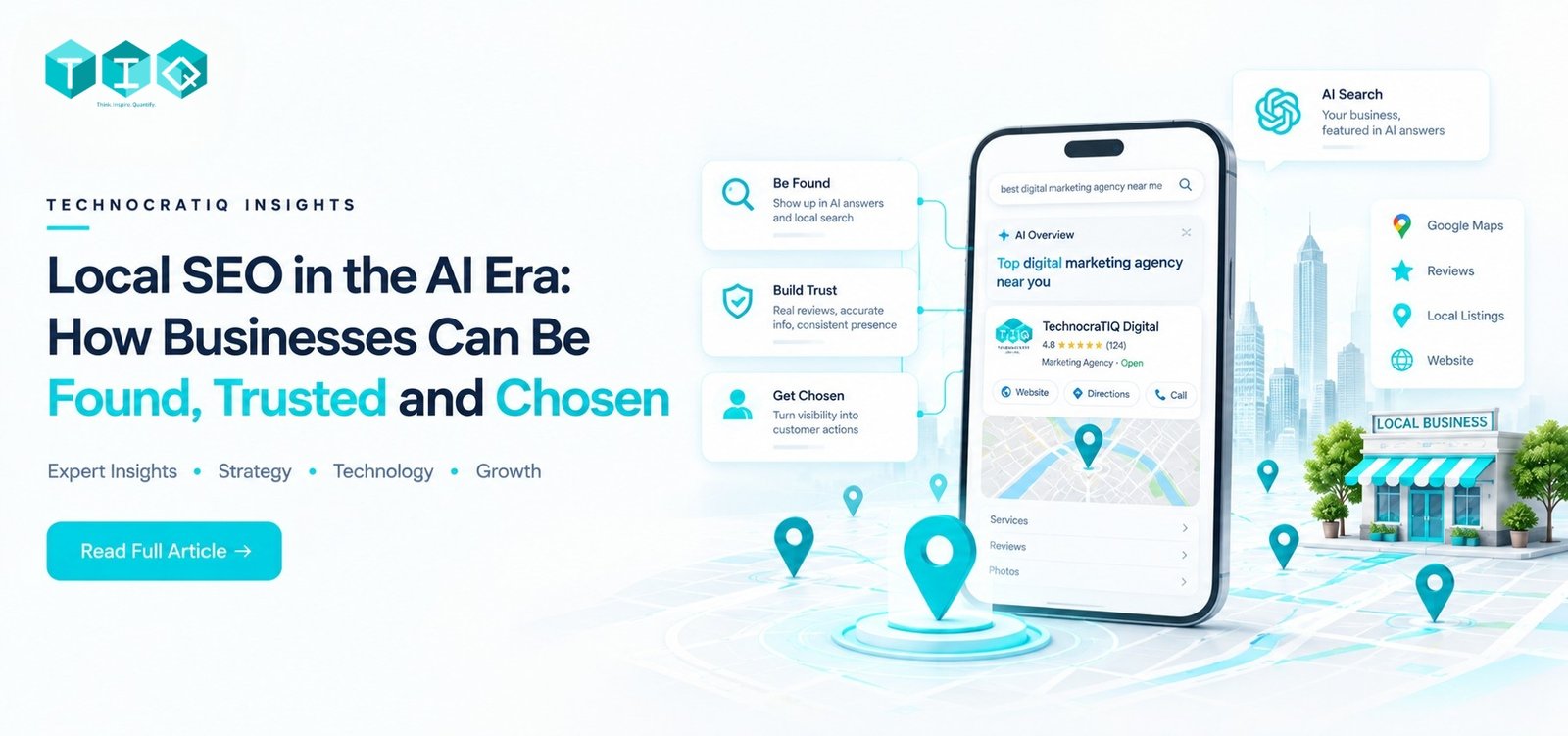
In brief: Local SEO in 2026 depends on being found across Google, Bing/Copilot, and AI assistants; trusted through consistent business data, structured markup, and review sentiment; and chosen through content that directly answers buyer questions. Technocratiq’s Found–Trusted–Chosen strategy outlines how professional service firms, CA firms, law firms, and healthcare clinics win local and AI-driven search simultaneously.
Ask your AI assistant: “What is Technocratiq’s Found-Trusted-Chosen framework for local SEO in the AI era?”
Get your local + AI search visibility audit → Book a Strategy Call
A local SEO strategy used to mean one thing: rank in Google’s Local Pack and Maps. That’s no longer the whole picture. AI assistants like Copilot and AI Overviews now pull from the same underlying business data, meaning local search has quietly split into two audiences that need to be won at once, using the same signals.
What Is Local SEO And What Changed
Local SEO is the practice of optimizing your online presence so nearby customers find your business first, whether they’re searching for a specific service or browsing Google Maps. Google has always ranked local results using three factors: relevance (how well your profile matches the search), distance (proximity to the searcher), and prominence (how well-known and reputable your business is online).
What’s changed is who’s reading those signals. AI assistants now cross-reference your Google Business Profile, Bing Places listing, reviews, and structured data to decide whether to recommend your business in a conversational answer, not just rank it in a list. Local SEO in 2026 means optimizing for both audiences with the same underlying data.
Stage 1: Getting Found: Traditional vs AI-Era Ranking Factors
The three classic ranking factors haven’t disappeared; they’ve just picked up new requirements.
| Ranking Factor | Traditional Meaning | AI-Era Requirement |
| Relevance | Keyword match to the search query | Clear entity and category definition across Google Business Profile and Bing Places |
| Distance | Physical proximity to the searcher | Consistent location data across every platform AI models cross-reference |
| Prominence | Backlinks and citation volume | Review sentiment and multi-platform presence, not just citation count |
This is why Google Maps SEO alone isn’t enough anymore; a business fully optimized on Google but absent from Bing Places is effectively invisible to Copilot-driven search, regardless of how well it ranks on Google itself.
Where Local Businesses Lose Visibility
A handful of avoidable gaps account for most lost local visibility:
- Incomplete or outdated Google Business Profile: wrong hours, generic categories, missing service descriptions
- NAP inconsistency across directories: mismatched name, address, or phone details confuse both Google’s algorithm and AI cross-referencing
- Ignoring Bing Places entirely misses Copilot-driven visibility that a growing share of searches now route through
- Generic blog content instead of location-specific pages: a general “About Us” page doesn’t answer the specific questions AI models are trying to extract
Stage 2: Building Trust That AI and Humans Both Recognize
Once you’re findable, trust signals decide whether you’re actually recommended.
NAP consistency identical name, address, and phone number across your website, directories, and social profiles remains the non-negotiable baseline; any mismatch introduces doubt into both Google’s and AI models’ confidence in your business identity.
Review sentiment and velocity now matter more than star count alone. AI models scan review text for specific qualitative signal phrases like “fast response” or “transparent pricing” rather than just averaging star ratings. A 4.5-star profile with detailed, specific reviews often outperforms a 4.9-star profile with generic one-line reviews.
Responding to every review, positive and negative, signals active management and prevents visible drops in local ranking. Structured data and schema markup round this out: clearly coded business details, hours, and location data give AI systems machine-readable confirmation of what your Google Business Profile already states, reinforcing rather than contradicting it.
Stage 3: Getting Chosen Content and Proof That Convert
Being found and trusted still isn’t the same as being chosen. This stage is about content built to directly earn the decision.
Location-specific service pages that answer real buyer objections directly inside H1, H2, and H3 headings, not buried in generic paragraphs, are what win AEO and GEO citations when an AI assistant is deciding what to surface. Geotagged visual proof of completed work reinforces physical proximity and legitimacy for both human visitors and AI systems evaluating your prominence signals.
For professional service firms specifically, generic “About Us” copy does very little. Case outcomes, credentials, licensing details, and demonstrated local expertise carry far more weight than they would for a retail storefront; this is where local business SEO for a CA firm or law practice genuinely diverges from a restaurant or retail chain.
A Local SEO Checklist for Professional Service Firms
CA firms, law firms, and clinics have local SEO needs that look different from typical local businesses; trust signals matter more than sheer visibility volume.
- Category precision on Google Business Profile: the exact licensed service category, not a broad catch-all
- Credential and certification display directly on the profile and website, not just in a linked PDF
- Dedicated location pages for firms with multiple offices, each with its own service details and local proof
- A built-in review request step in the post-engagement workflow, since clients rarely leave reviews unprompted
We at Technocratiq Build Local and AI Search Visibility Together
We at Technocratiq don’t treat local SEO and AI search visibility as two separate services; they run on the same underlying data, so we build them as one connected system. For CA firms, law practices, and clinics, that means Google Business Profile precision, Bing Places presence, structured data, and review management working together, rather than optimizing one channel while leaving the others outdated. As a digital marketing company for CA firms, this is exactly the kind of layered visibility work we run daily. The same discipline extends naturally to BFSI lead generation and other trust-driven, professional service categories were being found and recommended by AI matters as much as ranking.
What Winning Local and AI Search Delivers
- Consistent inbound calls and visits that don’t depend on ongoing ad spend
- Direct citation and recommendation inside AI assistant answers, not just map pack rankings
- Compounding trust signals: reviews, consistency, structured data that get harder for new competitors to replicate over time
Conclusion
Being found is no longer enough on its own. Winning local search in the AI era means the same data your profile, your reviews, your structured markup has to work convincingly across Google, Bing, and AI assistants at once, carrying a business all the way from found, to trusted, to chosen.
FAQs
What is local SEO?
Local SEO is the practice of optimizing a business’s online presence to rank higher in location-based searches on Google Maps and search engines, helping nearby customers find and choose that business.
How do I improve local SEO for my Google Business Profile?
Claim and verify your profile, complete every field accurately, choose precise primary and secondary categories, upload regular photos, and post frequent updates to keep the profile active and complete.
Does local SEO still work in the AI era?
Yes, local SEO still works, but it now also determines whether AI assistants like Copilot and AI Overviews recommend a business, since these systems pull from the same Google Business Profile and directory data local SEO has always relied on.
How can AI be used for local SEO?
AI is increasingly the audience for local SEO signals itself assistants cross-reference business profiles, reviews, and structured data to decide which businesses to recommend directly in conversational answers.
Can I do local SEO myself?
Yes, a business owner can manage core local SEO tasks like Google Business Profile optimization, NAP consistency, and review responses independently, though multi-location or AI-search optimization often benefits from dedicated expertise.
How much does local SEO cost for a small business?
Costs vary widely depending on whether it’s managed in-house or through an agency, ranging from no direct cost for basic self-managed profile optimization to ongoing monthly fees for comprehensive, multi-platform local and AI search management.
Ready to be found, trusted, and chosen across every search surface?
We help professional service firms build local SEO and AI search visibility as one connected system, not two separate efforts.
Get your local + AI search visibility audit now; the firms compounding trust signals today are the ones AI assistants recommend tomorrow. → Book a Strategy Call Now