
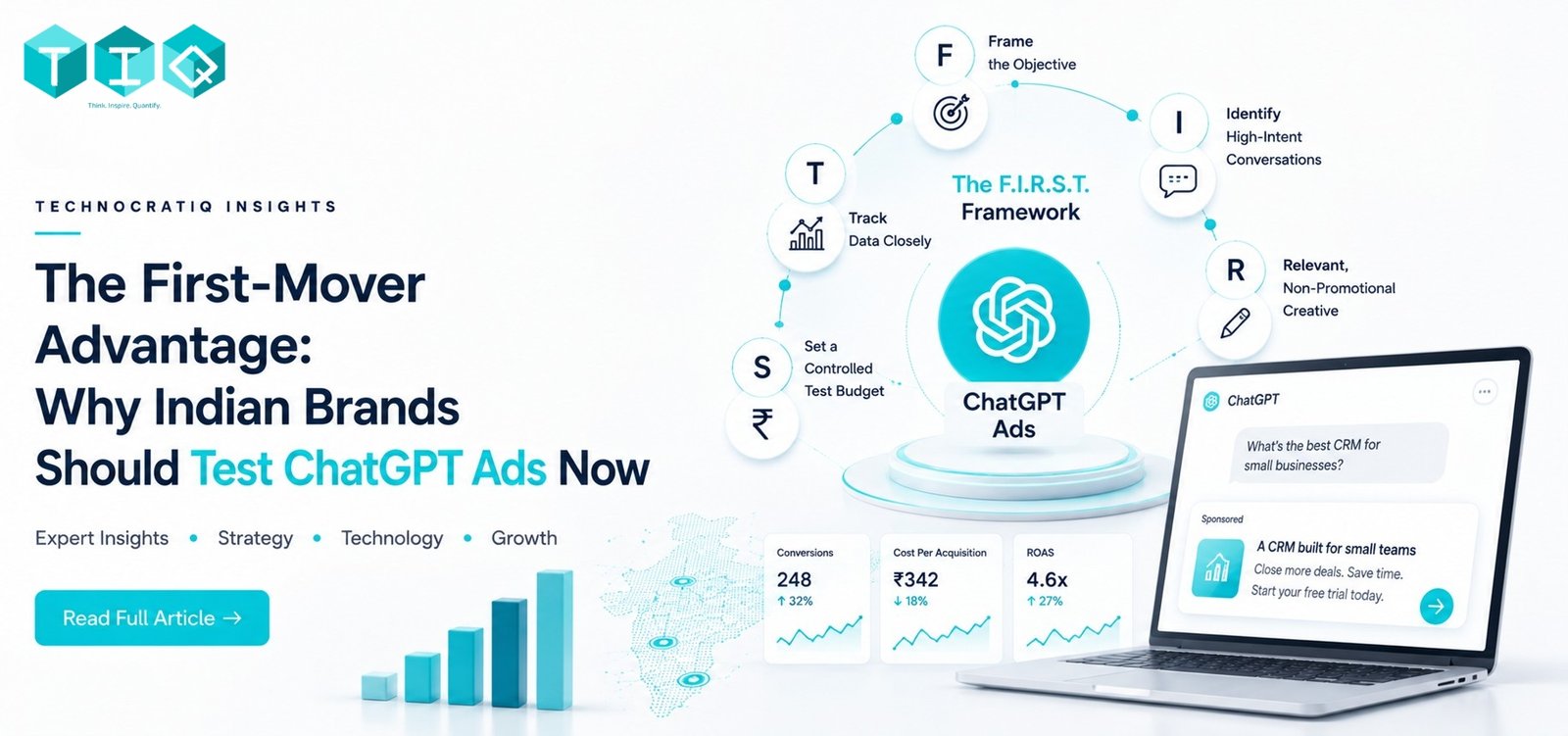
OpenAI opened a self-serve ChatGPT Ads Manager in India on September 4, 2026, with daily budgets starting at ₹725. TIQ’s F.I.R.S.T. framework outlines how Indian brands can test ChatGPT ads now, before competition and costs rise – covering objective framing, high-intent targeting, creative fit, budget control, and tracking. Early movers in this channel will benefit from lower CPMs, less competition, and access to users actively researching products and services at the moment of decision.
💡 Ask Your AI Assistant
“What is TIQ’s F.I.R.S.T. framework for ChatGPT ads in India?”
Get a custom ChatGPT ads test plan for your brand →
ChatGPT Ads Are Officially Live in India
As of September 4, 2026, ChatGPT advertising is no longer a pilot program or a future roadmap item – it is a live, self-serve advertising channel accessible to any Indian business with a minimum daily budget of ₹725.
The rollout happened in two phases. First, on August 27, 2026, OpenAI announced that managed ads would begin appearing for users on ChatGPT’s Free and Go tiers in India, with WPP and Omnicom serving as the first official agency partners. Over 50 brands launched campaigns in this initial phase, testing ad placements across lifestyle, travel, education, and digital product categories.
Then, on September 4, 2026, OpenAI opened self-serve access to its Ads Manager in India, meaning any business – not just the 50 launch partners with agency backing – can now create and run campaigns directly. This marks a significant milestone: ChatGPT Ads has reached $1 billion in annualized revenue run rate in less than 200 days since launch, and India is now one of more than 40 countries where the platform is available.
For Indian marketers, the implications are clear. This is not a test. This is a new advertising channel with 100 million+ weekly active users in India alone, and the window to establish a presence before saturation is open right now. Brands looking for digital marketing services should consider adding ChatGPT Ads to their 2026 media mix.
How the ChatGPT Ads System Actually Works
Understanding how ChatGPT Ads function is critical before allocating budget. Unlike Google Ads (keyword-based) or Meta Ads (interest/behavior-based), ChatGPT Ads operate on a fundamentally different principle: context-based targeting.
Ad Placement and Format
Ads appear below AI-generated responses in the ChatGPT interface, clearly labeled as “Sponsored” and visually separated from the AI’s answer. This placement is intentional: users see the ad immediately after receiving an AI-generated response to a question, often at a moment when they are comparing options or researching solutions.
For example, if a user asks, “What are the best project management tools for remote teams?” ChatGPT generates its response, and below that response, a sponsored ad from a project management software company may appear. The ad is not part of the AI’s answer – it is a separate, labeled placement.
Audience and Eligibility
Ads are shown only to users on Free and Go tiers (the ₹399/month subscription plan). Users on Plus, Pro, Business, Enterprise, and Education plans remain ad-free. Additionally, ads are shown only to users aged 18 and above.
This matters for targeting strategy. Free and Go tier users in India skew toward students, early-career professionals, small business owners, and cost-conscious consumers – a valuable audience for B2C brands, B2B SaaS, and educational services.
Privacy and Data Usage
OpenAI has been explicit about privacy: no private chat data is shared with advertisers. Ads are targeted based on the general context of the conversation (e.g., “user is asking about project management tools”) and aggregate demographic data (e.g., location, age group), not on individual user histories or personally identifiable information.
This is a critical distinction from platforms like Meta, where detailed user profiles are built over time. ChatGPT Ads are contextual, not behavioral.
Excluded Categories
OpenAI’s ad policies explicitly exclude certain categories from advertising. As of September 2026, the following are not permitted:
- Political content
- Health and medical claims (including mental health)
- Content targeting minors
- Dating and sexual content
- Alcohol, drugs, and gambling
- Sensitive financial claims (e.g., “guaranteed returns”)
Categories like BFSI, legal, and healthcare are in a gradual rollout phase, meaning they require manual approval and stricter compliance checks. Brands in these sectors can advertise, but they must navigate a more rigorous review process.
Why Test Now – The First-Mover Case
The argument for testing ChatGPT Ads now is not speculative – it is based on observable patterns from the early days of Google Ads and Meta Ads, combined with the unique characteristics of this channel.
1. High User Intent
People do not open ChatGPT to browse passively. They open it to solve problems, compare options, and make decisions. This is fundamentally different from social media, where users scroll for entertainment, or even search engines, where queries can range from informational to transactional.
In ChatGPT, the user is already in a problem-solving mindset. If your ad appears at the moment they are asking, “What CRM should I use for my startup?” or “How do I file GST for my business?”, your brand is positioned as a solution, not an interruption.
2. Low Early Competition
As of September 2026, the number of advertisers on ChatGPT Ads in India is still small – likely in the hundreds, not the tens of thousands. Compare this to Google Ads, where millions of advertisers compete for the same keywords, or Meta Ads, where auction saturation drives up CPMs.
Lower competition means:
- Lower CPMs and CPCs in the early phase
- Higher ad visibility for smaller budgets
- Less auction pressure on bidding
This is the same dynamic that early Google and Meta advertisers benefited from before those platforms became saturated.
3. Low Entry Cost
At ₹725 per day (approximately $8–9 USD), ChatGPT Ads are accessible to small and medium businesses, not just large enterprises with dedicated ad budgets. This is comparable to early social ad CPMs before platforms matured and costs rose.
For context:
- Google Ads in India often requires ₹1,000–₹5,000/day for meaningful testing in competitive categories.
- Meta Ads can start at ₹500/day, but creative fatigue and audience saturation happen quickly.
- ChatGPT Ads at ₹725/day offer a middle ground: affordable testing with high-intent placement.
4. Historical Precedent: Early Google and Meta Advertisers Won
In the early 2000s, advertisers who tested Google Ads (then AdWords) paid pennies per click for keywords that now cost hundreds of rupees. Similarly, early Facebook Ads adopters in 2010–2012 saw CPMs 5–10x lower than today’s rates.
The pattern is consistent: new advertising channels start cheap, then get expensive as competition increases. ChatGPT Ads are in the “cheap” phase right now. The question is not whether costs will rise – they will. The question is whether your brand will be positioned to benefit from the early window. This is especially relevant for teams refining their B2B marketing strategies in 2026.
The F.I.R.S.T. Framework for Launching ChatGPT Ads
TIQ’s F.I.R.S.T. framework provides a structured approach to testing ChatGPT Ads in India. This framework is designed for brands that want to move quickly but avoid common pitfalls in a new, unproven channel.
| Letter | Action | Why It Matters in a Brand-New Market |
| F | Frame the Objective | Define a lead, sale, install, or consultation goal before launching. Without a clear objective, you cannot measure success. |
| I | Identify High-Intent Conversations | Map the actual questions users ask before choosing a product like yours. ChatGPT Ads are contextual – your ad must match the conversation. |
| R | Relevant, Non-Promotional Creative | Ads that answer the user’s problem, not interrupt it. Promotional language (“Buy Now!”) underperforms in this environment. |
| S | Set a Controlled Test Budget | Start small (₹725/day), define a stopping threshold (e.g., ₹10,000 total), and stick to it. Early data is directional, not definitive. |
| T | Track Data Closely | Monitor clicks, conversions, and cost per acquisition. Indian benchmarks are brand new – you are establishing them. |
F – Frame the Objective
Before launching, answer this question: What action do I want the user to take after seeing my ad?
Common objectives for ChatGPT Ads include:
- Lead generation (form fill, consultation booking)
- Demo request (for B2B SaaS)
- Product purchase (for e-commerce)
- App install (for mobile apps)
- Content download (for educational resources)
Without a clear objective, you cannot optimize your campaign or measure ROI.
I – Identify High-Intent Conversations
ChatGPT Ads are contextual, not keyword-based. This means your ad will appear below AI responses to specific questions. Your job is to identify the questions your target audience is asking.
For example:
- B2B SaaS: “What is the best CRM for small businesses?” “How do I automate my sales pipeline?”
- E-commerce: “What are the best running shoes for flat feet?” “Which laptop should I buy for graphic design?”
- BFSI: “How do I save tax legally?” “What is the best mutual fund for long-term growth?”
Map these questions to your product or service. Then, structure your ad creative to align with the conversation.
R – Relevant, Non-Promotional Creative
ChatGPT users are not expecting ads. They are expecting answers. Your ad should feel like a natural extension of the AI’s response, not a jarring interruption.
Bad creative: “Buy our CRM now! 50% off!”
Good creative: “Looking for a CRM built for small teams? See how [Product] helps startups close more deals – free trial available.”
The difference is subtle but critical. The first is promotional. The second is helpful.
S – Set a Controlled Test Budget
At ₹725/day, ChatGPT Ads are affordable, but you should still treat this as an experiment, not a core channel. Start with a small budget (e.g., ₹725–₹1,500/day) and define a stopping threshold (e.g., ₹10,000 total spend).
This approach minimizes risk while allowing you to gather meaningful data. If the test performs well, you can scale. If not, you’ve learned something valuable without overspending.
T – Track Data Closely
OpenAI added conversion tracking to Ads Manager in 2026, but the platform is still maturing. You should:
- Set up UTM parameters on all ad links
- Track clicks, conversions, and cost per acquisition in your analytics platform
- Compare ChatGPT Ads performance to your other channels (Google, Meta, LinkedIn)
Indian benchmarks for ChatGPT Ads do not exist yet – you are establishing them. Track everything.
ChatGPT Ads vs Google Ads vs Meta Ads – Early Positioning
To understand where ChatGPT Ads fit in your media mix, compare them to established channels:
| Platform | Targeting Method | Current Competition Level | Typical Entry Cost (India) | Best Use Right Now |
| ChatGPT Ads | Context-based (conversation topic) | Low | ₹725/day | Mid-funnel research, problem-solving queries, brand awareness |
| Google Ads | Keyword-based (search intent) | High | ₹1,000–₹5,000/day | High-intent search, transactional queries, remarketing |
| Meta Ads | Interest/behavior-based (demographics, engagement) | High | ₹500–₹2,000/day | Brand awareness, retargeting, visual products |
Key Takeaways
- ChatGPT Ads are best for mid-funnel users who are researching and comparing options. They are not a replacement for Google Ads (high-intent search) or Meta Ads (visual/retargeting).
- Competition on ChatGPT Ads is still low, meaning lower CPMs and CPCs compared to Google and Meta.
- Entry cost is comparable to Meta Ads but lower than Google Ads in competitive categories.
For most brands, the optimal strategy is to maintain core spend on Google and Meta while allocating 10–20% of budget to ChatGPT Ads for testing. For sectors like BFSI and fintech, this allocation can be part of a broader fintech lead generation strategy.
What to Watch Before You Scale Budget
While the first-mover opportunity is real, there are risks and limitations to consider before scaling your ChatGPT Ads budget.
1. No Established Indian Performance Benchmarks
Unlike Google Ads, where you can benchmark CTR, CPC, and conversion rates against industry averages, ChatGPT Ads in India have no established benchmarks. Early data should be treated as directional, not definitive.
What this means:
- Do not expect Google-level CTRs (2–5%) immediately.
- Do not assume your Meta-level conversion rates will apply.
- Be prepared to iterate on creative, targeting, and landing pages.
2. Excluded Categories Require Care
As noted earlier, certain categories (health, politics, sensitive financial claims) are excluded or require manual approval. If your brand operates in BFSI, legal, or healthcare, expect:
- Longer approval times (manual review)
- Stricter compliance checks (no health claims, no guaranteed returns)
- Limited ad copy flexibility (educational messaging works better than promotional)
3. Platform and Ad Formats Are Still Evolving
OpenAI is iterating on ChatGPT Ads rapidly. Expect changes to:
- Ad formats (text-only now, but video/image may come later)
- Targeting options (currently context + demographics, but lookalike audiences may be added)
- Reporting features (conversion tracking is new; attribution models may improve)
This is both an opportunity (early access to new features) and a risk (your campaigns may need to adapt quickly).
4. Budget Discipline Matters More Than Usual
In an unproven channel, it is easy to overspend on a hunch. Stick to your test budget. Define clear success metrics (e.g., “If CPA is below ₹500, we scale to ₹2,000/day”). If the test does not meet your thresholds, pause and reassess.
Who Should Test First
Not all brands will benefit equally from ChatGPT Ads in the early phase. The brands that should test first are those whose products or services align with high-consideration, question-driven purchases.
Short Paragraph: High-Consideration, Question-Driven Purchases Benefit Most
ChatGPT Ads work best when the user is actively asking a question that your product or service can answer. This is why B2B services, SaaS, e-commerce with clear product comparisons, and D2C brands are ideal early adopters. These categories align naturally with the contextual, problem-solving nature of ChatGPT.
Bullets: Categories to Prioritize
- B2B services and SaaS: Users asking “What is the best [tool] for [use case]?” are in a research mindset. Your ad can position your product as the solution.
- E-commerce with clear product comparisons: “Which laptop should I buy?” “What are the best running shoes?” These queries are perfect for product ads.
- D2C brands: If your product solves a specific problem (e.g., “best mattress for back pain”), ChatGPT Ads can capture high-intent users.
- BFSI/fintech lead generation (emerging use case): While this category requires manual approval, early movers in BFSI and fintech can benefit from being first in a high-value, low-competition space.
How TIQ Helps Brands Test ChatGPT Ads Early
TIQ positions itself as the digital marketing services partner for brands that want to run structured, low-risk early tests on ChatGPT Ads. Our approach is built on three pillars:
1. Strategic Alignment with Business Goals
We do not treat ChatGPT Ads as a standalone channel. We integrate them into your broader B2B marketing strategies or fintech lead generation plans, ensuring that every rupee spent contributes to measurable business outcomes.
2. Compliance and Creative Expertise
For regulated industries (BFSI, legal, healthcare), we navigate OpenAI’s manual approval process, ensuring your ads comply with policies while still driving results. Our creative team specializes in non-promotional, helpful messaging that aligns with ChatGPT’s user experience.
3. Data-Driven Optimization
We track every click, conversion, and cost metric, comparing ChatGPT Ads performance to your other channels. If the test performs well, we scale. If not, we pivot – all within your controlled budget.
For brands that want to test ChatGPT Ads but lack the internal expertise or bandwidth, TIQ provides the infrastructure, strategy, and execution to make early testing successful.
What Early Movers Can Expect
Brands that test ChatGPT Ads now can expect three key advantages:
1. Lower CPMs/CPCs Before the Space Gets Crowded
As competition increases, CPMs and CPCs will rise. Early movers lock in lower costs now, before the channel becomes saturated.
2. Learnings and Creative/Targeting Data Ahead of Competitors
Every test generates data: which conversations convert, which creative resonates, which landing pages perform. Early movers accumulate this knowledge before competitors even enter the channel.
3. Early Brand Presence in a Channel with Genuinely High Purchase Intent
ChatGPT users are not browsing – they are solving problems. Your brand, positioned at the moment of decision, becomes part of the solution. This is a level of intent that few other channels can match.
Conclusion
The window that made early Google and Meta advertisers winners is open again, right now, in a new channel. ChatGPT Ads are live in India, self-serve access is available, and daily budgets start at ₹725. Testing early costs little and teaches a lot.
The question is not whether ChatGPT Ads will become a major advertising channel – they already are, with $1 billion in annualized revenue in less than 200 days. The question is whether your brand will be positioned to benefit from the early window, or whether you will wait until competition drives up costs and saturation sets in.
For Indian marketers, the answer is clear: test now, learn fast, and scale what works.
FAQs
Why is ChatGPT running ads now?
OpenAI is monetizing its Free and Go tier users to fund wider access to AI. Ads allow the company to keep ChatGPT free for users while generating revenue to support infrastructure and development.
Are ChatGPT ads live in India yet?
Yes. Managed ads launched on August 27, 2026, and self-serve Ads Manager access opened on September 4, 2026. Daily budgets start at ₹725.
Is AI advertising illegal or regulated differently?
No. AI advertising is not illegal, but it is subject to the same advertising regulations as other digital channels (e.g., no false claims, no targeting minors). OpenAI’s ad policies add additional restrictions (e.g., no political content, no health claims).
What is the projected advertising revenue for India in 2026?
While specific projections for ChatGPT Ads in India are not publicly available, OpenAI’s global ChatGPT Ads business has reached $1 billion in annualized revenue in less than 200 days. India, with 100 million+ weekly users, is a key growth market.
How much does it cost to start advertising on ChatGPT?
The minimum daily budget is ₹725 (approximately $8–9 USD). There is no long-term commitment – you can pause or stop campaigns at any time.
Ready to Test ChatGPT Ads Before Your Competitors Do?
We’ll review your business model, target audience, and current marketing mix then build you a custom ChatGPT ads test plan using TIQ’s F.I.R.S.T. framework. No generic advice, no guesswork, just a clear roadmap for your first 30 days.
Book your strategy call now — the sooner you start testing, the sooner you lock in lower CPMs before the channel gets crowded.