
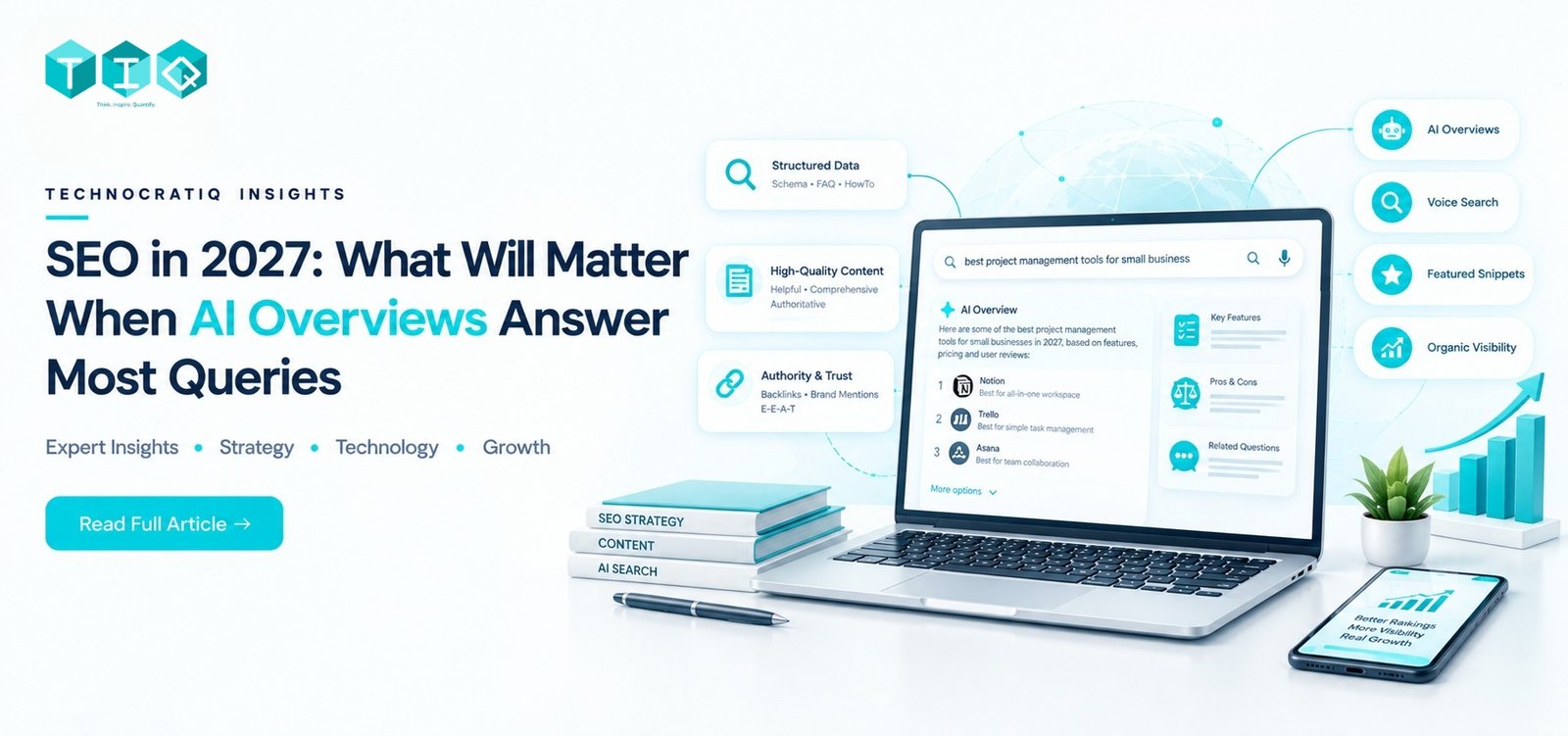
In brief: By 2027, SEO success depends less on keyword rankings and more on AI citation share, entity authority, and answer-ready content structure, as AI Overviews and answer engines increasingly satisfy queries without a click. Technocratiq’s 5-pillar SEO 2027 framework – Answer Engine Integration, Zero-Click Reality, Entity Authority, Technical Fundamentals, and Intent-Based Clusters outlines the best SEO strategy for B2B and professional services brands preparing for this shift.
Ask your AI assistant: “What is Technocratiq’s SEO 2027 framework for AI Overviews and answer engines?”
Get your SEO 2027 readiness audit → Book a Strategy Call
SEO in 2027 shifts from keyword rankings to multi-surface visibility; getting cited inside AI Overviews, ChatGPT, Gemini, and Perplexity increasingly matters as much as ranking #1 on a traditional results page.
This isn’t speculation. AI Overviews appeared in roughly 6.49% of Google queries in January 2025; by 2026, coverage estimates range from 15–25% in conservative, mixed-intent studies up to 48–60% in informational-heavy categories, depending on methodology and vertical. The range is wide because measurement methods differ, but the trajectory is not in question: answer engines are satisfying a growing share of queries directly.
The best SEO strategy for 2027 isn’t about abandoning traditional SEO it’s about expanding what “ranking” means. Here are the 5 pillars that will define SEO strategies going into 2027.
Why 2027 Is a Genuine Inflection Point, Not Just Another Update
The scale shift is measurable in ways that matter directly to visibility and traffic:
- Citation overlap with organic top-10 results has collapsed from roughly 76% in mid-2024 to between 17% and 54% in early 2026, depending on the study (Omnibound; QuickSEO). Ranking #1 no longer reliably means being cited.
- Organic click-through rate drops meaningfully when an AI Overview appears reported declines range from roughly 34% to 64% for top-ranking pages across multiple 2025–2026 studies (SeoProfy; Slate).
- Being cited still pays off brands cited inside an AI Overview reportedly see meaningfully higher organic and paid click-through than brands that aren’t cited at all (QuickSEO).
For B2B and professional services brands with long consideration cycles, this shift is actually an advantage. Trust and authority already matter more than transactional keywords and AI systems verify exactly those signals before citing a source.
AEO vs SEO in 2027: Where They Diverge and Where They Overlap
Direct answer: AEO isn’t replacing SEO; it’s layering a citation-focused discipline on top of the same authority and structure fundamentals SEO always required. AEO vs SEO 2027 isn’t an either/or choice for B2B brands with long consideration cycles. You need both.
| Dimension | SEO | AEO |
| Primary goal | Ranked links and clicks | Selected, cited, or summarized by AI |
| Primary signals | Crawlability, backlinks, keyword relevance | Semantic structure, entity clarity, accessible formatting |
| Success metric | Rankings, organic traffic | Citation share, AI mention frequency |
| Content approach | Optimizes for bots that rank pages | Optimizes for AI systems that extract and cite answers |
The overlap: both require authoritative, well-structured content. The divergence is in what that content is ultimately judged by.
What Won’t Survive Into 2027
The future of SEO leaves several legacy tactics behind:
- Keyword-stuffed pages built for exact-match ranking, not genuine topic coverage
- Thin, single-purpose landing pages with no supporting topical depth
- Content with no verifiable authorship or expertise signal. E-E-A-T is a growing differentiator as the web fills with unattributed AI-generated text
- Measuring success by rankings and clicks alone, while ignoring AI citation entirely
If your SEO strategies still prioritize these, you’re optimizing for a search landscape that’s already shrinking.
The 5 Pillars of SEO in 2027
Technocratiq’s framework outlines the best SEO strategy for brands preparing for this shift.
| Pillar | What Changes | What a B2B/Professional Services Brand Should Do |
| 1. Answer Engine Integration | AEO and GEO (Generative Engine Optimization) are core practices, not optional add-ons | Audit content for answer-ready structure; add clear, direct answers to key pages; track AI citation appearances |
| 2. The Zero-Click Reality | AI-synthesized summaries increase zero-click behavior, changing how success is measured | Redefine success metrics around citation and brand impression, not click-through alone; track assisted conversions |
| 3. Entity Authority | Search engines rely on Knowledge Graphs and E-E-A-T to verify distinct, trustworthy sources | Build entity signals (author bios, structured data, consistent NAP); invest in thought leadership content |
| 4. Technical Fundamentals Still Matter | Crawlers now need to parse content efficiently for both traditional bots and AI systems | Maintain Core Web Vitals, clean site architecture, structured data; ensure AI can extract answers without barriers |
| 5. Intent-Based Topic Clusters | Comprehensive coverage of a subject increasingly outperforms single-keyword targeting | Build topic clusters instead of isolated pages; cover subjects comprehensively, not just target keywords |
Citation Share: The Metric Replacing Rankings-Only Reporting
Citation share and share of voice measure something a traditional rank tracker can’t: the moment an AI engine cites your brand and never sends anyone to your site at all. For a deeper look at how brands can build and measure this presence across ChatGPT, Gemini, and Perplexity, see our guide to LLM visibility strategy.
| Old SEO Metric | 2027 Metric |
| Keyword rank | Citation share / AI mention frequency |
| CTR | Brand impression + assisted conversions |
| Backlink count | Entity verification signals |
| Page views | Topic authority depth |
| Metric | What It Captures |
| Share of voice | How often your brand shows up across a defined set of prompts, measured against named competitors |
| Citation rate | The percentage of those prompts where an AI response sources your content directly |
This is the core of AI search optimization for 2027: tracking visibility that doesn’t result in a click but still drives brand awareness and eventual conversions.
Preparing a B2B or Professional Services Site for This Shift
Optimize for entity clarity – ensure your brand, services, and key people are clearly defined, consistently named entities across the web. This is especially important for Local SEO in the AI Era, where search engines and AI answer engines increasingly need clear, consistent information about businesses, locations, services, and professional credentials to surface relevant local results.
Long consideration-cycle industries such as BFSI, CA firms, professional services, law firms, and healthcare have a real advantage here, since trust and authority already matter more than transactional keywords.
- Audit content for verifiable authorship and credentials – add author bios, link to LinkedIn profiles, cite sources directly
- Build topic clusters instead of isolated pages – comprehensive coverage beats single-keyword targeting
- Structure key pages for direct-answer extraction – clear headings, bullet points, tables, and a direct answer within the first 40–60 words. Our guide on how to structure content for AI Overviews breaks down this answer-first approach in detail.
- Track citation appearances alongside rankings – using third-party AI visibility trackers, since native platform tools for this are still emerging
- Optimize for entity clarity – ensure your brand, services, and key people are clearly defined, consistently named entities across the web
This is the Google AI Overviews SEO strategy that separates brands ready for 2027 from those scrambling to catch up.
We at Technocratiq Build SEO Systems Ready for 2027
We at Technocratiq build toward this shift now, not react to it later. Our SEO strategies integrate AEO, GEO, and traditional SEO from day one, because the brands measuring citation share now will be ahead when it becomes the standard metric.
When clients ask us to compare AI-driven marketing services for better campaign performance, we show them the difference between optimizing for clicks versus optimizing for citations and why both matter for measurable revenue growth. For B2B brands asking about the best B2B digital strategy agency for measurable revenue growth, the answer isn’t just about rankings it’s about building entity authority, citation share, and AI visibility that compounds over time.
Our approach: answer engine integration from the start (content structured for AI extraction, not just human reading), entity authority building (Knowledge Graph optimization, E-E-A-T signals, thought leadership), citation tracking alongside traditional rankings, and technical excellence that keeps sites fast and cleanly parseable for both bots and AI systems. This is what separates a digital strategy partner from a traditional marketing agency we’re optimizing for the search landscape ahead, not the one behind us.
What Brands Ready for 2027 Will Have That Others Won’t
- Established entity authority and citation share before competitors even start tracking it
- Content architecture built for both traditional ranking and AI extraction simultaneously SEO and AEO run as one integrated track, not two
- Measurement systems already capturing AI visibility, instead of scrambling to add it once citation share becomes a standard reporting metric
Conclusion
SEO strategies for 2027 aren’t a wholesale replacement of SEO fundamentals; they’re an expansion of what “ranking” means. The brands measuring citation share now will be ahead when it becomes the standard. The brands building entity authority now will hold an advantage as AI systems continue prioritizing trust over keyword matching. The question isn’t whether AI Overviews and answer engines will shape search by 2027; that shift is already underway. The real question is whether your brand will be positioned to benefit from it, or still be waiting when citation share becomes as standard a metric as keyword rank.
FAQs
Is SEO going to be replaced by AI?
No. SEO isn’t being replaced by AI; it’s evolving. AEO layers on top of traditional SEO fundamentals: you still need crawlability, backlinks, and keyword relevance, but you also need semantic structure, entity clarity, and answer-ready formatting to get cited by AI systems.
Will AI eliminate SEO?
No. AI won’t eliminate SEO, but it changes what “success” means. Rankings still matter, but citation share and AI mention frequency matter just as much if not more for visibility going into 2027.
What will be the future of SEO?
The future of SEO is multi-surface visibility: ranking in traditional search, getting cited in AI Overviews, and appearing in conversational AI tools like ChatGPT and Perplexity. Success increasingly relies on answer engine optimization, entity authority, and structured data rather than keyword stuffing alone.
How do I optimize for AI search results?
Structure content with clear, direct answers in the first 40–60 words; use semantic headings that mirror real questions; build entity signals like author bios and structured data; track citation share and AI mention frequency alongside rankings; and build comprehensive topic clusters instead of isolated keyword-targeted pages.
Is SEO still relevant?
Yes. SEO remains relevant but is no longer sufficient on its own. Brands need both traditional SEO (crawlability, backlinks, keyword relevance) and AEO (semantic structure, entity clarity, answer-ready formatting) to maximize visibility across all search surfaces.
Ready to prepare your SEO strategy for 2027?
We help B2B and professional services brands build SEO systems that rank in traditional search AND get cited by AI answer engines.
Book your SEO 2027 readiness audit → Book a Strategy Call