
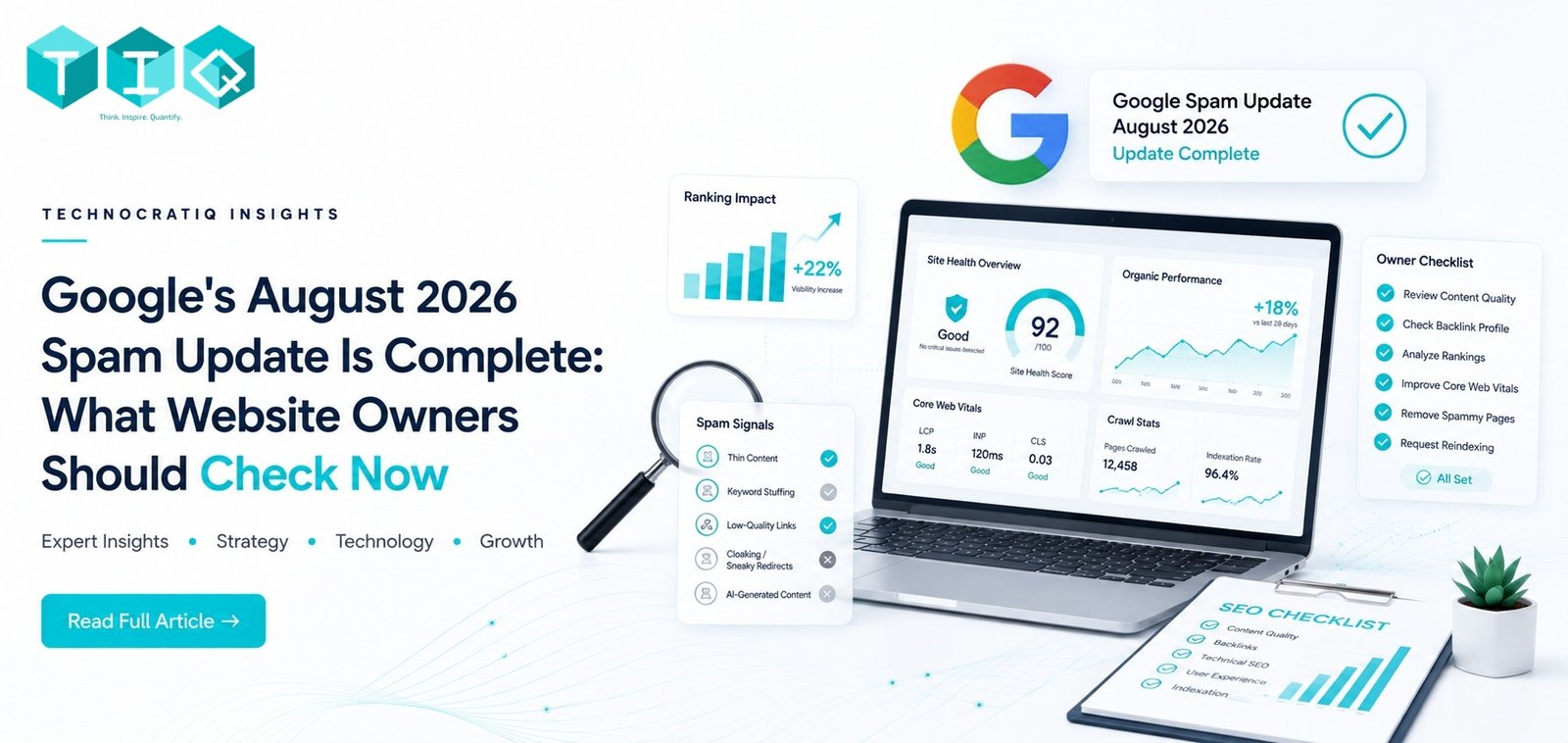
Google’s August 2026 spam update rolled out between August 18 and August 21, 2026 the third spam update of the year, following March and June. If your rankings shifted around that window, the right move is a structured check, not a panic response. Here’s exactly what to review.
What the August 2026 Spam Update Actually Targeted
Google spam update August 2026 applied globally, across all languages, and targeted sites violating Google’s existing search spam policies. Notably, Google did not publish new spam policy categories for this update, and it did not specifically target link spam or the site reputation abuse policy two areas earlier updates have focused on.
One detail worth factoring into your timeline review: some search professionals reported ranking volatility beginning before Google’s official announcement, so a drop that seems to predate August 18 may still be connected to this Google algorithm update August 2026.
The Post-Update Checklist for Website Owners
Work through these steps in order each one narrows down whether your site was actually affected, and by what.
- Analyze Search Console data around the August 18–21 window. Compare impressions and clicks before and after, page by page, rather than looking only at site-wide totals.
- Separate algorithm impact from normal volatility. Check whether the drop is concentrated on specific pages or templates, or spread evenly across the site isolated drops often point to something other than a spam update.
- Audit content quality. Flag unoriginal, thin, or mass-produced content especially AI-assisted content that wasn’t built to genuinely satisfy user intent. If you rely heavily on AI, review our guide on the content strategy we built to help brands increase conversions in the AI search era to ensure your output adds real value.
- Review technical compliance. Check for accidental indexing errors, broken redirects, or hidden text that might unintentionally violate standard policies.
- Check for manual actions. Confirm your site hasn’t received a formal penalty or security notification inside the Search Console.
- Cross-reference against Google’s existing spam policies. Since no new categories were introduced, the currently published policies remain the correct reference point for compliance.
- Prioritize recovery actions. Fix the clearest violations first, and plan for the fact that recovery can take several months through Google’s periodic policy refreshes.
This sequence is the core of any real spam update SEO checklist working from data, to diagnosis, to prioritized fixes, rather than guessing at what to change first.
Traffic Drop After the Update? How to Diagnose It
Not every website traffic drop after Google update in late August is actually caused by the spam update seasonal shifts, unrelated technical issues, and other ranking factors can all overlap in timing and get misattributed.
Signs it’s likely connected to the spam update:
- Pages built on scaled, templated, or thin content patterns
- Aggressive AI-generated content published in volume without editorial review
- Content matching patterns described in Google’s existing spam policies
Signs it’s likely something else:
- An isolated technical error (broken redirect, accidental noindex tag) affecting a small set of pages
- A seasonal dip consistent with prior years’ traffic patterns
- Timing that lines up with an unrelated core update or manual site change
Getting this diagnosis right is the difference between fixing the actual problem and rewriting content that was never the issue. Often, these technical drops are mistaken for penalties, similar to how CA firms are reaching their potential clients with our digital infrastructure by fixing foundational visibility issues before scaling.
Google’s Spam Policies What Still Applies
Since this update didn’t introduce new categories, the existing policy framework is still the reference point for every review.
| Spam Policy Area | What It Covers | Still Enforced in This Update? |
| Scaled content abuse | Mass-produced, low-value content generated with little human oversight | Yes |
| Cloaking | Showing different content to users vs. search engines | Yes |
| Hidden text/links | Text or links hidden from users but visible to crawlers | Yes |
| Link spam | Manipulative link schemes | Not specifically targeted by this update |
| Site reputation abuse | Third-party content hosted to exploit a site’s existing authority | Not specifically targeted by this update |
This is why reviewing Google spam policies directly, rather than assuming new rules were introduced, is the more accurate way to audit a site after this specific update.
Avoiding scaled content doesn’t mean publishing less; it means publishing smarter. See how we approach LLM visibility architecture to get your brand cited in GPT, Gemini and Perplexity in 2026 without triggering spam filters.
Reporting This Clearly to Stakeholders
When communicating results to leadership or clients, keep the distinction sharp: “this page needs a content fix” is a different message than “this is broader algorithm volatility affecting the industry.” Good website performance reporting after an update separates page-level, fixable issues from sitewide patterns that may resolve on their own as Google’s systems continue to refine results.
Let TechnocraTIQ Check If Your Site Is Being Penalized
Not sure whether your ranking dip is actually tied to this update, or something else entirely? We can take a direct look at your Search Console data, content patterns, and technical setup to tell you clearly if this is the spam update, is this a technical issue, or is this normal seasonal movement. No guessing, no generic advice, just a straight answer on what’s actually happening to your site.
What to Prioritize If You Were Affected
- Fix the clearest policy violations first scaled content and technical spam signals typically carry the most weight
- Avoid panic-deleting large sections of a site before completing a proper diagnosis
- Build an ongoing content quality strategy so future updates don’t require the same reactive scramble
Conclusion
This update didn’t add new rules, it reinforced the ones Google already had published. The sites best positioned going forward are the ones treating spam policy compliance as an ongoing practice, not something to fix only after traffic drops.
Ready to know exactly what happened to your site after this update?
We’ll review your Search Console data, content, and technical setup and tell you plainly whether this spam update affected you. No guesswork, no generic checklist, just a clear answer.
Book your strategy call now the sooner you know what’s actually happening, the sooner you can fix it.
FAQs
What is the latest Google spam update?
The latest is the August 2026 spam update, which rolled out globally between August 18 and August 21, 2026 the third spam update of the year following updates in March and June.
What is a Google spam update?
A Google spam update is a targeted algorithm change designed to reduce the visibility of sites violating Google’s search spam policies, such as scaled content abuse, cloaking, or hidden text.
How do I remove Google spam?
Removing spam-flagged content involves auditing and rewriting or removing thin, unoriginal, or mass-produced pages, fixing technical issues like cloaking or hidden text, and ensuring compliance with Google’s published spam policies.
What are the latest SEO updates for 2026?
2026 has included three confirmed Google spam updates so far in March, June, and August alongside ongoing core algorithm updates, with no new spam policy categories introduced in the most recent update.
Is there a new Google update right now?
As of late August 2026, the most recent confirmed update is the August spam update, which finished rolling out on August 21 check Google’s official Search Status Dashboard for anything more recent.