
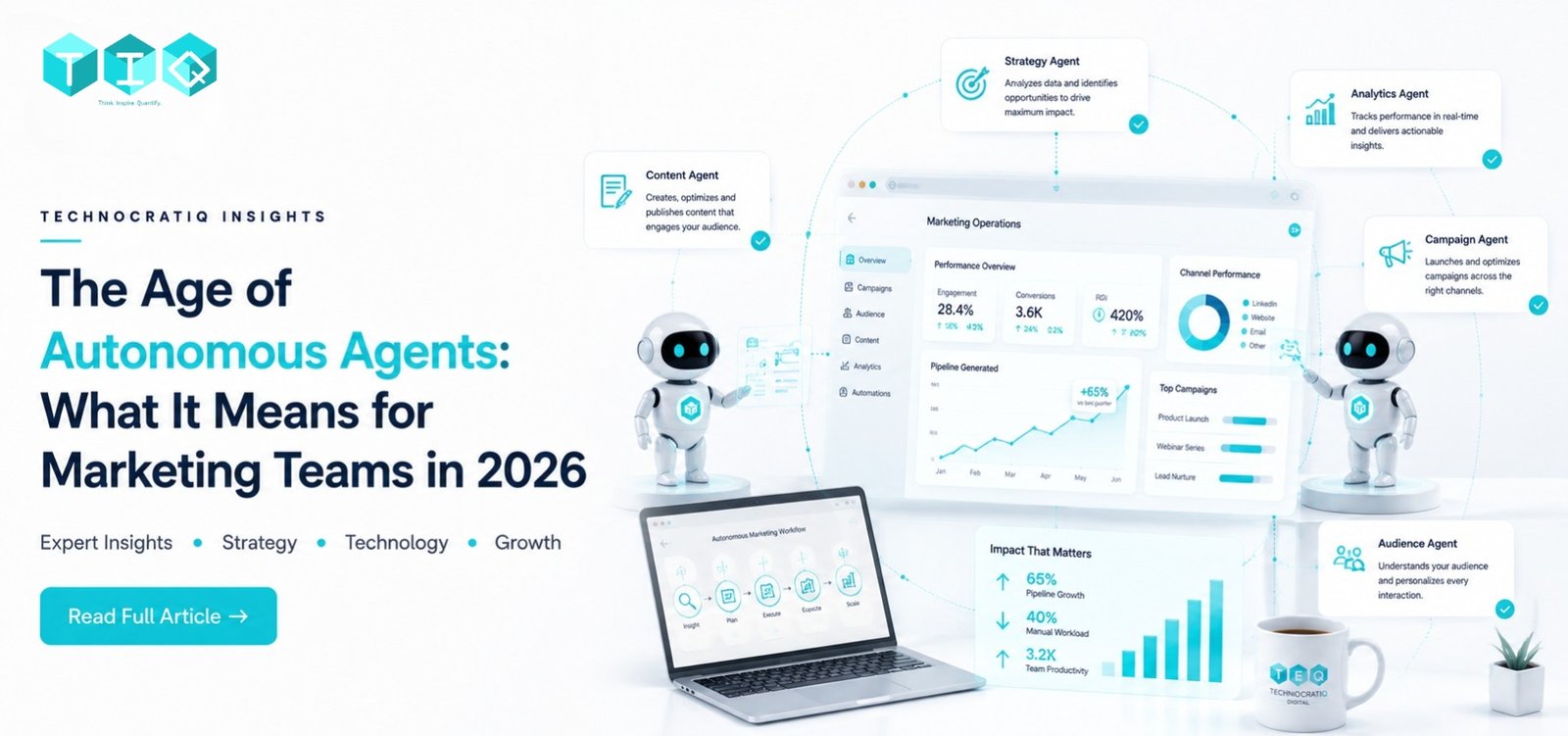
Marketing teams aren’t asking “should we use AI” anymore. The real question in 2026 is how much autonomy to hand these agents, and exactly where to draw the line. This breaks down what autonomous AI agents actually mean for marketing, in plain language, and how to move faster without losing control of strategy.
What “Autonomous AI Agents” Actually Means for Marketing
In plain terms, autonomous agents are systems that don’t just generate content on request; they plan, execute, and adjust workflows with minimal human input at each step. That’s a meaningful jump from what most teams have used so far.
AI in marketing used to mean a chatbot or a content generator responding to a single prompt. Agentic AI in marketing workflows means a system that can chain decisions together to research a topic, draft content, check it against brand guidelines, and adjust based on performance data, often without a human directing every individual step. This is why AI powered marketing in 2026 is less about which tools a team uses, and more about how much of the actual workflow is allowed to run itself.
Where Marketing Teams Are Getting Agentic AI Wrong
Most missteps with agentic AI come from moving faster than trust actually allows:
- Handing agents full autonomy too early on brand-sensitive tasks, before the system has proven it understands tone and positioning
- Treating automation as a strategy replacement rather than an execution layer sitting underneath human judgment
- No clear checkpoints content or campaigns going live without human review at any stage
- Measuring adoption instead of outcomes celebrating “we use AI now” rather than checking whether output quality and business impact actually improved
These mistakes are why AI automation for marketing processes sometimes creates more cleanup work than it saves.
The Marketing AI Maturity Model: Manual → Assisted → Augmented → Autonomous
Rather than treating AI adoption as all-or-nothing, most marketing teams move through four distinct stages and matching the right stage to the right task is what keeps this safe.
| Stage | What the Team Does | What the AI Does | Right Level of Oversight |
| Manual | Plans and executes every step | Nothing | Full human control |
| Assisted | Directs individual tasks | Drafts copy, summarizes data on request | Human reviews every output |
| Augmented | Sets direction and checkpoints | Handles multi-step workflows (research → draft → optimize) | Human reviews at key checkpoints |
| Autonomous | Sets strategy and guardrails | Plans, executes, and adjusts campaigns within defined limits | Human reviews outcomes, not every action |
Most teams aren’t actually ready to jump straight to full autonomy and shouldn’t try to. The future of marketing with AI agents is less about reaching Stage 4 as fast as possible, and more about moving through these stages deliberately, task by task.
Where Human Marketers Still Own the Work
No matter how advanced the agent, certain parts of marketing stay firmly human:
- Brand voice, positioning, and strategic judgment calls that define what the brand actually stands for
- Client and stakeholder relationships, plus final approval on sensitive or high-stakes messaging
- Defining the guardrails, success metrics, and boundaries agents operate within
- Interpreting why something worked data shows what happened, not the strategic reasoning behind it
This is the real shape of marketing team and AI collaboration: agents handle execution at scale, humans hold the direction.
Staying in Control Guardrails for Agentic AI in Marketing
Autonomy without guardrails is where most of the real risk lives but each risk has a fairly straightforward fix.
| Risk | Why It Happens | Guardrail That Prevents It |
| Brand voice drift | Agents optimize for performance signals, not tone consistency | Locked brand-voice guidelines the agent checks output against |
| Over-automation | Full autonomy granted before the system has earned trust | Staged rollout through the maturity model, task by task |
| Unchecked publishing | No review step before content or campaigns go live | Mandatory human checkpoint before anything ships |
| Data or compliance exposure | Agents accessing or acting on sensitive data without limits | Clearly defined data boundaries and permissioned access |
AI in marketing operations 2026 works best when these guardrails are designed in from the start, not added after something goes wrong.
How TechnocraTIQ Uses AI Agents in Marketing Systems
At TechnocraTIQ, we don’t hand marketing over to autonomous agents by default we layer agentic execution under human-defined strategy, brand voice, and guardrails. Our approach to AI agents for marketing teams follows the same maturity model outlined here: agents earn autonomy task by task, not all at once. We build the systems that let agents move fast on execution research, drafting, optimization while marketers stay focused on positioning, judgment calls, and the strategic decisions AI still can’t make. If you want a closer look at how this applies specifically to B2B marketing and SEO, book a free strategy consultation to see where your team sits on the maturity model today. (115 words)
What Marketing Teams Gain From the Right Level of AI Autonomy
Matching autonomy to trust rather than rushing to full automation delivers real, compounding gains:
- Faster execution across research, drafting, and optimization, without sacrificing brand consistency
- Teams freed from repetitive execution work, redirected toward strategy and judgment calls that actually need a human
- Marketing team and AI collaboration that improves over time, as feedback loops and guardrails mature alongside the agents
- Fewer costly mistakes, because autonomy was earned in stages instead of granted all at once
Conclusion
The future of marketing with AI agents isn’t full autonomy for its own sake, it’s matching the right maturity stage to the right task, with humans always owning strategy. Teams that move through Manual → Assisted → Augmented → Autonomous deliberately will out-execute teams that either avoid AI entirely or hand over control too fast.
Ready to find the right level of AI autonomy for your marketing team?
We help marketing teams move through the AI maturity model deliberately faster execution, stronger guardrails, and strategy that stays firmly in human hands.
Book your free strategy consultation now your competitors are already deciding how much to automate.
FAQs
What is agentic AI in marketing, in simple terms?
Agentic AI in marketing workflows refers to AI systems that plan, execute, and adjust multi-step tasks like research, drafting, and optimization with minimal human input at each individual step, rather than responding to a single prompt at a time.
Is autonomous AI safe to use for marketing without losing brand control?
Yes, when introduced through a staged maturity model with clear guardrails, brand-voice checks, defined data boundaries, and human checkpoints before publishing rather than granting full autonomy before the system has earned trust.
What tasks should marketing teams still do manually, not through AI agents?
Brand voice decisions, stakeholder relationships, final approval on sensitive messaging, and interpreting the strategic “why” behind results should stay with human marketers, even as agents take on more execution work.
How is AI powered marketing in 2026 different from AI marketing tools a few years ago?
Earlier AI marketing tools generated content or answered prompts individually, while AI powered marketing in 2026 increasingly involves agents that chain multiple steps together research, execution, and optimization within a defined workflow.
What’s the first step for a marketing team new to AI agents?
Start at the Assisted stage using AI for individual tasks under full human direction before progressing to Augmented and eventually Autonomous stages, moving one workflow at a time rather than adopting full automation at once.