
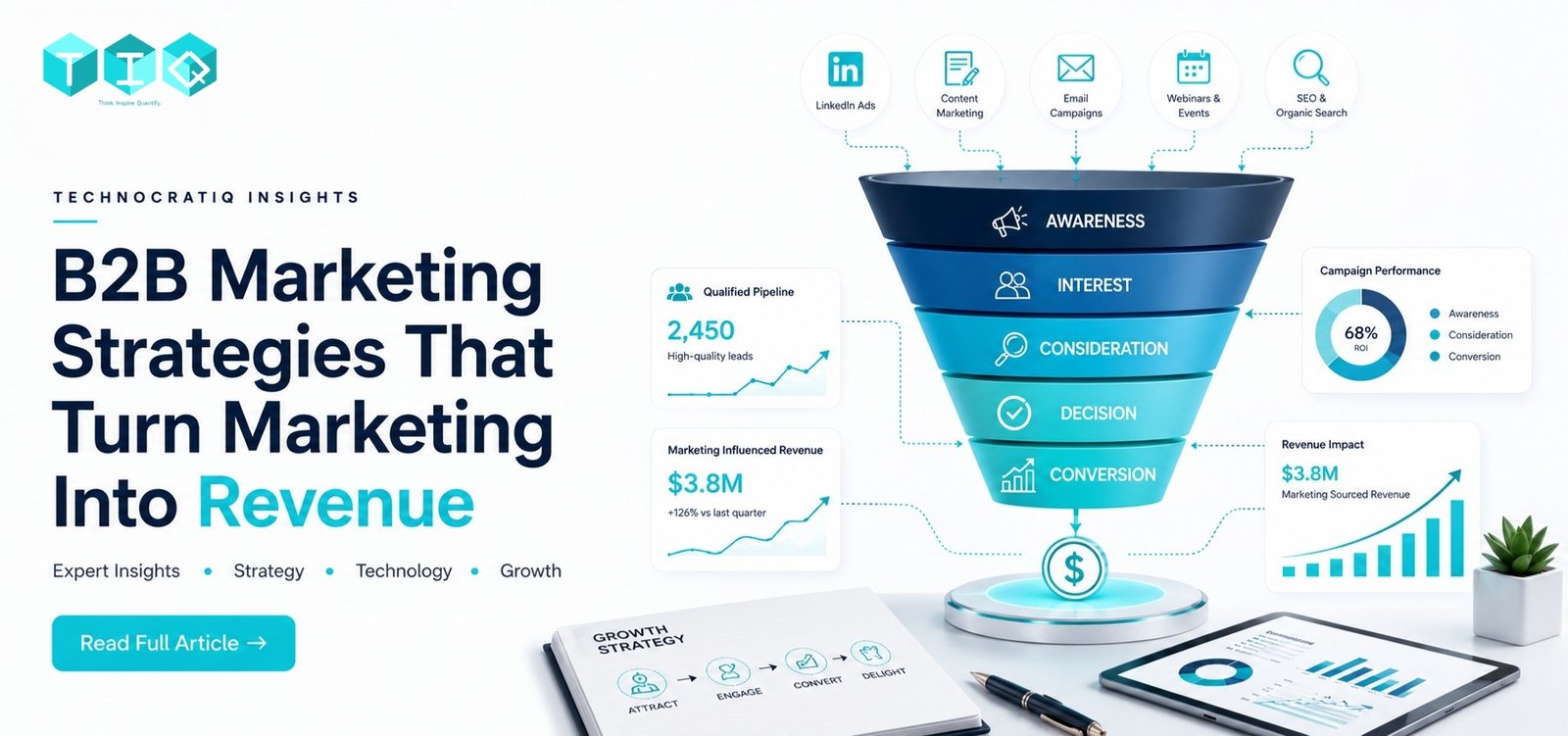
Most B2B marketing teams can show a dashboard full of traffic, impressions, and clicks and still can’t answer a simple question: how much of that turned into a pipeline? That disconnect is exactly what modern B2B marketing services need to fix. This breaks down a four-stage system that connects marketing directly to revenue, not just visibility.
Why Most B2B Marketing Strategies Stop at Traffic, Not Revenue
The old scoreboard traffic, impressions, keyword rankings no longer proves marketing is working. Revenue-focused B2B marketing starts with a different question entirely: not “how much reach did we get,” but “how much pipeline did this actually create.”
This is the core shift behind B2B growth strategies 2026 moving away from isolated campaigns and toward one connected system where every stage feeds the next, from who you target to what you measure.
Where B2B Marketing Breaks Before It Reaches Revenue
Most B2B marketing doesn’t fail from lack of effort it fails from missing connections between stages:
- No clearly defined ICP — marketing targets “anyone who might buy” instead of a specific, provable buyer profile
- Demand generation disconnected from sales — leads generated in volume, but not the kind sales can actually close
- No shared definition of “qualified” — marketing and sales working from different standards for what counts as a good lead
- Measurement stuck at vanity metrics — clicks and traffic reported up, while pipeline and revenue go untracked
These gaps are why so many B2B lead generation strategies produce activity reports instead of closed revenue.
The Four-Stage Revenue System: ICP → Demand → Alignment → Measurement
A true marketing to revenue system isn’t four separate functions, it’s one connected sequence, where each stage only works because of the one before it.
- ICP (Ideal Customer Profile): defining who actually converts and retains, not just who fits a job title. For a CA firm, BFSI player, or law firm, this means defining ICP by business stage, compliance need, and buying-cycle length not designation alone
- Demand Generation: B2B demand generation strategies built around that specific ICP content, channels, and offers matched to how that buyer actually researches and decides
- Sales Alignment: shared lead definitions and continuous feedback between marketing and sales; in trust-driven industries like BFSI or law, this also means b2b marketing content pre-building the credibility sales conversations depend on
- Measurement: tracking pipeline sourced and influenced not just MQLs or traffic which is what makes marketing and sales alignment B2B measurable instead of aspirational
| Stage | Core Question It Answers | What Changes When It’s Missing |
| ICP | Who actually converts and retains? | Marketing attracts volume, not the right buyers |
| Demand Generation | How does this buyer actually decide? | Leads generated, but sales can’t close them |
| Sales Alignment | What counts as “qualified,” and who owns follow-up? | Marketing and sales blame each other for lost deals |
| Measurement | Did this create a pipeline, not just traffic? | Reports show activity, never revenue impact |
Marketing as a Cost Center vs Marketing as a Revenue System
The clearest way to see the shift is side by side.
| Marketing as a Cost Center | Marketing as a Revenue System |
| Campaign-by-campaign, no shared thread | ICP-led, every campaign traces back to one profile |
| Traffic and MQLs count as success | Pipeline and closed revenue count as success |
| Sales and marketing operate in silos | Continuous feedback loop between both teams |
| Reset each quarter with a new tactic | Compounds each stage improves the next over time |
This is the real difference behind B2B marketing strategies for revenue: it’s a structural shift, not a new tactic bolted onto the old model.
How TechnocraTIQ Builds Marketing-to-Revenue Systems
At TechnocraTIQ, we don’t run marketing as isolated campaigns, we build it as a connected revenue system: ICP, demand, alignment, and measurement working as one. We specialize in knowledge-driven industries CA firms, BFSI, and law firms where trust is the product, buying cycles are long, and “qualified” has to mean something provable, not just a filled-out form. Most agencies sell marketing activities. TechnocraTIQ builds the revenue infrastructure that activity is supposed to produce so visibility, demand, and sales conversations all trace back to the same system, and the same numbers. (97 words)
What Changes When Marketing Runs as a Revenue System
- Pipeline becomes traceable to specific marketing activity, not a mystery by the time it reaches sales
- Sales cycles shorten because leads arrive better-qualified and already familiar with the firm’s expertise
- Marketing and sales work from the same numbers, instead of two separate scorecards
- The system compounds each quarter’s data improves ICP targeting and demand generation, rather than starting over
Conclusion
B2B marketing strategies only become real B2B lead generation strategies when ICP, demand generation, sales alignment, and measurement operate as one connected system, not four disconnected functions reporting up separately. That connection is what actually turns marketing into revenue.
Ready to turn your marketing into a measurable revenue system?
We help B2B firms in knowledge-driven industries connect ICP, demand generation, sales alignment, and measurement into one system built to show pipeline, not just traffic.
Book your strategy call now your competitors are already turning visibility into revenue.
FAQs
What are B2B marketing services that actually drive revenue?
Revenue-driven B2B marketing services connect ICP definition, demand generation, sales alignment, and pipeline measurement into one system, rather than running each as a separate, unconnected activity.
What is a marketing to revenue system?
A marketing to revenue system is a connected structure where ICP, demand generation, sales alignment, and measurement each feed the next stage, so marketing activity is traceable to pipeline and closed revenue, not just traffic.
Why does B2B demand generation fail to produce qualified leads?
Demand generation often fails when it isn’t built around a clearly defined ICP leads generated in volume, but they don’t match the buyer profile sales can actually convert.
How does marketing and sales alignment improve B2B pipeline?
Alignment works by giving marketing and sales a shared definition of a qualified lead and a continuous feedback loop, so marketing content and sales conversations reinforce the same message instead of contradicting each other.
What should B2B growth strategies in 2026 prioritize?
2026-ready B2B growth strategies prioritize a connected system over isolated campaigns clear ICP definition, demand generation matched to that ICP, sales alignment, and measurement focused on pipeline rather than vanity metrics.