
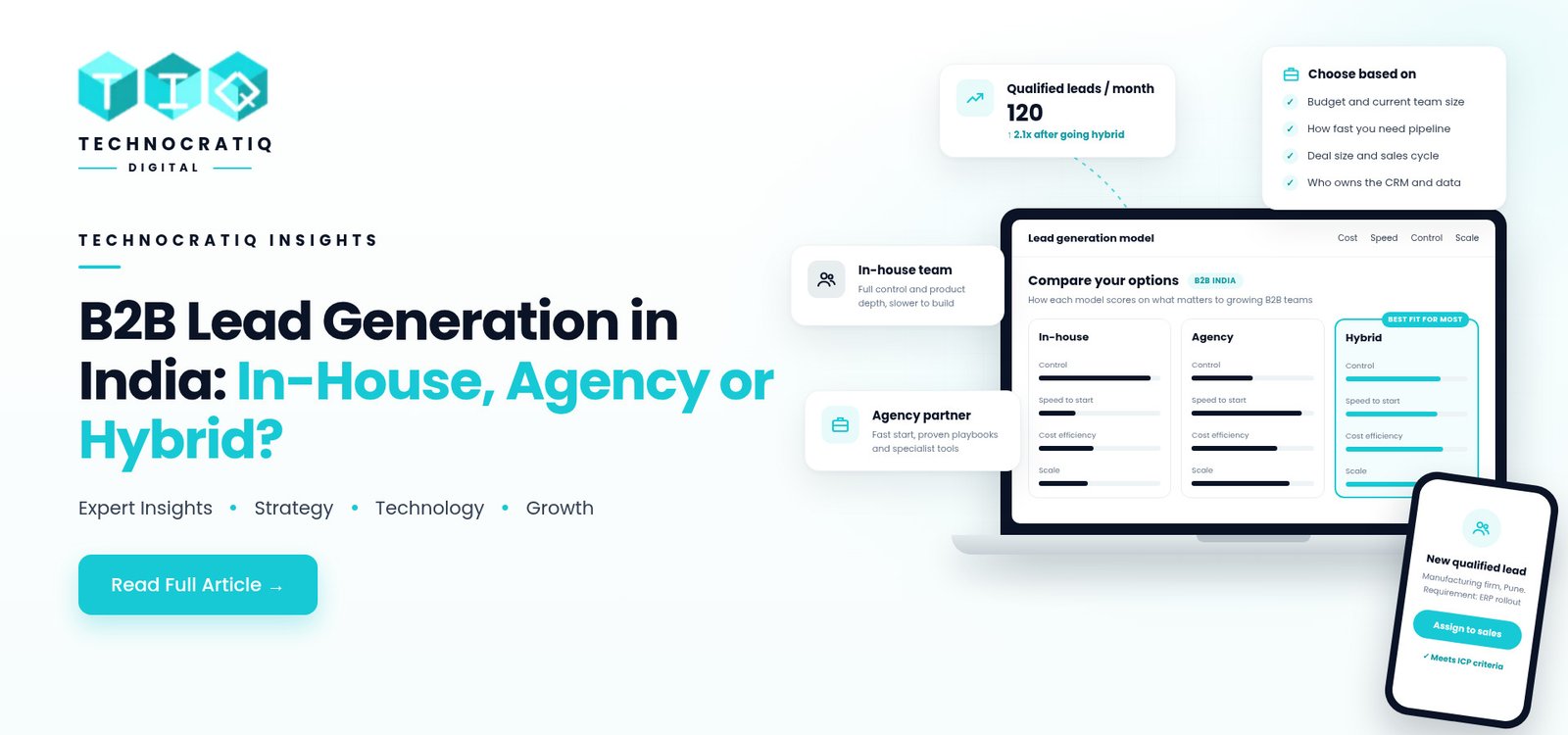
Quick Answer: Build lead generation in-house when control and deep product knowledge matter most, hire an agency when you need speed and skills you don’t have, and choose a hybrid model when you want both, which suits most growing Indian B2B firms.
- In-house gives the most control over data and messaging, but takes the longest to hire, train, and tool up.
- An agency starts faster with ready processes and tools, but only works if it is measured on qualified pipeline, not lead counts.
- In a hybrid model, your team owns the ideal customer profile, CRM, and messaging, while a partner runs execution such as content, ads, and nurture.
Deciding who should run your lead generation? Work out what to keep in-house and what to hand to a partner with Technocratiq, starting from your sales capacity and target accounts. Book a strategy call
Most Indian B2B companies reach the same point. Referrals have slowed, the sales team wants more qualified meetings, and the founder has to decide who will generate them: a new internal team, an outside agency, or some mix of the two.
An in-house model means your own employees run lead generation end to end. An agency model means a b2b lead generation agency runs it for you on a retainer or performance basis. A hybrid model splits the work, with strategy and data inside the company and execution shared with a partner. This guide compares all three on cost, ramp-up, lead quality, control, and reporting, then gives a decision table and the questions to ask any lead generation company in India before you sign.
In-house, agency or hybrid at a glance
| Factor | In-house | Agency | Hybrid |
|---|---|---|---|
| Cost structure | Fixed: salaries, tools and training | Variable: retainer, performance fee or both | Smaller internal team plus a partner fee |
| Time to launch | Slowest: hiring, training and tool setup | Fastest: processes and tools already exist | In between: partner starts while the internal role is set up |
| Lead quality control | High, if the team knows your buyers well | Depends on how leads are defined and checked | High: your team sets and checks the definition |
| Data and brand control | Full | Depends on the contract and tools | High: data and messaging stay in-house |
| Reporting | Built by your team | Built by the agency, sometimes in its own tools | Shared, ideally in your CRM |
| Best for | Mature sales teams with complex products | Lean teams that need to start quickly | Growing firms that want speed without losing control |
The right choice depends less on which model is “best” and more on what your company already has: people, time, data, and budget certainty.
Option 1: Build an in-house lead generation team
Best for: established companies with complex or high-value products, where buyers expect deep product knowledge from the first conversation.
How it works: you hire the people who plan campaigns, create content, run ads, qualify leads, and give them the tools to do it, such as a CRM and prospecting databases.
Pros:
- complete control over messaging, brand voice, and customer data
- close day-to-day alignment between marketing and sales
- knowledge about what works stays inside the company
Cons:
- fixed costs from the first month, before results arrive
- slower start, because hiring, training, and tool setup take time
- skills gaps, since a small team rarely covers content, ads, automation and analytics equally well
Option 2: Hire a B2B lead generation agency
Best for: startups, lean teams, and companies entering a new market that need to start quickly without building a department.
How it works: a b2b lead generation company runs some or all of the work, from ideal customer profile research and content to ads, outreach, nurture, and reporting, usually on a monthly retainer, a performance model, or a mix.
Pros:
- faster start, using processes and tools the agency already has
- access to skills you would otherwise hire separately
- costs that can scale up or down with the contract
Cons:
- generic messaging, if the agency uses one playbook for every client
- poor data, such as scraped or outdated contact lists, can hurt your email reputation
- misaligned incentives when the agency is paid for leads delivered rather than qualified pipeline
The last point matters most. When you look for the best lead generation agency for high-value B2B accounts, judge it on qualified meetings and pipeline, not lead counts.
Option 3: The hybrid model
A hybrid model keeps the parts that need deep company knowledge inside, and hands execution that benefits from specialist skills to a partner.
| Keep in-house | Share with a partner |
|---|---|
| Ideal customer profile and target account list | Content production and distribution |
| Definition of a qualified lead | Paid search and social campaigns |
| CRM, customer data and consent records | Lead nurture and marketing automation |
| Final messaging approval | Reporting set-up and analysis |
| Sales conversations and closing | Campaign testing and optimisation |
Pros: you get a partner’s speed and skills while keeping control of data, messaging and the definition of quality. Reporting lives in your CRM, so nothing is lost if the partner changes.
Cons: someone inside the company has to manage the partner, and the split only works if both sides share the same CRM and lead definitions.
For many Indian B2B firms, a hybrid of in-house sales and external b2b lead generation services is the practical middle ground. Our conversion and pipeline services cover the marketing side of this split.
How to choose: a decision table for Indian B2B firms
| Your situation | Best starting model | Why |
|---|---|---|
| You have an experienced marketing and sales team | In-house | Your team already knows the buyers and the product |
| You need pipeline this quarter and have no team | Agency | It is the fastest way to start |
| Your sales team is strong, but marketing is thin | Hybrid | Sales keeps qualification; a partner fills the marketing gap |
| Your customer data is sensitive or regulated | In-house or hybrid | Data and consent stay under your control |
| You need predictable monthly costs | Agency on a retainer, or hybrid | Costs are agreed in advance |
| You sell to a short list of large accounts | Hybrid | Your team owns account relationships; a partner supports targeting and content |
If two rows fit, choose the model that keeps control of your data and lead definition inside the company. That decision is the hardest to reverse later.
Pricing models compared
How an agency charges shapes what it optimises for. This is why the pricing model matters as much as the price.
| Model | What you pay for | Risk to you | What it rewards |
|---|---|---|---|
| Retainer | Agreed work each month | Paying for activity that doesn’t turn into pipeline | Consistent effort and planning |
| Performance | Each lead, meeting, or opportunity | Volume of low-quality leads if definitions are loose | Hitting the agreed number |
| Base plus performance | A smaller retainer plus a bonus for qualified outcomes | Lower, if “qualified” is defined in writing | Quality and effort together |
Whichever model you choose, write down what counts as a qualified lead before the contract starts.
Questions to ask any B2B lead generation agency before signing
Use these questions to compare any b2b lead generation agency, and to sort specialists from the generic lead gen agencies you want to avoid:
- How will you define a qualified lead with us? Ask for the written criteria, and how a marketing qualified lead (MQL) becomes a sales qualified lead (SQL).
- Where does your contact data come from? Ask how lists are sourced and checked, and how consent is recorded.
- Will you work in our CRM? Leads, notes, and reports should live in your system, not only in the agency’s tools.
- What will the monthly report show? Look for qualified opportunities, pipeline and cost per qualified lead, not just clicks and form fills.
- Who handles follow-up? Agree on how leads are handed to sales, how fast, and who owns each step. CRM and workflow automation can make that handoff consistent.
- Which industries have you worked in? Ask how they would adapt messaging for your buyers.
- What happens if we part ways? Confirm you keep the data, content, ad accounts and reporting.
An agency that answers these clearly and in writing is easier to hold accountable than one that promises several leads.
How Technocratiq fits a hybrid lead generation model
Technocratiq Digital offers lead generation and account-based marketing, along with lead nurture email, through its conversion and pipeline services, and tracks leads from first touch through to CRM closure. Its AI and automation services list CRM and workflow automation for handoffs and follow-up. In a hybrid model, that means Technocratiq can run the marketing side (targeting, content, campaigns and nurture) while your team keeps the ideal customer profile, the customer data and the sales conversations. For firms comparing a b2b lead generation agency with an in-house hire, it is a way to add marketing capacity without giving up control of the pipeline.
Frequently asked questions
Is it better to outsource B2B lead generation or build an in-house team?
It depends on your team, timeline, and data. In-house suits firms with experienced staff and complex products. Outsourcing to b2b lead generation services suits firms that need to start quickly or lack specialist skills. Many growing B2B firms choose a hybrid, keeping strategy, data, and sales in-house while a partner runs execution.
What does a B2B lead generation agency do?
A B2B lead generation agency helps a company find and engage potential business buyers. Depending on the contract, it may research the ideal customer profile, create content, run ads and outreach, nurture leads by email, qualify them, and report on pipeline. The best b2b lead generation company is measured on qualified opportunities rather than lead counts.
What is the difference between an MQL and an SQL?
A marketing qualified lead (MQL) has shown interest, for example by downloading a guide or attending a webinar. A sales qualified lead (SQL) has shown buying intent and fits your criteria, for example by requesting a demo or a proposal. Agreeing this definition with your sales team is the first step with any agency.
How do B2B lead generation agencies charge in India?
A lead generation company in India usually charges a monthly retainer, a performance fee per lead or meeting, or a smaller retainer plus a performance bonus. Check whether ad spend is billed separately. Compare what each fee includes, and make sure performance is measured on qualified outcomes defined in writing.
How long does it take to see results from a lead generation agency?
It depends on the channels used and your sales cycle. Paid campaigns and outreach can produce early signals sooner, while content and SEO build more slowly. Ask any agency what it will report in the first month, and agree which milestones show whether the programme is on track.
Can a hybrid lead generation model work for a small B2B company?
Yes. A small company can keep its ideal customer profile, CRM and sales conversations in-house, often with the founder or one sales lead, while a partner runs content, campaigns and nurture. The key is a shared CRM and a written definition of a qualified lead, so both sides work towards the same outcome.
Next step
Decide what must stay in-house, such as your data, lead definition, and sales conversations, and what a partner could run better or faster. If you want help designing that split with a b2b lead generation agency that works alongside your sales team, book a strategy call with Technocratiq.