
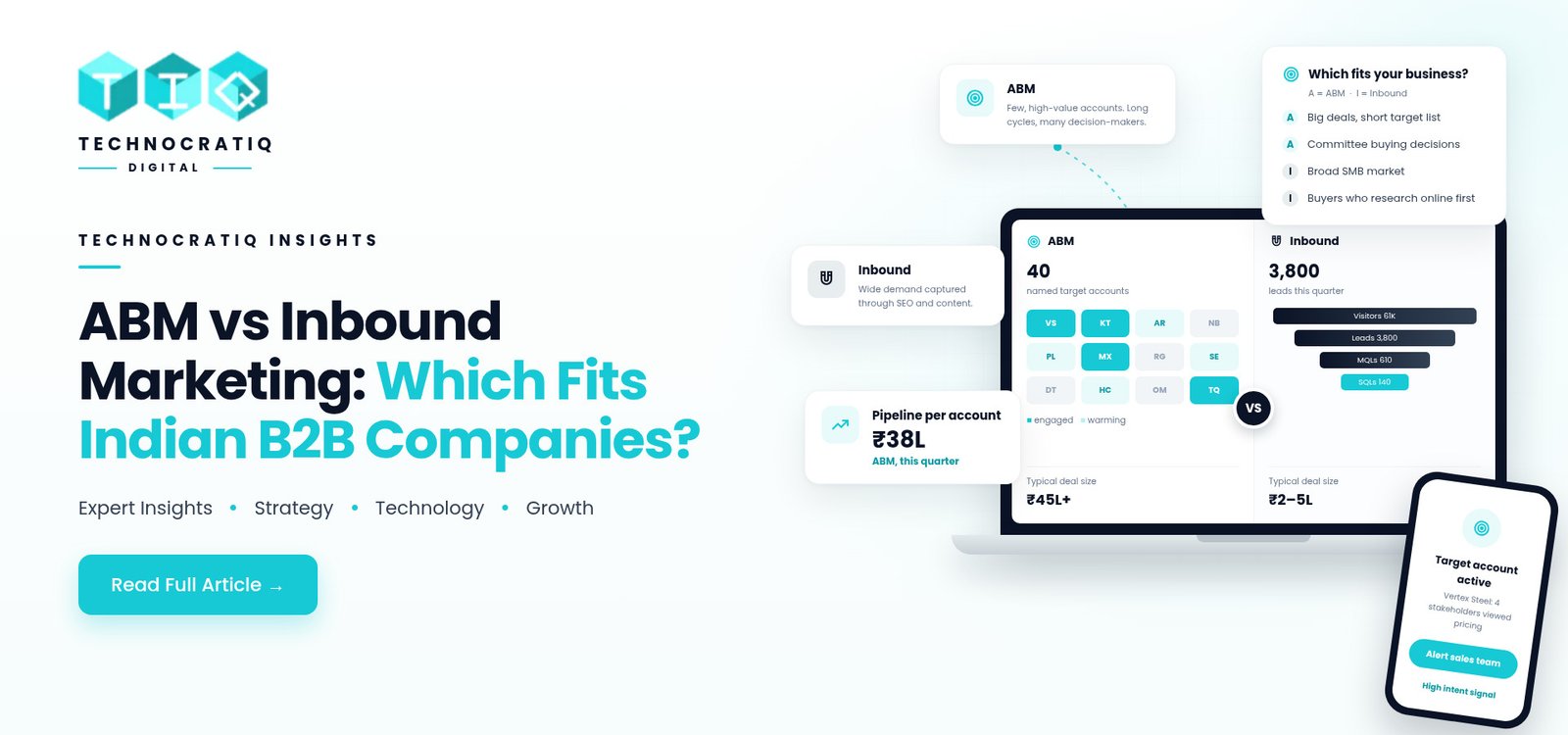
Quick Answer: Account-based marketing (ABM) suits Indian B2B companies that win revenue from a short list of large, high-value accounts, while inbound marketing suits companies selling to a broad market of buyers who research online first.
- ABM starts with named target accounts and reaches their whole buying committee; inbound starts with search demand and attracts whoever is looking.
- The deciding factors are deal value, the number of accounts worth pursuing, and how closely sales and marketing can work together.
- Most growing B2B firms use both: inbound to build demand and credibility, ABM to focus effort on the accounts that matter most.
Unsure whether your next quarter needs ABM, inbound or both? Map your target accounts, deal sizes and sales capacity with Technocratiq, a team that runs account-based and inbound programmes side by side. Book a strategy call
Every Indian B2B company eventually faces the same choice. Should marketing go after a defined list of companies you most want to win, or build content that brings in buyers you haven’t met yet?
Account-based marketing is a B2B strategy that treats each target company as a market of one, with campaigns personalised for the people who decide inside it. Inbound marketing is a strategy that attracts buyers through useful content, search visibility, and nurturing, so they come to you when they are ready. This guide compares ABM vs inbound marketing on the factors that decide the fit, gives a decision table for Indian B2B firms, and shows how to run both. It also covers what to ask an account-based marketing agency before you hire one.
ABM vs inbound marketing at a glance
The two approaches differ most in where they start. ABM starts with accounts; inbound starts with demand.
| Factor | Account-based marketing | Inbound marketing |
|---|---|---|
| Starting point | A named list of target companies | Topics and questions buyers search for |
| Audience | The buying committee inside each target account | Anyone matching your ideal customer profile who finds you |
| Decision-makers reached | Several roles per account, such as technical, finance and leadership | Usually the individual researching the problem |
| Main channels | Personalised outreach, LinkedIn campaigns, account-specific content | SEO, blogs, guides, webinars, email nurture |
| Sales and marketing | Plan and work the account list together | Marketing generates and nurtures leads, then hands off to sales |
| Resource intensity | Higher per account | Spread across content that serves many buyers |
| Success measured by | Engagement, pipeline and revenue from target accounts | Traffic, leads, conversion rates and pipeline |
Read the table as a choice of focus, not of quality. Account based marketing vs inbound marketing is really a question of whether your growth depends on a few accounts or many buyers.
How account-based marketing works: three tiers
ABM is not one tactic. Most programmes use one or more of three tiers, and an account-based marketing agency should tell you which tier it is proposing and why.
1:1 ABM (strategic)
Each account gets its own plan, messaging and content, often built with the sales lead for that account. It suits a small number of very large opportunities where a single win changes the year.
1:few ABM (cluster)
Accounts with similar needs, such as companies in the same industry or with the same problem, are grouped. Each cluster gets tailored content and campaigns, which keeps personalisation high without building everything from scratch.
1:many ABM (programmatic)
Larger account lists receive lighter personalisation at scale, using targeting by company, industry and role, plus automation. It suits firms with a clear ideal customer profile and more accounts than the sales team can work one by one.
How inbound marketing works: attract, convert, nurture
Inbound marketing earns attention rather than buying it. It runs in three linked stages:
- Attract: publish content that answers the questions your buyers search for, and make it findable through SEO and, increasingly, AI search.
- Convert: give visitors a clear next step, such as a guide, a calculator or a consultation request, on the pages they already read.
- Nurture: keep in touch with people who aren’t ready to buy yet through lead nurturing, usually email sequences that send the right content at the right stage.
Inbound is one of the most dependable b2b lead generation strategies because the content keeps working after it is published. It also builds the credibility that ABM later relies on, since target accounts check your website and content before they reply.
Which fits Indian B2B companies?
The right answer depends on how your revenue is shaped. Use this table to find your starting point.
| Your situation | Lean towards | Why |
|---|---|---|
| A few large accounts drive most revenue | ABM | Focused effort on named accounts beats waiting for them to find you |
| Deals involve several approvers, such as technical, finance and leadership | ABM | You can tailor messages to each role inside the account |
| You sell to thousands of small and mid-sized businesses | Inbound | Content reaches a broad market at a lower cost per buyer |
| Buyers research online before contacting suppliers | Inbound | Being found during research earns the first conversation |
| Your sales team is small and stretched | Inbound first | ABM needs sales time on every target account |
| You have both a broad market and a list of priority accounts | Both | Inbound builds demand; ABM focuses on the accounts that matter most |
For many Indian B2B firms, the honest answer is “both, in sequence”. Inbound builds the content and credibility; ABM then puts that content in front of the accounts you most want to win. ABM vs inbound marketing becomes a question of budget split, not a single choice.
When to run both: a hybrid playbook
A hybrid programme works best when each approach does what it is good at. A practical sequence:
- Define your ideal customer profile. Agree with sales which industries, company sizes and roles matter most.
- Build the inbound foundation. Publish guides, case studies and comparison content around the questions your buyers ask.
- Pick your priority accounts. Choose the accounts worth focused effort, and decide whether each needs 1:1, 1:few or 1:many treatment.
- Reuse inbound content for ABM. Tailor your best guides and case studies to each account’s industry and roles, rather than creating everything new.
- Set up lead nurturing for both streams. Inbound leads and engaged target-account contacts both need follow-up that matches where they are in the decision. Marketing automation and CRM workflows keep this consistent.
- Review together every month. Sales and marketing should review account engagement and inbound pipeline side by side, and move budget towards what is producing qualified opportunities.
This sequence also strengthens your other b2b lead generation strategies, because every account-specific asset begins as content that can serve the wider market.
How to measure ABM and inbound
Each approach needs its own scorecard. Judging ABM by lead volume, or inbound by a handful of named accounts, leads to wrong conclusions.
ABM measures:
- engagement from the target accounts, including how many roles within each account are interacting
- meetings and opportunities created with target accounts
- pipeline value and revenue from the account list
Inbound measures:
- organic and AI search visibility for buyer questions
- leads and their conversion into qualified opportunities
- pipeline influenced by content, and how long nurtured leads take to convert
The shared measure is pipeline. Both approaches should be judged on the qualified opportunities and revenue they help create.
What to ask an account-based marketing agency before you hire
Whether you are comparing an account-based marketing agency with an inbound specialist, or looking for the best lead generation agency for high-value B2B accounts, ask:
- Which ABM tier are you proposing for our account list, and why?
- How will you work with our sales team on each target account?
- How will you track engagement across the buying committee, not just one contact?
- How do you connect ABM activity to our CRM and to pipeline?
- Which of our existing content will you reuse, and what new content will you create?
- How does your lead nurturing hand off to sales, and who owns follow-up?
An agency that can only report clicks and form fills is running lead generation, not ABM.
How Technocratiq runs ABM and inbound together
Technocratiq Digital offers account-based marketing and lead nurture email as part of its conversion and pipeline services, and builds the inbound side through content and authority work, including thought leadership and multi-platform distribution. Leads from both streams are tracked from first touch through to CRM closure, so ABM and inbound can be judged on the same pipeline. For B2B firms that need both, that means one team planning the content once and using it for broad demand and for named accounts, rather than two agencies working from different playbooks. Each programme starts with agreeing the ideal customer profile and priority accounts with your sales team.
Frequently asked questions
What is an example of ABM marketing?
An example of ABM is a B2B software company that picks ten large manufacturing firms it wants to win, researches each one’s priorities, and sends tailored content to each firm’s operations, finance and IT leaders. Sales and marketing then follow up with each role, track engagement per account, and measure success by meetings and deals with those ten firms.
What is an example of inbound marketing?
An example of inbound marketing is a B2B services firm publishing a detailed guide to a problem its buyers search for, offering a checklist in return for an email address, and then sending a short email series that answers follow-up questions. Buyers find the firm during their research and contact it when they are ready, rather than being approached first.
Which platform is most suitable for B2B marketing?
It depends on where your buyers spend time. LinkedIn suits ABM because it lets advertisers target by company, job title and industry, while Google search suits inbound because buyers use it to research problems and suppliers. Most B2B programmes use both, alongside your own website and email.
Is ABM better than inbound for B2B companies?
Neither is better in general. In account-based marketing vs inbound marketing, the choice comes down to how your revenue is shaped. ABM fits companies whose revenue depends on a short list of large accounts with several decision-makers. Inbound fits companies selling to a broad market of buyers who research online. Many B2B firms combine them, using inbound for demand and ABM for priority accounts.
Does ABM work for smaller B2B companies in India?
Yes, if there is a clear list of accounts worth the effort. Smaller firms can start with 1:few or 1:many ABM, grouping similar accounts and reusing content, because 1:1 programmes need more sales and marketing time per account. If you have no priority accounts yet, start with inbound.
How does lead nurturing support ABM?
Lead nurturing keeps contacts inside target accounts engaged between sales conversations. It sends each role content that matches their concerns and stage, such as technical detail for evaluators and business cases for finance, so the account stays warm until it is ready to move forward.
Next step
Start by listing the accounts you most want to win and the questions your wider market searches for. If you want help deciding the split between ABM and inbound, or an account based marketing agency that also runs the inbound side, book a strategy call with Technocratiq.