Category: digital advertising

  • When Innovation Meets Integrity: Why Technocratiq Digital Built Its Compliance-First Marketing & Tech Division

    When Innovation Meets Integrity: Why Technocratiq Digital Built Its Compliance-First Marketing & Tech Division

    A few months ago, during a strategy meeting with a fast-growing law firm, the founder said something that stayed with me:

    “We’ve hired multiple marketing teams. They all know how to run ads. None of them understands how sensitive our work is.”

    That one sentence perfectly captured the disconnect in today’s digital marketing ecosystem.

    Most agencies know how to promote.
    Very few understand what they’re promoting — and the legal, ethical, and operational boundaries that define industries like legal, finance, healthcare, and consulting.

    Businesses today don’t just need marketers.

    They need partners who understand compliance, user behavior, technology, and the regulatory frameworks they operate in.


    The Real Challenge Behind Digital Growth Today

    One poorly worded landing page can trigger a compliance issue.
    One unverified claim on an ad can lead to regulatory scrutiny.
    One automated message can violate privacy rules.

    In a digital-first world, growth without governance isn’t strategy – it’s risk.

    And that’s exactly why Technocratiq Digital was built differently.

    The Technocratiq Digital Difference

    Technocratiq Digital isn’t a conventional marketing agency.
    We’re a tech-enabled marketing & consulting ecosystem, powered by professionals who understand:

    • The business logic behind B2B scaling
    • The technical architecture required to automate growth
    • The compliance and ethical boundaries required in regulated industries

    While others chase vanity metrics, we focus on:

     ✨ Accuracy over assumptions
    Compliance over shortcuts
    Sustainable growth over quick wins

    We’ve helped CFOs, CEOs, CTOs, CA Firms, Law firms, Healthcare groups, consulting companies, and B2B businesses across India and the Middle East build scalable, automated, and governance-focused digital ecosystems — without crossing ethical or regulatory lines.


    Why We Built Our Compliance-Aligned Marketing & Automation Division

    As digital communication evolves, the line between marketing, technology, and regulation is disappearing.

    Growth now depends on:

    ✔ systems
    ✔ automated workflows
    ✔ responsible communication
    ✔ and legal-safe digital execution

    That’s why Technocratiq Digital launched a Compliance-Aligned Marketing & Automation Division — a unit designed to help businesses grow faster, smarter, and safer.


    Our Core Services

    🔹 Digital Compliance Audits

    We evaluate your website, marketing funnels, automation sequences, and messaging to identify legal, operational, and reputation risks as per your industry.

    🔹 Ethical & Industry-Compliant Campaign Frameworks

    Every ad, piece of content, landing page, and automated message is structured to align with regulatory standards for your industry.

    🔹 Automated Outreach Systems (Safe & Compliant)

    We build an Integrated Corporate Communication Ecosystem (including WhatsApp First Responders, Email Series Triggers, and LinkedIn Automation Workflows that scale outreach – without violating platform limits or data privacy norms.

    🔹 Tech-Driven Process Optimization

    From CRM integration to workflow automation, we streamline your internal processes for better delivery, tracking, and reporting.

    🔹 Team Training & Implementation Support

    Your internal team gets trained on digital best practices, communication ethics, and compliant execution.


    A Message to Founders, CXOs, and Decision Makers

    In today’s fast-moving digital landscape, the real competitive advantage is not only visibility but responsibility.

    Your marketing, your communication, your data systems — everything needs to reflect:

    ✔ credibility
    ✔ compliance
    ✔ and clarity

    At Technocratiq Digital, we make sure your digital foundation is built on all three.

    “Every strategy we create passes through three filters: Technical Accuracy, Compliance Safety, and Business Impact.” — Team Technocratiq

    The Future of Digital Growth

    The world doesn’t need louder marketing.
    It needs smarter, cleaner, and more accountable digital ecosystems.

    With our compliance-aligned and tech-powered approach, we’re building a future where businesses grow confidently — knowing every campaign, system, and message is backed by:

    ✔ technology
    ✔ ethical communication
    ✔ and regulatory clarity

    Because in business, just like in life, trust is earned – not advertised.

    Let’s build a Smart, Compliant, & Growth-friendly system together for your business.

    📧 info@technocratiq.com
    🌐 www.technocratiq.com

  • Trendsetter: SEO to Amplify Hospital Telemedicine Visibility

    Trendsetter: SEO to Amplify Hospital Telemedicine Visibility

    Introduction

    In a quiet village outside Chennai, 2025, Priya, a working mother, needs urgent medical advice for her son’s fever. She opens Google, types “telemedicine near me,” and finds a local hospital’s website with a clear guide to virtual consultations. Within minutes, she’s booked a video call with a pediatrician. That seamless connection wasn’t chance—it was SEO at work. As India’s telemedicine market surges, hospitals must optimize for healthcare search ranking to build patient trust. Technocratiq Digital’s 2025 SEO strategy ensures your hospital leads the hospital visibility race, connecting patients like Priya with your virtual care services effortlessly.

    The Telemedicine Boom: A 2025 Imperative

    India’s telemedicine market is projected to reach $5.4 billion by 2025, growing at 31% annually, per a McKinsey report. With 70% of urban Indians using online health services, per Statista, patients are searching for terms like “telemedicine consultation” or “online doctor India.” Yet, many hospitals lag in hospital SEO, buried under generic listings. Google Trends shows a 40% spike in telemedicine searches in 2025, but only optimized sites capture this traffic. SEO is your tool to boost hospital visibility and foster patient trust in a crowded digital space.

    Your 2025 SEO Trendsetter Plan for Telemedicine

    Technocratiq Digital’s SEO plan positions your hospital as a telemedicine leader. Here’s how to amplify healthcare search ranking:

    Keyword Mastery: Target Patient Queries
    • Research: Use Ahrefs to identify high-intent keywords like “telemedicine SEO,” “hospital visibility 2025,” and “online doctor consultation.” These drive patient searches, per Semrush.
    • Optimize: Embed keywords in page titles (e.g., “Telemedicine: Book Your Virtual Visit Today”), meta descriptions, and H1 tags.
    • Local SEO: Target terms like “telemedicine Chennai” to attract nearby patients, where Forbes notes 46% of searches are location-based.
    Content That Connects: Build Trust
    • Patient Guides: Publish blogs like “How Telemedicine Saves Time for Busy Families” to address pain points. A Content Marketing Institute study shows user-focused content boosts engagement by 25%.
    • Videos: Host short clips on your site explaining virtual consultations, optimized with patient trust keywords. Videos improve Google rankings by increasing dwell time.
    • FAQs: Answer queries like “Is telemedicine secure?” to rank for voice searches, which Search Engine Journal predicts will drive 50% of searches in 2025.
    Technical SEO: Ensure Seamless Access
    • Site Speed: Optimize for under 2-second load times using Google PageSpeed Insights. Slow sites deter patients and harm hospital SEO.
    • Mobile-First: With 85% of Indian searches on mobile, per Statcounter, ensure responsive design for telemedicine pages.
    • Schema Markup: Add “Medical Clinic” schema to highlight virtual services in search snippets, per Schema.org, boosting clicks by 20%.
    Backlink Strategy: Boost Authority
    • Partnerships: Guest-post on health blogs or collaborate with platforms like Practo to earn backlinks.
    • Media Outreach: Share telemedicine success stories via PR sites, linking to optimized pages for healthcare search ranking.
    • Community Engagement: Contribute to forums like Healthcare India to drive referral traffic and patient trust.
    Analytics: Refine and Scale
    • Track telemedicine SEO performance with Google Analytics 4, focusing on organic traffic and keyword rankings.
    • If “hospital visibility” pages perform well, expand with related content like “Top 5 Benefits of Telemedicine in 2025.”
    • Update content monthly to align with Google’s 2025 freshness algorithm, per Google Search Central.

    Success Story: A Hospital’s Telemedicine Triumph

    In 2024, a mid-sized Bangalore hospital struggled with low hospital visibility for its telemedicine services. Technocratiq Digital implemented a SEO strategy:

    • Keyword Focus: Targeted “telemedicine Bangalore” and “online doctor consultation,” reaching page 1 in 3 months.
    • Content Surge: Launched blogs and YouTube videos on virtual care, viewed 20,000 times.
    • Technical Fixes: Reduced load time by 40% and added medical schema markup.

    The result? A 180% increase in organic traffic, 500 monthly telemedicine bookings, and a feature in a local health blog. In 2025, this hospital could lead “healthcare search ranking” with our plan—yours can, too.

    Why 2025 Is Critical

    The telemedicine wave is reshaping healthcare, and hospital visibility is your competitive edge. McKinsey notes 60% of patients prefer virtual consultations, but only SEO-optimized hospitals capture them. Google’s 2025 algorithms prioritize mobile-friendly, fresh content—our SEO strategy delivers both. Delay, and competitors mastering telemedicine SEO will claim your patient trust. A Forbes study predicts 70% of brands with strong SEO will see higher conversions in 2025—don’t miss out.

    Connect with Technocratiq Digital

    Your telemedicine services deserve to shine. Technocratiq Digital’s SEO experts amplify hospital visibility to build patient trust. Take the first step toward a brighter digital future with TIQ Digital.

    Get in Touch with Us!
    Phone: +91 7982534881
    Mobile: +91 99711 50579
    Email: info@technocratiq.com
    WhatsApp Us Now!
    Book Your Free Consultation Slot Today and lead healthcare search ranking in 2025!

    Sources:

    1. McKinsey: Telehealth in India, 2024.
    2. Statista: Telemedicine in India, accessed April 2025.
    3. Google Trends: Telemedicine, accessed April 2025.
    4. Content Marketing Institute: B2C Content Marketing, February 2024.
    5. Search Engine Journal: Voice Search Optimization 2025, January 2025.
    6. Google PageSpeed Insights, accessed April 2025.
    7. Statcounter: Mobile Market Share India, accessed April 2025.
    8. Schema.org: Structured Data, accessed April 2025.
    9. Google Search Central: Freshness Algorithm, accessed April 2025.
    10. Forbes: SEO Trends for 2025, November 2024.
  • Why Every Business Needs a Digital Marketing Audit

    Why Every Business Needs a Digital Marketing Audit

    Introduction

    In the digital age, companies work hard to keep up with continually changing technologies. A digital marketing audit can help ensure that a company is on the right path. It assists in assessing the efficacy of existing marketing campaigns and offers areas for improvement.

    If you are a small business or a company, periodic marketing auditing will keep your strategies aligned with your goals and improve your web activities. In this blog post, we will clarify why digital marketing auditing is important, provide a step-by-step guide on how to market audit and inform you how marketing auditing can benefit your business in the long run.

    What Is a Digital Marketing Audit?

    A digital marketing audit is a comprehensive report on your current digital marketing activity, performance, and channels. It is an exercise in analysis of how well your online presence is functioning through different digital channels, such as social media, email, website, and search engines.

    The aim is to identify gaps in your strategy, understand what works, and how to make it better. Quality audit allows you to create a roadmap to optimize business results, hence the importance of it being a fundamental component of any business’s long-term plan.

    Why Digital Marketing Audit is Necessary

    Why do we require a digital marketing audit?

    Regular audits provide you with valuable insights into your web marketing performance and allow you to:

    1. Discover Digital Strategy Gaps: A thorough audit will reveal behind-the-scenes methods, outdated strategies, and missed opportunities, all of which can be then rectified.
    2. Maximize Marketing ROI: By analyzing data and metrics, you can fine-tune your strategy so that it provides the best return on investment (ROI).
    3. Be Ahead of the Game: A professional audit puts you in the know about what’s trending now, allowing you to remain ahead of your competition.
    4. Improve Customer Engagement: Having an understanding of your digital strengths and weaknesses helps to support more efficient targeting and engagement with your customers.

    For instance, organizations like Technocratiq Digital have seen an improved digital performance by using digital marketing audits to improve their marketing process.

    Performing a Marketing Audit Step by Step

    A marketing audit can seem daunting, but breaking it down into simple, easy-to-accomplish steps makes it less intimidating to complete. Below is step-by-step process for performing a marketing audit:

    Step 1: Define Your Audit Goals

    Clearly defined objectives should be in your mind when beginning the audit. It might be to spot things that can be improved on, categorizing campaigns, or learning about the customer‘s behavior.

    Step 2: Get Your Data and Metrics

    Drag in all the data that reflects your digital marketing performance. Key performance measures (KPIs) such as traffic, conversion rate, social media, email opening rate, and bounce rate are important because of this very reason.

    Step 3: Test Your Site

    Review your user experience, SEO optimization, conversion paths, and web design. A well-designed website should be easy to navigate and SEO-optimized. Verify that your site includes features such as page loading speed, mobile-friendliness, and content.

    Step 4: Audit Your Social Media Presence

    Check your social media. Are you engaging your audience? Keep an eye on follower growth, engagement rate, and performance of individual posts to see what works.

    Step 5: Check Your Content Strategy

    Check if your content marketing campaign is successful. Check blog performance, SEO, and how well content is performing at engaging your target market.

    Step 6: Check Paid Campaigns (PPC, Ads, etc.)

    Check your expenditure on paid online ad campaigns to determine whether you’re targeting the right audience and maximizing return on ad spend.


    Step 7: Find Out Competitor Strategies

    Do a competitive review to find out where your competition is. Are they outperforming you in certain areas? This can provide strategic realignments

    .

    Advantages of Conducting Marketing Audits Regularly

    The benefits of regular marketing audits are immense for businesses looking to stay competitive and ensure their marketing efforts are driving results. Some of the key benefits include:

    1. Improved Strategy Alignment: A regular audit helps ensure your marketing strategy aligns with your business objectives, making sure you’re not investing time or resources in the wrong channels.
    2. Cost Effectiveness: Identification of inefficiencies and areas of higher priority, audits allow businesses to refine their advertising spend, weeding out wastage.
    3. Customer Experience Optimization: Audits provide you with the insights to optimize customer experience where you can improve it, and the potential to turn browsers into repeat business.
    4. Data-Driven Decisions: A marketing audit allows you to make informed, data-driven decisions with the confidence that comes from strong performance data, leading to better outcomes.
    5. Better Risk Management: Regular audits can identify potential risks, e.g., compliance or privacy law violations, and allow you to remove them before they impact your business.

    Identifying Gaps in Digital Strategy

    One of the most significant reasons companies have to constantly perform digital marketing audits is to find gaps in their digital strategy. The gaps may emerge in various forms:

    1. Poor Targeting: If you’re targeting the wrong people with your campaigns, then you may have poor engagement and awful conversion.
    2. Weak SEO: If you’re not optimizing your content for search, your company will be forgotten in search.
    3. Underperforming Channels: Your digital channels are perhaps not as great as they can be. Knowing which channels to prioritize will allow you to adjust accordingly.
    4. Content Gaps: If you are not providing the type of content that your customers seek, you are losing them to other companies who are getting it right.
    5. Lack of Brand Consistency: Message and brand inconsistency across channels will confuse your audience and destroy your credibility.

    Regular audits expose these areas, which can be corrected and improved to better perform.

    Marketing Audit Tools and Techniques

    To simplify your digital marketing audit, some tools and techniques are available that you can use. Some of the most common marketing audit tools include:

    Tool

    Purpose

    Link

    Google Analytics

    Website performance and user behavior

    https://analytics.google.com

    SEMrush

    SEO and competitive analysis

    https://www.semrush.com

    Ahrefs

    Backlink and content analysis

    https://www.ahrefs.com

    HubSpot

    Social and email marketing audits

    https://www.hubspot.com

    Moz

    Keyword and SEO performance tracking

    https://moz.com

    Having the tools readily available allows businesses to conduct audits easily, obtain correct data, and identify areas for improvement quickly.

    Conclusion

    In today’s digital-first era, outpacing the curve and getting your marketing aligned with your business goals is more than shooting in the dark—it’s about intelligence based on data. A digital marketing audit is a valuable tool that assists in identifying what is working and what is not, and how to enhance your digital strategy in the most effective manner possible to yield improved results. By undertaking a step-by-step marketing audit, businesses can unlock unseen opportunities, provide richer customer experiences, and create more ROI. To be having regular audits is to be in the know about your constant performance and in a position to make strategic moves toward long-term success.

    Let your campaigns be more than silent contributors; have them reach their full potential. Make it a routine digital audit a part of normal marketing procedure and 

    ensure you’re topped out to perform at top levels at any given time. If you‘re an experienced auditor or an experienced marketer, by getting it done for you by a professional company like Technocratiq Digital, you can get them to do the job and provide you with the tools and the know-how to come up with the best solution.

    Start your digital marketing audit today and unlock the full potential of your web presence!

    Get in Touch with Us!

    Phone: +91 7982534881 

    Mobile: +91 99711 50579

    Email: info@technocratiq.com

    Whatsapp Us Now! – 7982534881

    Book Your Free Consultation Slot Today and take the first step towards a brighter, more successful digital future with TIQ Digital.

    FAQs Regarding Digital Marketing Audits

    1. How frequently should I conduct a digital marketing audit?

    A- It is best to conduct a digital marketing audit annually, but quarterly audits may keep businesses on top of their game when strategizing and optimizing.

    1. What are the most important metrics to track when conducting an audit?

    A- Web traffic, conversion rates, bounce rates, social media engagement, email open rates, and pay-per-draw return on investment.

    1. Will a marketing audit make my ROI go up?

    A- Yes, and why? A good marketing audit will be able to identify areas for improvement, optimize your campaigns, and improve your net return on investment (ROI) by focusing on your top-performing tactics.

    1. Must I hire professional services to undertake a marketing audit?

    A- While small enterprises can conduct an in-house audit using available technology, corporations would be better off outsourcing to a professional marketing firm like Technocratiq Digital to carry out a thorough and detailed audit.


  • Retargeting Ads Done Right: Techniques to Boost ROI in 2025

    Retargeting Ads Done Right: Techniques to Boost ROI in 2025

    Introduction

    Retargeting ads have come a long way in helping businesses reconnect with potential customers who previously interacted with their brand. Advanced retargeting ad tactics in 2025 shape marketing strategies, resulting in higher conversions and better ROI. In this guide, Technocratiq Digital explores the best retargeting techniques for higher ROI, ensuring businesses make the most of their ad spend.

    What Are Retargeting Ads?

    Retargeting ads are designed to re-engage users who have visited your website but haven’t performed a desired action, like purchases. The ads employ cookies or pixel tracking to serve relevant ads across different platforms, including Google, Facebook, and Instagram.

    Retargeting vs. Remarketing Strategies

    Feature

    Retargeting Ads

    Remarketing Strategies

    Definition

    Display ads targeting past visitors

    Email campaigns targeting past customers

    Channels Used

    Google, Facebook, Display Networks

    Email, SMS, Push Notifications

    Primary Goal

    Bring visitors back to the website

    Re-activate old customers

    Best suited

    Brand awareness, conversions

    Customer retention, repeat sell

    Although paid marketing is an emphasis of retargeting methods in 2025, remarketing involves mainly email marketing.

    Top Retargeting Techniques for Maximized ROI in 2025

    1. Stratify Your Traffic for Smarter Targeting

    Not all visitors are created equal. Stratify them on-

    • Pages visited such as product pages, blog pages, and even checkout pages
    • Time spent at the site
    • Actions such as adding a product to the cart, or the cart is abandoned, forms submitted

    This ensures that ads are targeted to specific user intent, which increases engagement and conversion rates.

    1. Use Dynamic Retargeting Ads for Personalization

    Dynamic retargeting ads tips help show the exact products users viewed, increasing their chances of returning to purchase. Google Ads and Facebook’s Dynamic Product Ads (DPA) are great tools for this.

    1. Create Personalized Retargeting Ad Campaigns
    • Use custom messaging based on user behavior.
    • Offer discounts or incentives to bring users back.
    • Social proof such as testimonials and ratings makes a user believe in the product.

    Example: A person has abandoned the purchase of a shoe from an e-commerce website. A retargeting ad with 10% off, with a customer review could clinch the sale for the user.

    1. AI and Machine Learning for Optimization

    AI-based retargeting can forecast the pattern of a user’s behavior and optimize ad display. Performance Max through Google and Advantage+ through Facebook automate and improve the ads.

    1. Retargeting on Google and Facebook: Which One to Choose?

    Platform

    Benefits

    Best For

    Google

    Huge Display Network, YouTube ads

    Reaching the user on different websites

    Facebook

    Social engagement, Custom Audiences

    Engage users on Facebook & Instagram

    For clients of Technocratiq Digital, a combination of both is the best in terms of delivering maximum reach and conversion.

    1. Optimize Ad Frequency to Avoid Ad Fatigue

    Ads shown  many times are a nuisance to the user and result in wasted ad spend. The optimal frequency should be 3-5 impressions per user per week.

    1. Testing and Optimization of Retargeting Campaigns
    • A/B testing of ad creative, copy, and CTAs
    • Monitoring Key Metrics: CTR, Conversion Rate, CPA
    • Audience targeting refinement on performance data

    Retargeting Campaign Optimization Checklist

    ✔Segment based on behavior

    ✔ Dynamic product ads

    ✔ Personalize messaging

    ✔ Ad frequency optimizes

    ✔ Creatives tested through A/B testing

    ✔ Monitoring and adjustments of targeting

    Frequently Asked Questions (FAQ)

    1. Which are the best retargeting platforms for 2025?

    The biggest platforms are still Google Ads and Facebook Ads, but LinkedIn has become a popular channel for B2C and B2B retargeting.

    1. What are dynamic retargeting ads?

    They serve products a user views automatically. They use Google Merchant Center data or Facebook Catalog.

    1. What is the difference between retargeting and remarketing?

    Retargeting uses paid advertisements, while remarketing is purely email marketing

    1. How can businesses improve retargeting campaigns?
    • Optimize audience segmentation
    • Use targeted messaging
    • Test and optimize ad creatives

    Conclusion 

    Retargeting ads are an essential component of a successful digital marketing strategy in 2025. By leveraging advanced retargeting ad tactics, segmenting audiences, and optimizing ad creatives, businesses can maximize their return on investment. Platforms like Google and Facebook offer powerful retargeting tools, but the key lies in personalization and continuous optimization.

    At Technocratiq Digital, we specialize in creating personalized retargeting ad campaigns that drive conversions and boost brand engagement. Whether you’re looking to refine your retargeting strategies in 2025 or implement the best retargeting techniques for higher ROI, our expertise ensures you achieve the best results.

    Ready to optimize your retargeting campaign? Contact us today!

    References

    1. Google Ads Retargeting Best Practices: ads.google.com
    2. Facebook Dynamic Ads Guide: facebook.com/business


    Get in Touch with Us!

    Phone: +91 7982534881 – 

    Mobile: +91 99711 50579

    Email: info@technocratiq.com

    Whatsapp Us Now! – 7982534881

    Book Your Free Consultation Slot Today and take the first step towards a brighter, more successful digital future with TIQ Digital.

    Let TIQ Digital help you climb the search engine ranks and establish your business as an industry leader in 2025 and beyond.

  • Voice Shopping in 2025: What Every E-Commerce Business Needs to Know

    Voice Shopping in 2025: What Every E-Commerce Business Needs to Know

    It significantly changed the interaction of consumers with the same technology after the invention of voice technology. Online shopping through voice is what everyone used to consider a technology meant for 2025. And, surprisingly, today voice shopping is an almost mainstream way by which consumers shop online. E-commerce businesses, thus, need to adopt this strategy as it has increasingly grown in importance-voice commerce. Explore here 2025 Voice Commerce Trends: How to deploy AI in the e-commerce assistance world’s most trusted voice assistants in the world into the realm of online retailers, with guide assistance on getting maximum performance for this voice search feature. Take a step closer and in front of it all with us.

    Voice Purchases are Growing, too

    Voice shopping has emerged increasingly as a better activity primarily attributed to the improvement in artificial intelligence, and smart devices or gadgets accompanied with the voice recognition facility. Very many households carry such smart, audio-activated devices called Amazon Echo, Google Nest, or Apple Home Pod within it, a vast number of things involved within the act do happen to form as no-brainer accessory e-shop.

    Such trends may predict-
    • Voice commerce will reach an average of about $75 billion all over across the world till 2025.
    • More than 60% of smartphone users use voice search in their day-to-day life while shopping.
    • Voice assistants adoption is going up among the e-commerce companies at a rate of 25% year over year.

    From the discussion above, this statistic boldly states the extent that which voice-commissioned retailing could amount to companies, such as Technocratiq Digital in offering and executing.

    Voice Commerce Trend 2025

    Find information on new voices and commerce trends to watch for and be familiar about

    • Personalized Voice Experiences: AI-based voice assistants can now increasingly identify what the user will prefer, so the shopping experience goes hyper-personalized. The AI assistant will suggest items bought before, which the customer searched or interacted.
    • Voice Payments: Voice-based payments are frictionless and thus friction-related checkout processes are eradicated. The integration of voice-based payments with safe systems like biometric voice authentication is making voice shopping fast and safe.
    • Multilingual Voice Commerce: Global brands are using multilingual AI in their e-commerce voice assistants to reach a greater audience than is possible without language barriers. This feature makes the application more inclusive.
    • Better Product Discovery: The ability of a customer to ask very precisely like “What is the best eco-friendly washing machine under $500?” will allow proper product recommendation.

    With the help of these trends, it will help maintain e-commerce businesses ahead in the constantly changing voice shopping landscape of integration.

    Voice Shopping E-commerce Strategy

    Full Potential on Targeting Voice Shopping Strategy That Is How Your Brand Wins.

    • Voice Search Optimization for online retailers: As it is so much different from a text search, users are mostly in more conversational phrases such as “Where do I get inexpensive sports shoes around here?” Consider:
    1. Long tail terms
    2. Phrases of natural language
    3. Optimizing for Local SEO
    How it looks
    • For example: using schemas and structured data in making your website more voice-friendly.
    • E-Commerce Voice Assistants Using AI: The secret sauce in creating compelling voice interactions lies in AI. Leverage AI-based assistants to predict user intent accurately, offer personalized recommendations and give customers instant and accurate support. Innovations for integration of AI in the voice shopping platforms are at hand with Technocratiq Digital.
    • Focus on Mobile Integration: Most voice commerce happens on mobile, so your website and app must be optimized for mobile, and voice.
    • Improve content to optimize for voice search: Make the content more conversational-like is a good way that sounds like people naturally talk. FAQs are amazingly up to voice search requirements. Include high-quality, engaging answers to common customer queries.
    • Analytics of Voice Shopping Behavior: Monitor your customers’ behavior with your voice assistant. The analytics information, which includes the most asked questions by your customers, how they buy through voice assistants, and conversion rate through voice, will be of immense help in changing your voice strategy.

    Benefits of Voice Shopping for E-commerce

    Optimize voice search for online retailers and come up with best-in-class voice shopping e-commerce strategies for enormous business impacts.

    • Improved Customer Experience: Voice shopping is hands-free and hence more convenient for busy customers and for accessibility-friendly purposes.
    • Increased Interaction: AI-driven voice interactions create a more personalized experience, which boosts customer loyalty and repeat purchases.
    • Lower Cart Abandonment: Voice-activated payments and easy navigation reduce friction points during checkout, which enhances conversion rates.
    • The multilingual and mobile-first voice assistants do reach a widespread audience from various demographics and geographies.

    Companies like Technocratiq Digital will focus on the positive side and take care that by 2025, the retailers can look forward to utilizing voice shopping to its fullest extent.

    Challenges and Solutions

    Future of voice-activated shopping seems bright and well but has challenges to be crossed over:

    • Privacy: Consumers are not comfortable with the safety of their data when using voice devices. Adopt proper encryption, voice authentication, and data policies transparent to customers in order to get them to be more trusting.
    • Accuracy of Voice Recognition: Your voice assistant should understand the accents, dialects, and regional nuances. Advanced NLP technology investment is a must.
    • Competitive Differentiation: The more the merrier; the tougher it gets to differentiate. More and more retailers accept voice shopping. Unique selling points like exclusive products, better AI integration, or sustainability initiatives will be sought.

    Technocratiq Digital will help businesses navigate these challenges and provide secure, reliable, and innovative voice solutions for the future of voice-activated shopping.

    Future of Voice-Activated Shopping: What Lies Ahead

    The future of voice shopping is quite bright because, with the continuous emergence of even more intelligent devices in the development of AI and NLP, here is what’s headed our way:

    • AR/Virtual Reality Compatibility: Imagine voice commands married to augmented and virtual reality technology for an intuitive shopping experience. Customers would walk in and command, “Show me how this sofa could look in my living room.”.
    • More Adoption in B2B E-commerce: The voice shopping would not be an option for consumer only. There would be wide implementation in B2B business for procuring at the speed that can help companies complete tasks within some seconds.
    • How Much More Personification by AI: The latest AI technology would resemble a human-being almost perfectly within voice shopping assistance. Personalised product recommendation also becomes accurate over all other ever-known before that time.

    How Technocratiq Digital Can Help

    As expert farmers providing businesses of all kinds and types with access to all of the latest tools that ride this voice commerce revolution, here at Technocratiq Digital we are looking forward to offering to you development on AI in e-commerce voice assistants or developing high-end voice search optimization for an online retailer-forging this surety guaranteeing your brand thrives even after 2025.

    Our voice commerce trends 2025 experts are highly informative and can bring to the fore personalized solutions keeping in view all your needs. Ready to become a pioneer of the e-commerce revolution? Just reach us today at Technocratiq Digital.

    Conclusion

    Voice shopping is not in the future but today. Since all modern trends show that consumer behavior always changes, a business must be flexible enough and take every opportunity from the E-commerce voice shopping strategy. Get ahead of voice commerce trends for 2025 with some innovative ideas, including AI-powered assistants and voice optimization techniques in your business.

    Technocratiq Digital is here to help you every step of the way. Embrace the era of voice shopping in 2025, and take your e-commerce venture to new heights. The time to act is now!

    Get in Touch with Us!

    Phone: +91 7982534881 

    Mobile: +91 99711 50579

    Email: info@technocratiq.com

    Whatsapp Us Now! – 7982534881

    Book Your Free Consultation Slot Today and take the first step towards a brighter, more successful digital future with TIQ Digital.

    Let TIQ Digital help you climb the search engine ranks and establish your business as an industry leader in 2025 and beyond.

  • How to Make Data-Driven Decisions in Your Marketing Strategy

    How to Make Data-Driven Decisions in Your Marketing Strategy

    Introduction

    Today’s changing digital world does not allow decision-making to be an option anymore, it is a compulsion. A company should especially venture into sectors like finance or law that have high competition and, therefore, need a marketing strategy designed appropriately for this market to attract. Data-driven marketing would bring results that have never been achieved before, as mentioned at Technocratiq Digital. Let us dig deeper and understand the process of seeking help from data to evolve marketing in ways it cannot with the current scenario, including steps towards smarter approaches.

    Data-Driven Marketing

    Data-driven marketing is a strategic approach that focuses on using information that can be gathered through examining data to formulate more effective, targeted marketing strategies. A business will not rely purely on instinct or guesswork and use this data analysis to thoroughly examine the behavior of customers and measure performance metrics in as minute detail as possible before they are continually perfected into an optimized marketing campaign. Such a systematic approach ensures resources are allocated in such a way that their impacts and effects are maximized.

    Why Data-Driven Marketing Matters

    Outlined below are a few strong arguments that will illustrate precisely why data-driven marketing needs to be integrated at the very core of your overall strategy:

    • Increased ROI: Targeted campaigns ensure that money paid towards your marketing is spent strictly on its purpose.
    • Better Customer Insights: Data helps analyze and understand what your audience needs and is likely to expect.
    • Optimized Campaigns: Through this platform, anything can be changed and amended as needed for the campaigns so that they reach their fullest potential.

    Given that it will be backed with data and consistent in messaging, such a brand would be stronger.

    Build a Data-Driven Marketing Strategy

    Achieving success in data-driven marketing requires a set of basic steps:

    Step 1: Clearly define goals

    Before setting out into data, define what success is your business. Do you try to increase website traffic, conversions, or customer retention? Your objectives have to be SMART – meaning Specific, Measurable, Achievable, Relevant, and Time-bound.

    For example, if your primary goal is to attract a larger market of clients, especially in the field of law, then doing content marketing aimed for lawyers by developing targeted blogging articles and long research case studies would be an excellent place to start.

    Step 2: Establish a Powerful Resilient and Noticed Brand

    A strong brand serves as the foundation for all marketing efforts. 

    Here’s how to create one:

    • Logo Design: Come up with a memorable logo that reflects the values of your business. Perhaps, one design trend we highly recommend at Technocratiq Digital is minimalist designs, being versatile and timeless.
    • Consistent tone of voice: Professional, conversational, or authoritative – whatever your voice happens to be, let it be consistent throughout how you communicate.
    • Color Scheme: The choice of color that one feels may appeal to the target market. For instance, money services are best associated with the color blue for trust, or a legal firm perhaps prefers a neutral color to portray professionalism.
    • Consistent Messaging: Every campaign, be it a paid ad campaign or a campaign for organic content, ought to be aligned with your brand message.
    Step 3: Collect and Analyze Data

    This all begins with the core of a data-driven approach: the all-important process of gathering data. There are many ways this can be done, and some of those ways include:

    • Website Analytics: Use such tools as Google Analytics to closely track and analyze the visitors’ behavior who are reaching your website.
    • Social Media Insight: There are various sites, including Facebook and LinkedIn, that offer highly valuable metrics; users may gather information about the depth levels.
    • Customer Surveys: Collect the feedback directly to know their preferences.
    • Campaign metrics: Paid advertisements require measurement since this will help identify specific channels that drive good results and outcomes.
    Step 4: Segment Your Audience

    Not all customers are the same. Segmentation is important because the tailored message is truly tailored for your audience. This is how it is done:

    • Grouping based on some demographic criteria – by age, gender, income level, and others.
    • Behavioral segmentation: Buying behavior history, site behavior, etc.
    • Psychographic segmentation can be defined as “interests, values and lifestyle.”.

    For example, if the objective is specifically targeting legal professionals within a certain industry, content such as “How to Improve Your Law Firm’s SEO” proves to be highly effective and works very well as a strategy for content marketing aimed at lawyers.

    Step 5: Leverage Data for Campaign Optimization

    Use your data insights to refine campaigns, as follows:

    • A/B Testing: Try different headlines, visual themes, or call-to-action buttons in the experiment to find which elements work most powerfully with your audience.
    • Personalized content: Use the right knowledge of all the email campaigns as well as ads based on users’ personal preferences and interests.
    • Optimize Paid Ads: Keep the paid advertisement to where your potential audience is actually present most, such as Google or LinkedIn.

    At Technocratiq Digital, we’ve seen how a data-driven approach to financial digital marketing can result in significantly higher conversions.

    Step 6: Monitor and Refine

    The best marketing strategy is never static. Review data regularly to know more clearly what works and what doesn’t. Some metrics to look out for are:

    • CTR stands for Click-Through Rate and is the measure of effectiveness, and how your ads are truly driving traffic.
    • Conversion Rate: The number of users who make the desired action.
    • Bounce Rate: This exhibits to what extent your contents attract the users their expectations or otherwise.

    Real-Life Applications of Data-Driven Marketing

    To understand the relatively high impact that data-driven marketing may have, it helps to look at a few concrete and pragmatic examples:

    • Paid Advertising: A finance company targeting investors determined the profitable keywords for its paid advertising using data. It, therefore, was able to increase the ROI by 30%.
    • Content Marketing for Lawyers A law firm has been successful in upgrading the acquisition of clients through developing and publishing articles supported by relevant data, especially the ones targeting the various concerns that may trouble legal matters that would-be clients encounter.
    • Customer Retargeting: Here, the brand of e-commerce utilized retargeting ads specifically designed by building on data derived from cases of abandoned cart. Due to this targeted strategy, conversions saw a tremendous 20% boost.

    These examples give an insight into how firms operating in different sectors can use data to their advantage and even lead to concrete and measurable effects.


    The Future of Data in Marketing

    Tools like Google Data Studio are rich because one can generate highly detailed and comprehensive dashboards that would enable you to monitor how things have been performing in terms of metrics over time.

    That being said, data will be an integral part of marketing communication, which is primarily growing with technology. Here are a few trends shaping the future:

    • AI and Machine Learning: Predictive Analytics will enable businesses to predict trends and optimize communications.
    • Advanced Personalization: Marketing will become hyper-personalized with the real-time data that businesses collect.
    • Data Privacy: Strong ethical collection and release of data on transparency will be needed as the regulation under GDPR is increasingly tightening.
    • Voice Search and IoT will help extract new targeting opportunities from data of smart devices.

     At Technocratiq Digital, we have always worked to be proactively aware of these emerging trends because this helps us allow our clients not just to survive but to thrive in this continuum of evolving and ever-dynamic digital landscape.

    The Role of Paid Ads in Data-Driven Marketing

    The final but important element in data-driven marketing is paid advertising. On Google Ads and Facebook Ads, there is an abundance of robust targeting options for marketers to use, making the paid ads stronger at actually reaching the audience. Combined with relevant data insights, these paid advertisements are very powerful when it comes to driving results:

    • Keyword Targeting: Focus on finding and leveraging high-intent keywords that specifically cater to a financial digital marketing niche or any niche market for that matter.
    • Retargeting campaigns– Such campaigns are one that is designed to target users who have previously interacted with your brand in multitudes.
    • Performance Metrics: Using extensive analytics is essential for ad copy and visuals at both improvement and finally the very much improved performance advertising outcome.

    Conclusion

    Data-driven marketing was once something considered a luxury but has now become an absolute requirement in this highly competitive environment that we find ourselves in today. Having defined objectives, a strong and recognizable brand identity, a deep analysis of data, and continuously fine-tuning your strategies and methods is what helps one make more informed and intelligent decisions that lead to better outcomes and greater results.

    Join forces with Technocratiq Digital, and let us give you a chance to tap into the vast power of data that leads you to the paralleled success you have always aimed for.

    To learn more about how information can make a difference in your marketing, please call us today!


    Get in Touch with Us!

    Phone: +91 7982534881

    Mobile: +91 99711 50579

    Email: info@technocratiq.com

    Whatsapp Us Now!

    Book Your Free Consultation Slot Today and take the first step towards a brighter, more successful digital future with TIQ Digital.

    Let TIQ Digital help you climb the search engine ranks and establish your business as an industry leader in 2025 and beyond.

  • The Power of Content Marketing in 2025: Key Strategies for Success

    The Power of Content Marketing in 2025: Key Strategies for Success

    Introduction

    Content marketing is one of the oldest reigning strategies of the ever-changing world of digital marketing. With some techniques coming and going, while others remain and resurface, yet the importance seems to show more intensely as we are approaching 2025. For a company like Technocratiq Digital which specializes in helping brands grow online, it would be important to understand why content marketing remains king. We will talk about the importance of content marketing in this blog and also provide actionable tips on making quality content that will attract engagement.


    Why Content Marketing Continues to Reign Supreme

    • Consumer-Centric Approach
      Content marketing puts the consumer at its heart. Content marketing does not interrupt, but rather it seeks to educate, inform, and even entertain a consumer. It builds trust, leading to loyalty: those are the two necessary ingredients for a successful, long-term business.

    • Domination of Search Engines
      With Google’s ever-improving algorithms, the quality and relevance of content have never been more important. As search engines favor useful content, businesses that commit to strategic content marketing are more likely to rank higher in the search results. Companies such as Technocratiq Digital use SEO best practices to ensure that their clients’ content is seen and heard by their target audience.

    • Flexibility Across Channels
      Content marketing easily transcends various channels. Blog and podcast content can be re-appropriated and customized for individual preferences on social media and email campaigns. For that reason, it is essential to stay relevant in 2025’s multi-channel environment.

    • Cost-Effectiveness and Long-Lasting
      Compared to paid advertisements, content marketing is much cheaper and shows longer-lasting results. The same well-written blog post or the most captivating video can produce leads long after it’s been published, providing the greatest ROI ever

    • Human Connection in the Age of AI
      There’s no exaggeration that human-centric, empathetic content importance becomes paramount as the significance of AI tools comes increasingly into focus. None at all of the personalization, no storytelling, and relevance happen without human-centric empathetic content in a world more automated every day.


    Key Trends Shaping Content Marketing in 2025

    To remain competitive, one should keep afloat on the trends. Here are a few of the major trends that will define content marketing this year:

    •  Interactive Content
      The name of the game is engagement, and interactive content like quizzes, polls, and infographics will be more eye-catching than the static format.

    • Video Content Supremacy
      By 2025, video will be responsible for 82% of internet traffic. Brands will be well placed to leverage this ground on platforms like YouTube, TikTok, and Instagram Reels with storytelling and engaging, aesthetically appealing content.

    • Voice Search Optimization
      Voice search, the phenomenon of using smart speakers and voice assistants, leaves one little option but to ensure optimization. Keywords in conversation and answers to direct questions boost visibility.

    • Focus on Authenticity
      Authenticity is valued by consumers. Brands need to create content that mirrors their values, is transparent, and builds trust.

    • AI-Enhanced Content Creation
      AI tools can make content creation much easier, but there is a need for human creativity. Businesses like Technocratiq Digital blend the efficiency of AI with human-driven storytelling to produce content that resonates.


    Tips for Creating High-Quality Content That Drives Engagement

    • Know your audience
      Be relevant with your content based on your readers’ needs, preferences, and pain points. Using the analytics tools available, derive insights to further refine the approach.

    • Quality Over Quantity
      Good and engaging content in a few pieces has a higher impact compared to flooding them with bad pieces. Give more attention to depth, accuracy, and relevance.

    • Make use of the best practices in SEO
      Incorporate targeted keywords like “content marketing,” “engagement strategies,” and “digital growth” in a natural manner through your content to boost ranks in search. Avoid keyword stuffing because it can only be 2 percent density as done in this blog.

    • Incorporate Visuals
      Images, videos, and infographics enhance readability and make your content more engaging. Visuals also improve social sharing, increasing reach.

    • Use Strong CTAs (Call-to-Actions)
      Encourage the audience to take action to subscribe to a newsletter or download a guide or call Technocratiq Digital to avail expert digital marketing services

    • Focus on Storytelling
      Stories are emotions and give memories to your audience, sharing real-life examples of your customers or behind-the-scenes of content.

    • Promote Through Channels
      A great piece of content only performs if it is amplified. Use email campaigns, social media, and partnerships to amplify your message.

    • Monitor and Optimize Performance
      Check analytics regularly to see what is working and make adjustments as needed. Content marketing is a dynamic process that benefits from continuous improvement.


    Why Quality Content Matters for Businesses

    Quality content is not only about making a good mark in search engines; it is about doing something relevant for the audience. Businesses invest in quality content with the aim of building authority, gaining more engagement through informative and entertaining content, or even getting conversions as such content addresses consumer needs.


    Technocratiq Digital understands the power of quality content and works with businesses to create strategies that drive engagement, generate leads, and achieve tangible results.


    How TIQ will help 

    TIQ Digital elevates your brand’s content marketing by providing data-driven strategies and engaging content tailored to your target audience. We specialize in creating compelling blogs, social media campaigns, and SEO-optimized content that drives organic traffic and builds brand authority. Our expertise ensures consistent messaging across platforms, enhancing customer engagement and boosting conversions. Advanced analytics help TIQ Digital identify trends and tailor content for maximum impact. Whether you’re looking to build awareness or drive leads, TIQ Digital’s comprehensive content marketing solutions help your brand achieve measurable success. Ready to transform your content strategy? Visit TIQ Digital to get started.


    Conclusion

    As we move into 2025, content marketing would most surely form the basis of every efficient digital strategy. Its communicative power to educate and tempt in this world of fierce competition cannot be measured or even monetized. Tapping trends like video and voice searches and authenticity, along with setting best practice for attention-worthy content creation, is the business edge over competition.


    Technocratiq Digital is the best place for the most experienced advice in navigating the future of content marketing. Our agency creates strategies that help businesses grow and thrive in today’s digital world.

    It’s not the king. It’s the kingdom. Beyond 2025, content marketing is the right investment. The returns would be exponential.


    Get in Touch with Us!

    Phone: +91 7982534881 

    Mobile: +91 99711 50579

    Email: info@technocratiq.com

    Whatsapp Us Now! – 7982534881

    Book Your Free Consultation Slot Today and take the first step towards a brighter, more successful digital future with TIQ Digital.

    Let TIQ Digital help you climb the search engine ranks and establish your business as an industry leader in 2025 and beyond.

  • A Beginner’s Guide to A/B Testing: How to Improve Your Marketing Campaigns

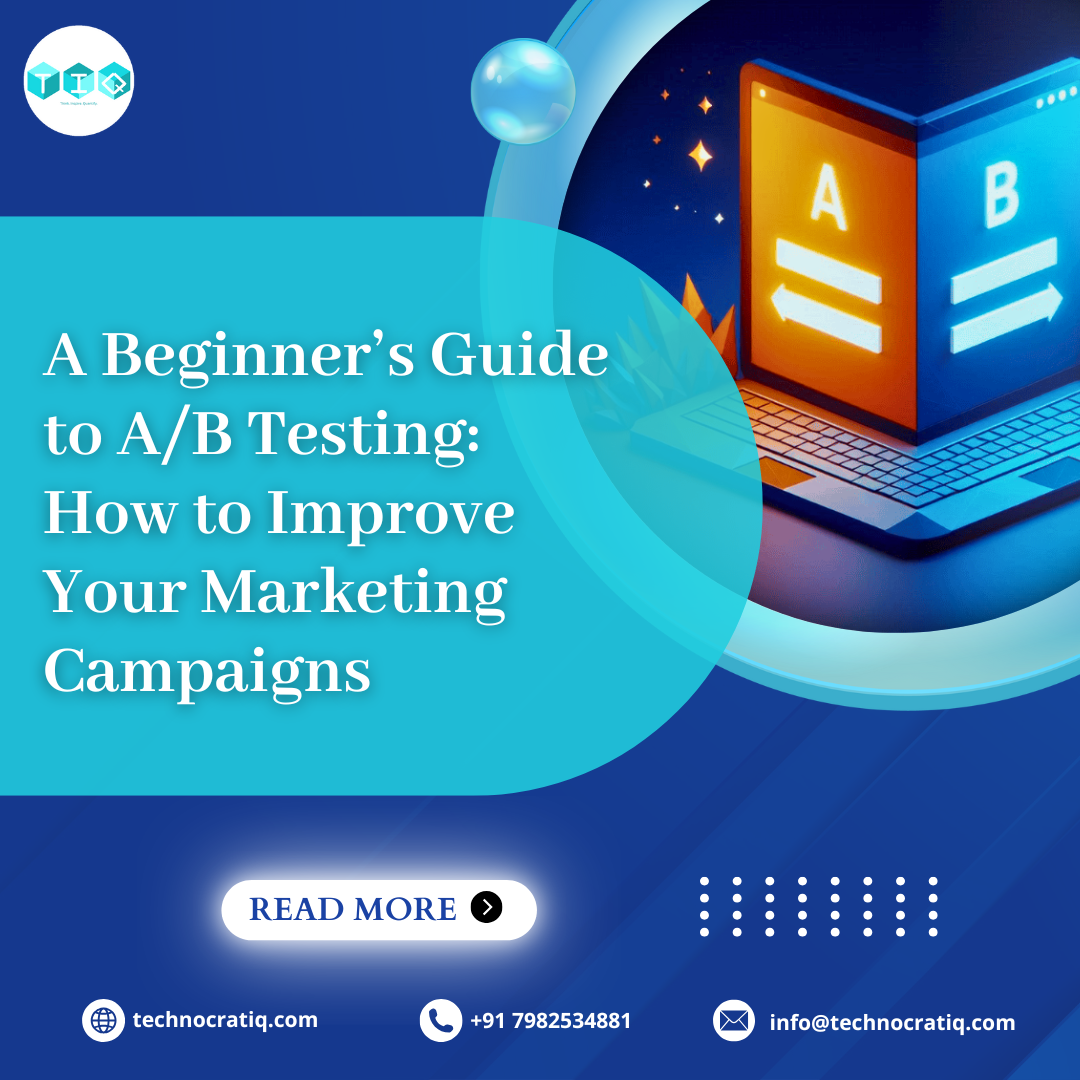
    A Beginner’s Guide to A/B Testing: How to Improve Your Marketing Campaigns

    Introduction

    A/B testing is one of the powerful digital marketing strategies in pushing through data-driven and results-oriented marketing communications. Whether for web optimization, email campaigns, or advertising refinement, A/B testing can provide vital insights into what would work best for your targeted audience.


    This A/B testing guide from Technocratiq Digital is styled to navigate you through the basics of A/B testing, the benefits available, and how to initiate the implementation of A/B testing in your marketing campaigns. At the end of this guide, you will know exactly how to improve marketing with A/B testing and how to boost all your conversions.

    What Is A/B Testing?

    A/B testing, also known as split testing, refers to a process wherein two versions of a marketing asset webpage, an email, or an advertisement are compared to find out which one works better. In other words, A/B testing can test a variable such as a headline, image, or call to action to see which combination yields the highest conversion rates or engagement.

    For instance, in an A/B testing guide, we might compare two variants of a landing page with a red CTA button and one with a blue CTA button by tracking which generates more clicks or sign-ups.

    Technocratiq Digital helps businesses improve marketing with A/B testing by ensuring that every test is structured in such a way that it will yield useful actionable data that will directly influence the performance of their campaigns

    Why A/B Testing is Essential for Your Marketing Strategy

    A/B tests allow making educated business decisions based on data, letting students apply direct actions. No longer wishful thinking determines or shapes marketing campaigns; A/B tests are based on real user behavior.

    Here are four compelling reasons why A/B testing is essential for any business that wants marketing optimization:
    • Data-influenced Decisions: A/B testing enables results-based findings, thus letting you shape your work according to what works instead of what you think works.
    • Higher conversion rate: Testing various elements like headlines, images, and CTAs candidates to understand what could get more conversions.
    • Improved User Satisfaction: A/B tests help you create great experiences by focusing on aspects that are most appealing to users.
    • Cost-Affected Advertising: Aids in guiding you to wisely invest your marketing budget by offering insights into various strategies you can consider, to pick the best performer.

    Through this A/B testing guide, you’ll be on your way to improving marketing with A/B testing and seeing tangible results in your campaigns.

    How to Conduct Effective A/B Testing

    Installing a structured method is essential for ensuring the validity and reproducibility of A/B test results. This is a step-by-step procedure for performing A/B tests:

    1. Outline Clear Goals

    Before any A/B testing can begin, it is crucial to draw up objectives. Would you like to increase your site conversion rate, increase your click rate, or reduce your bounce rate? Clear goals not only guide the testing process but also give you something to measure your success against later.

    For example, one beginner’s guide to A/B testing allowed one of Technocratiq Digital’s clients to improve sign-ups for a webinar by testing different headlines on their landing page. The winning headline led to a 25% increase in sign-ups.


    1. Choose Variables to Be Tested

    The next thing you ought to do is decide which element of the asset you’re going to test. Common variables are:

    Headlines: Evaluate which headline gets more attention and actual traffic.

    Images: Does changing an image increase engagement/conversions?

    CTAs: Test wording, colors, and placements of CTAs.

    In this A/B testing guide, we will recommend you to test only one variable at a time, so you can clearly see its effect on performance.

    1. Build the Two Versions

    Once you have selected your variable to be tested, you will then create two versions of the asset, namely the control (Version A) and the variant (Version B). For instance, if you’re testing a particular CTA button, Version A could read “Sign Up Now,” while Version B reads “Get Started Today.”

    It’s essential that the only difference between the two versions is the tested element. By doing so, any performance differences can be logically attributed to the variable being tested. 

    1. Split  Your Audience

    Just so your test can yield valid results, it is necessary to split your audience randomly. One group sees version A, while the other sees version B. Randomization is what causes external factors such as time or demographics not to affect the results.


    1. Allow Enough Time For Your Test

    The time period of the test depends on your traffic. Make sure you’ve run the test long enough to get useful data with more reliable conclusions. If you conduct your test too short, your results may not be statistically significant.


    1. Analyze  The Results

    After the completion of the test, the next step is to analyze the results. Analysis provides the outcome in favor of version A or B according to your objectives (for example, to find out which one generates more conversions or clicks). You can change to a new domain name once the winner is established.

    Technocratiq Digital has taken this beginner’s guide to A/B testing, and clients have reported measurable improvements. A call-to-action test recently resulted in an 18% increase in clicks for one of our clients.


    1. Implement The Winning Version

    Once you know which version won, put the changes into your entire marketing strategy. A/B testing does not stop here; A/B testing is an ongoing process since you can keep testing out other variables to further optimize your marketing efforts. 

    What is Conversion Rate Optimization (CRO)?

    CRO is nothing but conversion rate optimization. In simple terms, it means increasing the number of visitors to your website who perform an action you desire. That could be purchasing a product, subscribing to the newsletter, or filling out a form. Businesses will A/B test various elements on their website, including headlines, CTAs, and layouts, to see what works best with their audience.

    This Beginner’s Guide to A/B testing will introduce you to the basics and how to apply A/B testing to boost returns for your business.

    Tactic 1: Optimize landing pages with A/B Testing

    Landing Pages are the starting point for all conversion-rate-wide enhancements. Being the key drivers to conversion, it is very important to make landing pages the most effective and conversion-oriented. Here are some ways in which A/B testing can be utilized for landing page optimization:

    • Headlines: This is the first thing that your visitors notice. Just a slight difference in the wording can yield a high conversion rate. Different headlines addressing your audience’s pain points should be tried out.
    • Call to Action: It’s time to test an array of call-to-action buttons, including their color, position, and text to see what gets people active.
    • Visuals: Try out images or videos that captivate your target audience. Visuals significantly affect user engagement.

    With the guidance of this A/B testing, go ahead and run some tests and iterations to find the landing page elements that drive the most conversions. 


    Tactic 2:- Make Content Personal

    Personalization is a highly effective method to boost conversions. By applying behavioral or preference-based approaches to your content, visitors start feeling like they belong. Here is how you can employ A/B testing to make your content personal:

    • Dynamic Content: Display the messages, content, or product suggestions that change depending on the visitor’s location or browsing behavior.
    • Product suggestions: Show tailored suggestions that remind the user of things he or she liked previously.

    When you improve marketing with A/B testing, personalizing content can significantly enhance user engagement and conversion rates.


    Tactic 3: Shorten Forms for Higher Submission Rates

    Forms can refer to anything from signup forms and lead-collection forms to forms requesting donations or volunteering. They are imperative in lead collection, but long, lengthy forms can lead to drop-offs. To improve marketing with A/B testing, try testing:

    • Form length: Lay off your form length, and test the submissions while minimizing fields to key respondents.
    • Form placement: Test where on your page your form performs best, either the header, content, sidebar, or footer of the page.
    • Call-to-action clarity: Write a clear, action-oriented call to action for your form, e.g. “Get my free ebook.”

    With this beginner’s guide to A/B testing, you can learn the actual elements in the conversion forms that capture visitors’ interest. 


    Tactic 4: Build trust and credibility

    Trust is key for conversions. If the user feels that the website is trusted, the chances of him filling up his details or making a purchase increase considerably.

    You can boost trust and credibility aspect with the following A/B test:

    • Customer Testimonials: Display reviews or testimonials that would add credibility to your website. Test the placement and the word content of testimonials for their effectiveness.
    • Trust Badges: Build trust by featuring secure checkout badges, money-back guarantees, or industry certifications.
    • Case Studies: Add case studies that provide evidence of the success of your product or service.

    Once you trial these trust elements via A/B testing, you’re bound to strengthen user trust and have better conversion rates.


    Tactic 5: Testing different user journeys and traffic sources

    Traffic sources make or break conversions. Users who come from different sources (social media, paid ads, or organic search) will have different expectations and behaviors. Use A/B testing to discover what traffic sources or user paths would yield better conversions:

    • Test Traffic Sources: Test multiple traffic sources to discover which traffic sources yield some conversions. Since it’s paid ads or social media, some traffic sources may require different landing pages or offers.
    • Test User Paths: Compare the conversion rates for visitors coming from different paths. Will blog post users convert better by clicking through to a product page or a landing page?

    Testing traffic sources and different user flows will help you improve marketing with A/B testing, which will then assure you of getting the maximum ROI in your marketing efforts.

    Example: HubSpot’s Traffic Source Analysis

    HubSpot conducted an A/B test to discover which converted better, a blog post landing page or a product page, for traffic from organic search. The results show that blog post landing pages converted 22% better than product pages.

    Some examples of what to test:
    • Conversion rates of users from various traffic sources (social media, email campaigns, organic search)
    • User paths-directing users to specific landing pages vs. product pages
    • Custom offers in conjunction with the source of traffic.

    While this is the wake-up call towards businesses in adopting smart analysis, it brings to mind the excerpt from the Beginner’s Guide to A/B Testing regarding the right practices that aid organizations in figuring out on-the-spot strategies to make the best use of the prospects that engage visitors depending on where they entered. 


    Common A/B Testing Mistakes to Avoid

    While A/B testing is a powerful approach, it may have possible pitfalls, such as:

    • Testing too many variables: Focus on testing one thing at a time. Too many variables can confuse results.
    • Not allowing tests to run long enough: Testing for short periods of time can lead to unreliable results. Ensure your tests have enough time to gather sufficient data for a meaningful conclusion.
    • Lack of statistical significance: Ensure your results are statistically significant before deciding on a specific tackle. Otherwise, you will risk changing your policy based on misleading information.

    Technocratiq Digital’s Expertise in A/B Testing

    At Technocratiq Digital, we simplify the A/B testing process to help businesses achieve measurable results. Our approach ensures that every test is not just an experiment but a step towards improved performance and ROI. Here’s how we assist our clients:

    • Strategic Test Design: We identify key variables—whether it’s headlines, CTAs, or visuals—and design tests that deliver actionable insights.
    • Data-Driven Decisions: Our experts analyze results to recommend changes that directly impact your conversion rates and engagement metrics.
    • Continuous Optimization: We go beyond single tests by iterating and refining strategies to ensure sustained growth.
    • Tailored Solutions: By understanding your audience and business objectives, we create customized A/B testing strategies that resonate with your target market.


    Conclusion

    A/B testing is the holy grail of marketers looking to finesse their strategy and achieve better results. This A/B testing guide has demonstrated that, even with small changes, you can achieve big to moderate shifts in engagement and conversions. Following this beginner’s guide to A/B testing gives you the proper confidence to execute tests, analyze results, and make the changes that resonate best with your audience.


    You would either want to boost website performance or performance in terms of advertisement campaigns; A/B testing offers a verified way that develops marketing further into A/B testing. Technocratiq Digital helps companies to leverage these strategies towards measurable growth. Start testing today and see small changes move the needle.

     

    Get in Touch with Us!
  • The AI Advantage: Maximizing Your SEO Game with Artificial Intelligence

    The AI Advantage: Maximizing Your SEO Game with Artificial Intelligence

    Introduction

    In today’s online world, businesses must stay updated with the latest trends to stand out. If you’re a business owner, marketer, or someone interested in digital marketing, you’ve probably noticed that traditional SEO techniques are changing. The reason? Artificial Intelligence (AI) is making a big impact, and understanding this change can help your business grow.

    Think about it: when someone searches for something on Google, AI algorithms quickly figure out what they want, why they want it, and even how they feel about it. This isn’t something out of a sci-fi movie; it’s happening right now, and it’s changing how businesses can reach their customers. The rise of AI in SEO isn’t just about keeping up with trends; it’s about using new tools to attract more customers and beat the competition.

    For you, learning about AI in SEO is crucial. It’s not just about getting your website seen; it’s about making sure people find exactly what they’re looking for when they visit. You might be wondering: How does AI affect my website’s ranking? How can I use AI to make better content? These are important questions, and this blog will answer them, focusing on practical tips that you can use.

    As you read through this post, think of it as a helpful guide to understanding AI in SEO. Whether you’re experienced in digital marketing or just starting out, this information is designed to help you. Let’s explore how you can use AI to improve your SEO strategies and make your brand more visible to both search engines and customers.

    The Evolution of SEO: From Keywords to AI

    SEO has evolved significantly from its early focus on keyword stuffing. Initially, websites aimed to rank higher by using specific words and phrases, like “best coffee shop,” repeatedly. However, as the internet expanded, search engines like Google shifted towards prioritizing content quality over quantity.

    Today, Artificial Intelligence (AI) has revolutionized SEO. AI helps search engines understand the intent behind keywords, enhancing user experience. For example, if someone searches for “how to plant a tree,” AI can discern whether they’re looking for a guide, a tool list, or species recommendations.

    Key stats illustrate this transformation:

    • By 2023, 83% of marketers believe AI will be crucial for better marketing decisions.
    • By 2024, 50% of all searches are expected to be voice searches.
    • Over 60% of Google searches are now from mobile devices, emphasizing the need for mobile-friendly websites.

    AI technologies like machine learning and natural language processing (NLP) further refine search results. For instance, Google’s BERT algorithm, introduced in 2019, helps understand the context of words, impacting 1 in 10 searches.

    For businesses, this shift means focusing on user experience and providing valuable content. Instead of just using keywords like “best bookstore,” consider what your audience is actually searching for, such as “best books for summer reading” or “where to find rare books.” This approach allows you to offer more personalized and relevant information.

    Key AI Technologies Driving SEO

    AI technologies are revolutionizing SEO, making it easier for businesses to connect with their audience. Here are the key AI technologies shaping the future of SEO:

    1. Machine Learning
      • Overview: Machine learning allows systems to learn from data and improve over time without explicit programming. For SEO, this means search engines can better understand user behavior and refine their algorithms.
      • Fact: 60% of marketers believe AI will significantly impact marketing in the next five years (BrightEdge).
      • Example: Google uses machine learning to analyze search patterns and improve the relevance of search results, enhancing user experience.
    2. Natural Language Processing (NLP)
      • Overview: NLP enables computers to understand and interpret human language, which is crucial for understanding search queries’ context and intent.
      • Stat: Google’s BERT algorithm, an NLP model, impacts 10% of all searches.
      • Example: BERT helps Google grasp the context of queries like “how to catch a train to Paris,” ensuring relevant travel information appears in search results.
    3. Voice Recognition and Search
      • Overview: With the rise of voice-activated assistants, voice recognition has changed how people search. Voice searches are more conversational and detailed.
      • Fact: 75% of households will own a smart speaker by 2025.
      • Example: Optimizing content for voice search means using natural language and addressing specific user questions.
    4. AI-Powered Content Creation and Optimization
      • Overview: AI tools like GPT-4 can generate human-like text, aiding in content creation and optimization.
      • Stat: The AI market for content creation is projected to grow to $9.8 billion by 2026 (MarketsandMarkets).
      • Example: AI tools assist with keyword research and content suggestions, helping businesses create optimized content efficiently.
       5. Predictive Analysis
      • Overview: Predictive analysis forecasts future trends based on historical data, helping businesses anticipate popular topics.
      • Fact: Predictive analytics tools are expected to reach a market size of $63.3 billion by 2032.
      • Example: A fashion blog can use predictive analysis to focus on emerging trends like “sustainable fashion,” attracting more visitors by staying relevant.

    These AI technologies are transforming how businesses approach SEO, making it more effective and user-centric. By leveraging these tools, businesses can better understand their audience, create engaging content, and stay ahead in a competitive digital landscape.

    Bringing It All Together

    AI technologies are revolutionizing SEO, making it more user-centric and efficient. For businesses and content creators, leveraging AI tools is key to understanding audiences, creating engaging content, and boosting visibility in search results. It’s about delivering value through optimized content, voice search, and personalized user experiences. Embracing AI ensures a strong, impactful online presence.

    AI-Powered SEO Strategies for Maximizing Search Market Share

    1. AI-Enhanced Keyword Research:
      • Tools: Ahrefs, SEMrush
      • Impact: 70% of marketers using AI see increased organic traffic. AI uncovers valuable long-tail keywords.
    2. Optimizing Content with AI:
      • Content Creation: Tools like Copy.ai and Jasper use NLP for relevant content.
      • Content Optimization: Clearscope and Surfer SEO enhance relevance and readability.
      • Impact: Up to 60% improvement in content engagement.
    3. Enhancing User Experience with AI:
      • Personalization: AI chatbots and tailored experiences increase engagement.
      • Voice Search: With 27% using voice search, optimizing for natural language is crucial.
      • Impact: AI-driven personalization boosts user satisfaction by up to 80%.
    4. Predictive Analytics for SEO:
      • Trend Forecasting: AI anticipates market shifts, guiding SEO strategies.
      • Competitive Analysis: Identifies gaps and opportunities.
      • Impact: Up to 50% improvement in SEO performance.
    5. AI for Technical SEO:
      • Automated Audits: Tools like Screaming Frog detect and fix technical issues.
      • Impact: Improved site health and better search engine indexing.

    Incorporating these AI strategies can significantly increase your search market share and set you apart from competitors. Embrace AI for a more efficient and successful SEO approach.

    Case Studies and Success Stories

    In SEO, AI-powered strategies have transformed how businesses achieve success. Let’s explore some notable examples:

    1. HubSpot’s AI-Driven Keyword Research
      • Challenge: Increase organic traffic and content relevance.
      • Solution: AI tools for analyzing search patterns and user intent, focusing on long-tail keywords.
      • Results: 55% increase in organic traffic, 35% improvement in keyword rankings. AI-enhanced keyword targeting accuracy by 70%.
    2. Domino’s Pizza and AI-Powered Personalization
      • Challenge: Enhance user experience and boost online sales.
      • Solution: AI-driven recommendation engines for personalized product suggestions.
      • Results: 20% increase in online orders, 15% boost in average order value, and 30% increase in customer retention.
    3. Netflix and AI-Optimized Content Recommendations
      • Challenge: Improve content discovery and reduce churn.
      • Solution: AI algorithms for personalized content suggestions.
      • Results: 60% increase in user engagement, a 25% reduction in churn rates. Over 80% of the content watched was recommended by AI.
    4. SEMrush and AI-Powered Competitive Analysis
      • Challenge: Provide deeper competitive insights.
      • Solution: AI analysis of competitors’ SEO strategies and keyword performance.
      • Results: 40% improvement in identifying market opportunities, 50% increase in SEO performance metrics.
    5. Adobe and AI-Enhanced Content Optimization
      • Challenge: Optimize content marketing strategies.
      • Solution: AI analysis for content performance and user engagement.
      • Results: 45% increase in content engagement, 30% boost in conversion rates, and 40% increase in marketing campaign effectiveness.

    These examples highlight the powerful impact of AI in SEO, offering valuable insights and driving significant improvements in traffic, engagement, and conversions. Businesses leveraging AI can stay competitive and achieve remarkable results.

    Challenges and Considerations

    While AI can boost SEO, it brings its own challenges. Understanding these can help you leverage AI effectively.

    1. Data Privacy and Security
      • Challenge: AI tools require large amounts of data, raising privacy concerns.
      • Tip: Ensure AI tools comply with data protection laws like GDPR. Implement strong security measures and be transparent about data use.
      • Fact: 80% of companies worry about data privacy with AI tools (IBM, 2023).
    2. Algorithmic Bias
      • Challenge: AI can sometimes produce biased results.
      • Tip: Regularly review and update AI algorithms. Use diverse data sets and include human oversight to correct biases.
      • Fact: 90% of AI systems exhibit some level of bias (MIT, 2022).
    3. Complexity and Learning Curve
      • Challenge: AI tools can be complex, requiring time to learn.
      • Tip: Invest in team training and consider consulting AI experts. Start with simpler tools to build skills.
      • Stat: 68% of companies struggle with AI adoption due to complexity (Deloitte).
    4. Integration with Existing Systems
      • Challenge: AI tools must integrate smoothly with existing systems.
      • Tip: Plan integration carefully and test before full deployment. Collaborate with vendors to address compatibility issues.
      • Fact: 55% of companies face integration challenges with new AI technologies (McKinsey).
    5. Cost Considerations
      • Challenge: AI tools can be expensive.
      • Tip: Evaluate the ROI of AI tools. Start with trials or pilot projects to assess value and fit.
      • Stat: 45% of companies view cost as a major barrier to AI adoption (Gartner).
    6. Over-Reliance on AI
      • Challenge: Over-reliance on AI can limit human creativity.
      • Tip: Use AI to support, not replace, human insight. Blend AI data with human creativity for balanced strategies.
      • Fact: 70% of businesses combine AI with human expertise for optimal results (Forrester).
    7. Keeping Up with Rapid Changes
      • Challenge: AI evolves quickly, making it hard to stay updated.
      • Tip: Follow industry news, participate in webinars, and regularly update tools and strategies.
      • Stat: 62% of organizations struggle to keep pace with AI advancements (AI Trends).

    By acknowledging these challenges and planning accordingly, you can effectively integrate AI into your SEO strategy. Balancing AI with human creativity and insight is key to navigating these issues and achieving success.

    Conclusion

    In the dynamic world of SEO, harnessing the power of AI is no longer just an option but a necessity. AI-driven technologies offer unprecedented opportunities to refine your SEO strategies, maximize your search market share, and stay ahead of the competition. From understanding the evolution of SEO to leveraging cutting-edge AI tools and overcoming challenges, integrating AI into your SEO practices can lead to transformative results.

    At TIQ Digital, we’re passionate about guiding you through this exciting landscape with precision and expertise. Whether you’re launching a new venture or enhancing an established brand, our team is dedicated to providing customized solutions that align with your goals and drive measurable success. Our approach, rooted in the R.A.C.E. framework—Reach, Act, Convert, Engage—ensures that every strategy we implement is designed to accelerate your path to success.

    Ready to elevate your SEO strategy and achieve remarkable results? 

    Let’s partner together to turn your vision into reality. Contact us today and discover how we can help you leverage AI and other innovative solutions to propel your business forward.

    Get in Touch with Us!

    Book Your Free Consultation Slot Today and take the first step towards a brighter, more successful digital future with TIQ Digital.

  • The Impact of Influencer Marketing on Fintech Brand Awareness

    The Impact of Influencer Marketing on Fintech Brand Awareness

    In today’s digital age, where social media dominates the marketing landscape, the fusion of fintech and influencer marketing has emerged as a powerful strategy for boosting brand awareness. But what exactly is influencer marketing, and how does it affect the fintech industry? 

    Let’s take a look at the world of fintech marketing, explore the dynamics of influencer marketing, and uncover how this strategy is reshaping the landscape of fintech brand awareness.

    Table of Contents

    1 Understanding Fintech Marketing

    2 The Rise of Influencer Marketing in Fintech

    3 Leveraging Influencers in Fintech Marketing

    4 Key Benefits of Fintech Influencer Marketing

    5 Crafting a Winning Fintech Influencer Strategy

    6 Case Studies: Successful Fintech Influencer Campaigns

    7 Measuring Success: Metrics for Fintech Brand Awareness

    8 Overcoming Challenges in Fintech Influencer Marketing

    9 The Future of Fintech Marketing

    10 Conclusion

     
    1. Understanding Fintech Marketing

    Before considering the impact of influencer marketing on fintech brand awareness, it’s essential to grasp the essence of fintech marketing itself. Fintech, short for financial technology, encompasses a wide range of innovative solutions that disrupt traditional financial services. 

    Fintech companies leverage technology to offer efficient, user-friendly alternatives to traditional banking, investing, and payment systems.

    1. The Rise of Influencer Marketing in Fintech

    In recent years, influencer marketing has gained significant traction across various industries, including fintech. Influencer marketing involves collaborating with individuals who have a substantial following and influence on social media platforms. These influencers endorse products or services to their audience, leveraging their credibility and trust to drive engagement and conversions.

    1. Leveraging Influencers in Fintech Marketing

    According to a study done by Qualtrics and Credit Karma, 56% of Gen Z and Millennials intentionally seek out financial advice through social platforms.
    Fintech companies can harness the power of influencers to reach this target audience more effectively. By partnering with influencers who specialize in finance, technology, or related fields, fintech brands can tap into existing communities of engaged followers who are interested in financial innovations.

    1. Key Benefits of Fintech Influencer Marketing

    Influencer marketing offers several advantages for fintech brands:

    Enhanced Credibility: When influencers endorse a fintech product or service, it lends credibility and trustworthiness to the brand, especially among skeptical consumers.

    Expanded Reach: Influencers have dedicated followers who trust their recommendations, allowing fintech brands to expand their reach and tap into new markets.

    Authenticity: Authenticity is crucial in the fintech industry, and influencers can humanize the brand by sharing their genuine experiences and insights.

    1. Crafting a Winning Fintech Influencer Strategy

    To maximize the impact of influencer marketing on fintech brand awareness, companies must develop a comprehensive strategy. This involves identifying the right influencers, defining clear objectives, and creating compelling content that resonates with the target audience.

    Here is a sample 90-day fintech influencer marketing strategy that outlines a structured approach to collaborating with influencers, from initial research and outreach to campaign execution, optimization, and evaluation.

    Day

    Activity

    Day 1-10

    Research and Identification: Conduct thorough research to identify potential influencers in the fintech niche. Analyze their audience demographics, engagement rates, and content relevance.

    Day 11-20

    Outreach and Engagement: Reach out to selected influencers with personalized messages expressing interest in collaboration. Engage with them on social media platforms to establish rapport and familiarity.

    Day 21-30

    Negotiation and Agreement: Initiate negotiations with interested influencers regarding collaboration terms, including compensation, content requirements, and campaign objectives. Draft and finalize influencer contracts.

    Day 31-40

    Content Creation: Collaborate with influencers to develop engaging content that highlights the fintech company’s products or services. Provide clear guidelines and creative direction while allowing influencers to infuse their unique style and voice.

    Day 41-50

    Campaign Launch: Launch the influencer marketing campaign across various social media platforms. Monitor campaign performance closely and address any issues or concerns promptly.

    Day 51-60

    Monitoring and Optimization: Continuously monitor key metrics such as engagement rates, website traffic, and conversion rates. Optimize the campaign based on performance insights and adjust strategies as needed to maximize results.

    Day 61-70

    Community Engagement: Encourage influencers to actively engage with their audience by responding to comments, hosting Q&A sessions, and facilitating discussions about the fintech brand.

    Day 71-80

    User-Generated Content: Encourage followers to create user-generated content related to the fintech brand and share it on social media platforms. Repurpose this content for additional marketing initiatives.

    Day 81-90

    Evaluation and Analysis: Conduct a comprehensive evaluation of the influencer marketing campaign’s overall impact and ROI. Analyze feedback from influencers and audience reactions to identify strengths, weaknesses, and areas for improvement.

    1. Case Studies: Successful Fintech Influencer Campaigns

    Several fintech companies have successfully leveraged influencer marketing to boost brand awareness. For example, a leading digital payment platform collaborated with popular finance influencers to promote its mobile app, resulting in a significant increase in app downloads and user engagement.

    Also, as quoted in the Times of India, The #DoubleBenefitFromRBLBank campaign is one example. Collaborating with Sameera Reddy and Ujjawal Pahwa, the fintech influencer marketing campaign targeted working professionals and home-makers across India to stunning effect. The campaign reached almost 670,000 people and garnered 770,000+ engagements.

    1. Measuring Success: Metrics for Fintech Brand Awareness

    Measuring the success of influencer marketing campaigns is essential for refining strategies and optimizing performance. Key metrics for evaluating fintech brand awareness include website traffic, social media engagement, brand mentions, and conversion rates. The following listicle will provide you with the top KPIs required for measuring a successful FinTech influencer marketing campaign. 

    Website Traffic:

    • Monitor the volume of traffic to your fintech company’s website over time.
    • Analyze website traffic sources to identify which channels drive the most visitors.
    • Track changes in website traffic patterns in response to marketing initiatives or external factors.

    Social Media Engagement:

    • Measure engagement metrics such as likes, shares, comments, and clicks on social media posts.
    • Evaluate the reach and impact of your fintech brand’s social media content.
    • Monitor audience interactions and sentiment to gauge brand perception and engagement levels.

    Brand Mentions:

    • Use social listening tools to track mentions of your fintech brand across social media platforms, forums, and blogs.
    • Analyze the frequency and context of brand mentions to understand how your brand is perceived and discussed online.
    • Identify influencers, advocates, and detractors who mention your brand and assess their influence on brand awareness.

    Conversion Rates:

    • Measure conversion rates for various marketing channels, campaigns, and landing pages.
    • Track the percentage of website visitors who complete desired actions, such as signing up for a demo, requesting more information, or making a purchase.
    • Analyze conversion funnels to identify bottlenecks and optimize the user journey for improved conversion rates.
    1. Overcoming Challenges in Fintech Influencer Marketing

    While influencer marketing offers numerous benefits, it also comes with challenges. Fintech brands may face issues such as finding the right influencers, ensuring compliance with regulations, and maintaining authenticity amidst sponsored content. Here are the top challenges and best practices for overcoming these challenges shared by top experts at TIQ Digital. 

    Challenges:
    1. Finding the Right Influencers: Identifying influencers who resonate with the fintech audience and align with the brand’s values can be challenging.
    2. Regulatory Compliance: Ensuring compliance with regulations such as disclosure requirements for sponsored content and consumer protection laws can be complex.
    3. Maintaining Authenticity: Striking a balance between promotional content and authenticity is crucial to maintaining credibility with the audience.
    4. Measuring ROI: Determining the return on investment (ROI) of influencer marketing campaigns and attributing conversions to specific influencers can be difficult.
    Expert Solutions from TIQ Digital:
    1. Thorough Research and Vetting: Conduct comprehensive research to identify influencers with relevant expertise and engaged audiences. Vet potential influencers based on their content quality, audience demographics, and engagement metrics.
    2. Legal Guidance and Compliance Checks: Seek legal guidance to ensure compliance with relevant regulations and guidelines governing influencer marketing. Implement robust processes for reviewing influencer content to ensure compliance with disclosure requirements and consumer protection laws.
    3. Authentic Storytelling: Encourage influencers to share authentic stories and experiences related to the fintech brand. Provide influencers with creative freedom while ensuring that branded content aligns with the brand’s messaging and values.
    4. Utilize Tracking and Attribution Tools: Implement tracking and attribution tools to measure the impact of influencer marketing campaigns on key performance metrics such as website traffic, conversions, and ROI. Use unique tracking links, promo codes, or referral codes to attribute conversions to specific influencers and evaluate campaign effectiveness.
    1. The Future of Fintech Marketing

    As the fintech industry continues to evolve, influencer marketing is poised to play an increasingly significant role in shaping brand awareness and consumer perceptions. Fintech companies must adapt to changing trends and embrace innovative marketing strategies to stay ahead of the competition.

    1. Conclusion

    In conclusion, influencer marketing has emerged as a potent tool for enhancing fintech brand awareness in today’s digital landscape. By partnering with influencers, fintech companies can amplify their message, build credibility, and connect with their target audience on a deeper level. As the fintech industry continues to grow, leveraging influencer marketing effectively will be key to staying competitive and driving sustainable growth. Contact us at TIQ Digital, a leading fintech marketing agency in India. 

    FAQs

    1. What is influencer marketing, and why is it important for fintech companies?

    Influencer marketing involves collaborating with individuals who have a significant following on social media to promote products or services. For fintech companies, influencer marketing is important because it helps build credibility, expand reach, and humanize the brand.

    1. How can fintech companies find the right influencers to partner with?

    Fintech companies can find the right influencers by conducting thorough research, assessing their audience demographics and engagement rates, and ensuring alignment with the brand’s values and objectives.

    1. What are some key metrics for measuring the success of influencer marketing campaigns in fintech?

    Key metrics for measuring the success of influencer marketing campaigns in FinTech include website traffic, social media engagement, brand mentions, conversion rates, and ROI (Return on Investment).

    1. How can fintech brands maintain authenticity in influencer marketing campaigns?

    Fintech brands can maintain authenticity in influencer marketing campaigns by ensuring transparency, encouraging genuine endorsements, and collaborating with influencers who resonate with their target audience.

    1. What are the regulatory considerations for fintech influencer marketing?

    Fintech companies must ensure compliance with relevant regulations, such as disclosure requirements for sponsored content and adherence to consumer protection laws, to avoid legal issues and maintain trust with consumers.