
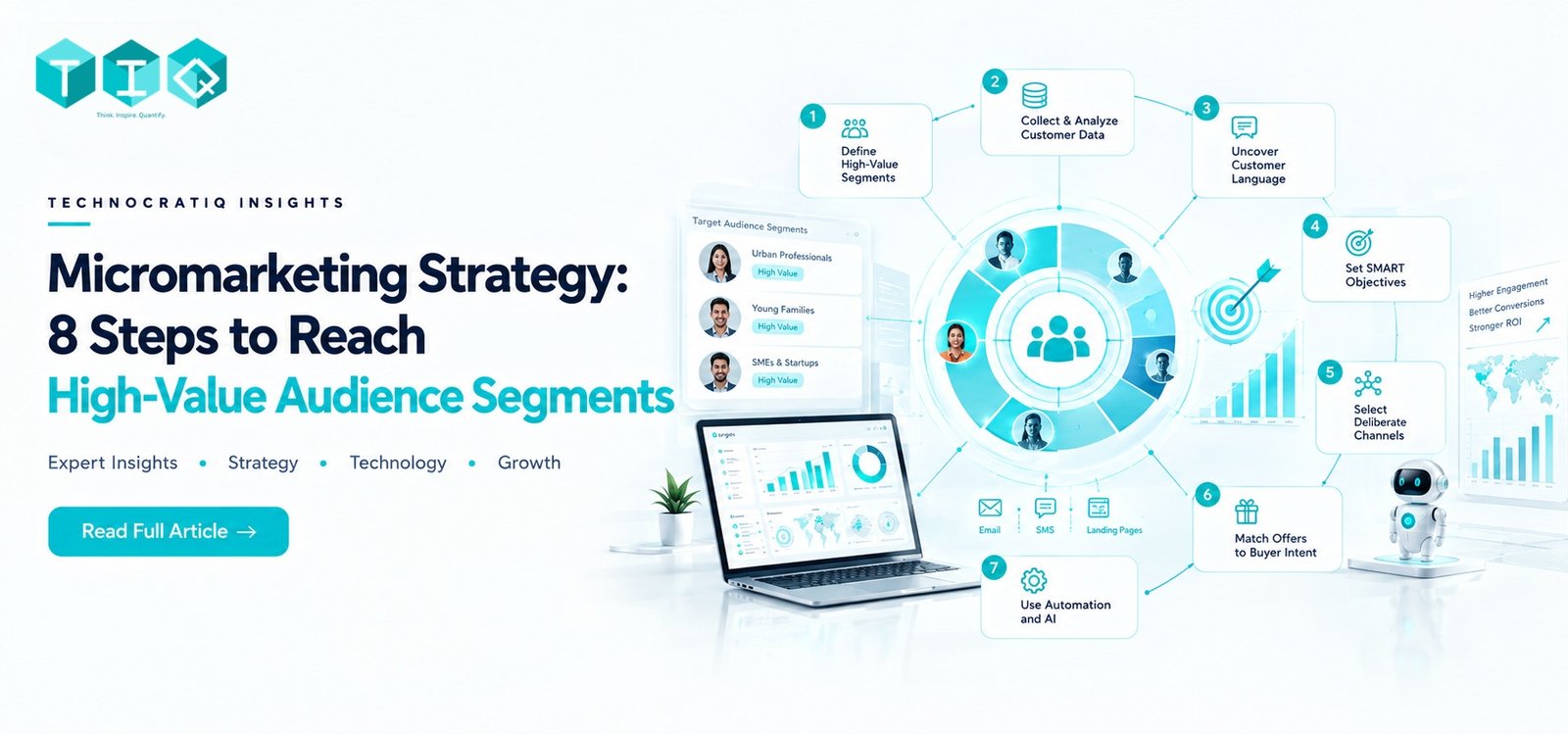
A micromarketing strategy targets small, high-value audience segments with tailored messaging, offers, and channels instead of broad, one-size-fits-all campaigns aimed at everyone. It replaces reach with relevance, which is exactly why it tends to outperform mass marketing on both engagement and budget efficiency. This breaks down the eight steps to actually build one.
What Is a Micromarketing Strategy?
In simple terms, what is a micromarketing strategy comes down to this: instead of speaking to a broad market with one message, you identify a small number of specific, high-value groups and build messaging, offers, and channel choices around each one individually.
This is what separates a real micro marketing strategy from generic “personalization”, it’s not about adding a first name to an email. It’s a deliberate structure: defined segments, tailored offers, and measurement built around each group’s actual behavior, not assumptions about a broad audience.
For a deeper look at the different types of micromarketing and classic examples like personalized product recommendations, our earlier guide on what micromarketing is breaks down in full this piece focuses on how to actually build and execute the strategy.
The 8-Step Micromarketing Strategy Framework
Building a working micromarketing campaign comes down to eight sequential steps skipping any one of them is usually where campaigns start wasting budget.
| Step | What It Involves | Common Mistake to Avoid |
| 1. Define high-value segments | Identify 1–3 distinct groups by location, behavior, or need with the highest return potential | Trying to segment everyone at once instead of starting narrow |
| 2. Collect and analyze customer data | Gather purchase history, browsing habits, and engagement data from analytics and feedback tools | Relying on assumptions instead of actual behavioral data |
| 3. Uncover customer language | Read reviews, comments, and direct messages to learn the exact phrasing and pain points your audience uses | Using internal company language instead of the audience’s own words |
| 4. Set SMART objectives | Define specific, measurable, achievable, relevant, time-bound goals per segment | One vague goal (“increase engagement”) applied across every segment |
| 5. Select deliberate channels | Choose a small number of channels where the segment is genuinely active | Spreading thin across every channel instead of committing to a few |
| 6. Match offers to buyer intent | Tailor specific incentives a discount for new users, loyalty perks for repeat buyers | Sending the same offer to every segment regardless of intent |
| 7. Use automation and AI | Deliver personalized messaging efficiently at scale across email, SMS, and landing pages | Manual execution that can’t scale past a handful of segments |
| 8. Monitor and optimize | Track conversion rates and engagement regularly to refine messaging and future campaigns | Launching once and never revisiting performance data |
This is the backbone of any real market segmentation strategy; each step builds directly on the one before it, which is why skipping straight to “select channels” without first defining segments and gathering data rarely produces strong results.
Micromarketing Examples Across Business Types
The strongest micromarketing examples share one trait: the offer and message clearly reflect something specific about that segment’s behavior or context, not a generic pitch.
- A local service business sending a geo-targeted offer only to residents within a specific radius, timed around a seasonal need in that area
- A B2B company building a role-based campaign speaking directly to a compliance officer’s priorities, distinct from messaging aimed at a finance lead at the same company, a tactic commonly used in modern b2b marketing strategies.
- An e-commerce brand triggering a personalized follow-up based on a specific browsing pattern items viewed but not purchased within a defined category
- A subscription business running a loyalty-tier campaign with different messaging and perks for new customers versus long-term repeat buyers
Each of these reflects personalised marketing campaigns built around real behavior and context rather than a single message pushed to an entire customer list.
Micromarketing vs Broad Targeted Marketing What Changes
The practical differences between broad and micro-targeted approaches show up clearly once you compare them side by side.
| Broad / Mass Targeting | Micromarketing |
| One message across the entire audience | Tailored messaging per defined segment |
| Wide channel spread, thinly resourced | Few channels, chosen deliberately per segment |
| Hard to measure which message drove results | Clear, segment-level performance tracking |
| Budget spent reaching uninterested audiences | Budget concentrated on high-value, responsive segments |
| Generic engagement, unpredictable ROI | Higher engagement per segment, clearer ROI |
This is the real distinction behind a targeted marketing strategy and a niche marketing strategy both prioritize depth of relevance over breadth of reach, which is what protects budget from being spent on audiences unlikely to convert.
How TechnocraTIQ Builds Micromarketing Systems for High-Value Segments
At TechnocraTIQ, we treat micromarketing as a measurable system, not a buzzword bolted onto a generic campaign. Our approach to audience segmentation strategy starts with real customer data not assumptions and builds tailored messaging, offers, and channel selection around each high-value segment individually. This connects directly into how we approach personalised marketing campaigns more broadly: relevance built from data, not guesswork. The result is a segmentation and targeting system tracked through the same audience and performance insights that show which segments are actually converting so the budget keeps moving toward what works.
What a Strong Micromarketing Strategy Delivers
- Reduced wasted spend, since budget concentrates on segments most likely to convert
- Higher engagement per campaign, because messaging reflects real behavior instead of generic appeals, the same principle behind AI powered marketing systems that learn from customer data.
- Clearer, easier-to-report ROI, since performance is tracked at the segment level
- Stronger retention among high-value customers, who receive messaging that actually reflects their relationship with the brand
Conclusion
A micromarketing strategy isn’t about doing less marketing, it’s about being deliberate with who you reach and how you reach them. Following these eight steps, from defining segments to continuous optimization, is what actually protects budget while improving results, instead of spreading messaging thin across an audience that was never going to respond the same way.
FAQs
What is a micromarketing strategy?
A micromarketing strategy targets small, specific, high-value audience segments with tailored messaging, offers, and channels, rather than broad campaigns designed to reach as many people as possible.
What is an example of micro marketing?
A common example is an e-commerce brand sending personalized follow-up messaging based on a shopper’s specific browsing behavior, rather than sending the same generic promotion to its entire customer list.
What are audience segments?
Audience segments are defined groups within a broader customer base, grouped by shared characteristics like location, behavior, demographics, or psychographics, that allow for more relevant and effective marketing.
What are the different types of audience segmentation?
The main types include geographic, demographic, behavioral, and psychographic segmentation, each grouping audiences by a different characteristic, from location to purchasing behavior to values and lifestyle.
What are the 6 steps of customer segmentation?
Customer segmentation typically involves defining objectives, collecting customer data, identifying segment variables, building the segments, validating them against real behavior, and continuously monitoring and refining them over time.
Ready to build a micromarketing strategy around your highest-value segments?
We help brands define real audience segments, tailor messaging and offers around actual behavior, and track performance segment by segment not guesswork dressed up as personalization.
Book your strategy call now, your highest-value customers are currently getting the same message as everyone else.