
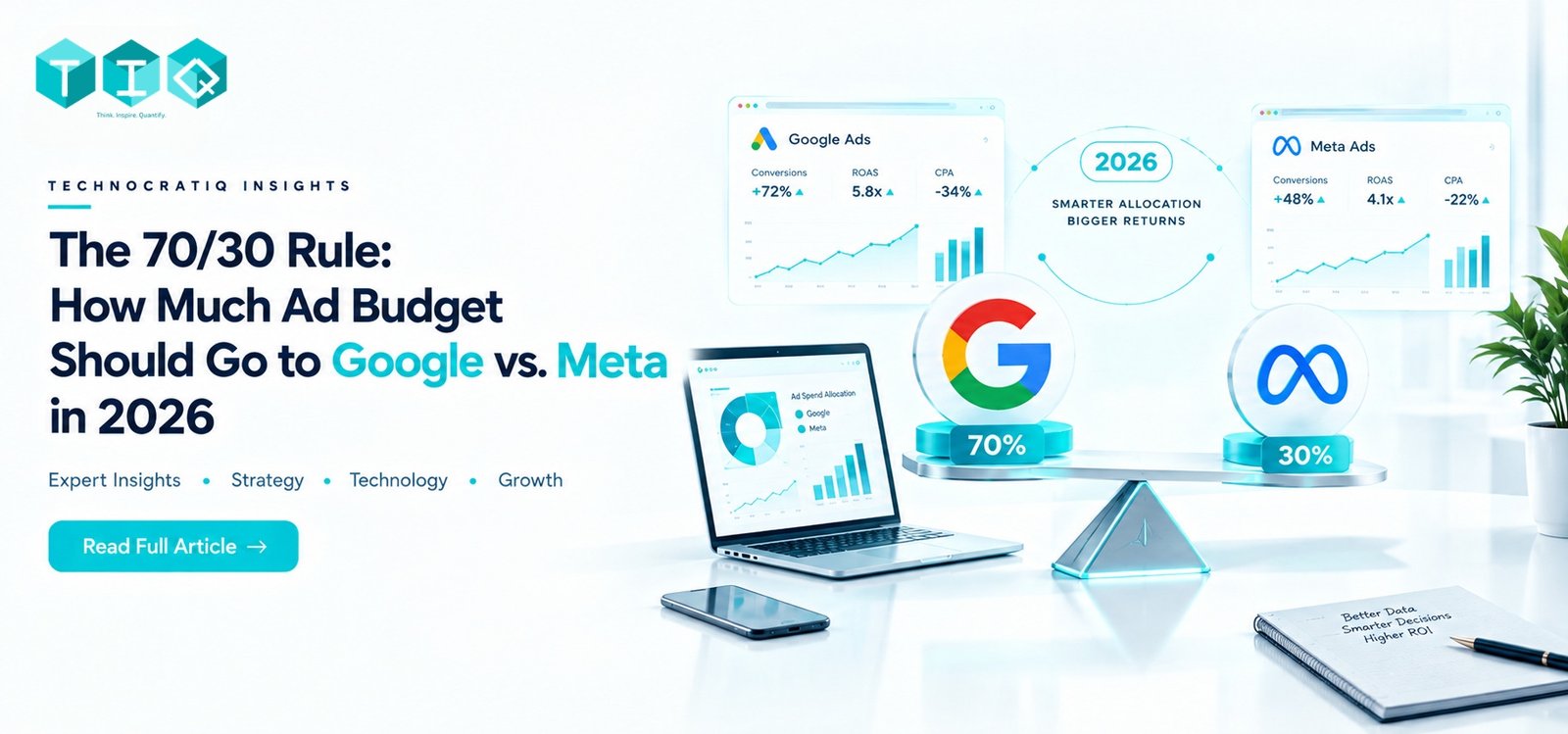
The 70/30 rule gets quoted everywhere 70% to Google, 30% to Meta as if it’s a fixed law of paid advertising. It isn’t. It’s a starting hypothesis that works well for some businesses and badly for others, and almost nobody explains exactly when it should flip. This breaks down how to actually decide your Google Ads vs Meta Ads split, using intent, order value, funnel stage, and real data instead of a borrowed percentage.
What the 70/30 Rule Actually Means
At its core, the 70/30 framework says: put 70% of the budget toward Google for demand capture, and 30% toward Meta for demand creation. The logic comes down to one core distinction that shapes everything else in this decision.
Google captures existing demand. When someone searches for “best CRM software” or “emergency plumber near me,” they already know what they want. Google Search just needs to show up at the right moment. Meta creates new demand. It interrupts someone scrolling who wasn’t actively looking for your product, and builds enough interest that they want it.
That distinction is why Google vs Meta advertising isn’t really an either/or decision; it’s a question of where your buyers currently sit: already searching, or not yet aware they have a need.
Why Businesses Get Ad Budget Allocation Wrong
Most poor budget splits don’t come from picking the wrong platform they come from skipping the actual decision process:
- Splitting 50/50 by default, without testing either platform’s performance for the specific business
- Copying a competitor’s ratio without matching their business stage, AOV, or audience behavior
- Using platform-reported ROAS to decide allocation both Google and Meta often claim credit for the same customer journey, inflating both numbers
- Ignoring minimum viable spend thresholds, which produces noisy data neither platform’s algorithm can actually learn from
Getting Google Ads budget allocation and Meta Ads budget allocation right starts with replacing guesswork with a real decision framework.
The Four Decision Drivers Behind Your Google vs Meta Split
Rather than starting from a fixed ratio, four questions determine which direction your budget should actually lean.
| Driver | Question to Ask | Pulls Budget Toward Google | Pulls Budget Toward Meta |
| Buyer Intent | Does the audience already know they need this? | Yes, active search demand exists | No, needs to be introduced to the idea |
| Average Order Value (AOV) | Is this a considered purchase or an impulse buy? | Higher AOV, longer consideration | Lower AOV, impulse-friendly |
| Funnel Stage / Brand Maturity | Is the brand established with search volume, or still building awareness? | Mature brand, existing demand | New/early-stage, needs demand creation |
| Data & Marginal ROAS | What does incrementality testing actually show? | Marginal ROAS favors search | Marginal ROAS favors social discovery |
Buyer intent is the most important driver of the four a Google Search vs Meta Ads decision almost always starts here. If your category has meaningful search volume, Google can capture it profitably. If it doesn’t (a genuinely new product or a discovery-led purchase), Meta has to do the work of creating that demand first.
AOV matters just as much: lower-ticket, visually driven products tend to perform well on Meta’s interruption model, since impulse decisions don’t require the same research Google searches imply. Higher-ticket, longer-consideration purchases usually convert better through the intent Google Search already captures.
Funnel stage shifts the ratio over time and brand-new companies almost never have search volume yet, so leaning Meta-heavy early is often correct, then rebalancing toward Google as search demand for the brand itself grows.
Finally, data and marginal ROAS should override all of the above once you have enough spend to measure it properly. Platform-reported ROAS is not neutral, it’s marketing for the platform itself.
70/30 Starting Points by Business Type
These starting ratios reflect where most businesses in each category land treat them as a hypothesis to test, not a final answer.
| Business Type | Recommended Starting Split | Why |
| New/early-stage brand (under 6 months) | 60–70% Meta / 30–40% Google | Needs demand creation before search volume exists |
| E-commerce / D2C | Balanced-to-Meta-leaning (45–55% Meta) | Visual discovery and lower AOV favor Meta’s format |
| B2B / professional services / SaaS | 70%+ Google | High-intent search, longer research cycles favor demand capture |
| Local services | 75–80% Google | “Near me” and immediate-need searches dominate intent |
| Lead-gen / education | Balanced (55% Google / 45% Meta) | Nurture-heavy funnels benefit from both search and discovery |
This is where the classic 70/30 rule holds up best for established B2B and professional-services brands with real search demand. For everyone else, it’s a starting point to adjust, not a target to hit.
Google Search vs Meta Ads Cost and Performance Snapshot
Raw cost-per-click comparisons between the two platforms are almost always misleading on their own, because cheap clicks and profitable clicks aren’t the same thing.
- Google’s average CPC runs meaningfully higher than Meta’s, but that cost reflects buyers already showing purchase intent through their search query
- Meta’s CPC is significantly lower, but conversion rates per click also run lower, since most Meta traffic wasn’t actively shopping when the ad appeared
- Google Ads ROI tends to look stronger on paper for high-intent categories, while Meta Ads ROI often shows up further upstream driving branded searches on Google days or weeks later
- Blended ROAS, measured through a neutral attribution source rather than either platform’s own dashboard, is what actually reflects reality
This is why comparing Google Ads vs Facebook Ads purely on cost-per-click, without accounting for intent and downstream conversion behavior, leads to the wrong allocation decision almost every time.
How to Know When to Shift the Ratio
The 70/30 split isn’t a “set once” decision; a few signals reliably indicate it’s time to adjust.
Shift more toward Google when: branded search volume is rising, or you notice a consistent pattern of customers discovering the brand on Meta and later converting through a Google search for your brand name specifically.
Shift more toward Meta when: top-of-funnel growth has plateaued, search volume in your category has flattened, or Google costs are climbing faster than conversion value can justify.
Reviewing this monthly using real incrementality data rather than platform dashboards is a core part of any working paid advertising budget strategy.
How TechnocraTIQ Approaches Google vs Meta Budget Strategy
At TechnocraTIQ, we treat budget allocation as a system decision, not a guess borrowed from a blog post. Our Google Ads and Meta Ads strategy starts with the same four drivers outlined here intent, AOV, funnel stage, and measured data rather than defaulting to a fixed ratio for every client. As part of a broader performance marketing strategy, we build the marketing performance analytics layer needed to see true incremental impact across both platforms, so budget shifts are based on what’s actually driving revenue, not which platform’s dashboard reports the bigger number.
What Getting the Split Right Delivers
- Better blended ROAS across both platforms, instead of one platform quietly subsidizing the other’s inflated numbers
- A budget structure that adapts as the business matures, rather than staying fixed at whatever ratio launched the account
- A clearer, more honest picture of true incremental performance, measured outside either platform’s self-reported attribution
- Faster identification of when to reallocate, before underperforming spend compounds into a real revenue gap
Conclusion
The 70/30 rule is a useful starting hypothesis, not a fixed law the businesses winning with paid media in 2026 are the ones adjusting that ratio based on buyer intent, AOV, funnel stage, and real incrementality data, not the ones copying a percentage from someone else’s business model.
FAQs
How much do Google Ads cost in 2026?
Google Ads costs vary widely by industry and keyword competitiveness, with Search campaign CPCs generally running several times higher than Meta’s average CPC, reflecting the higher purchase intent behind search traffic.
What is the 70/20/10 rule for marketing budget?
The 70/20/10 rule is a broader marketing budget framework 70% to proven channels, 20% to emerging channels, and 10% to experimental tactics distinct from the platform-specific 70/30 Google-to-Meta split discussed in this guide.
Are Facebook ads worth it in 2026?
Yes, for most businesses Meta ads remain effective for demand creation, visual product discovery, and lower-cost-per-click reach, particularly for e-commerce, D2C, and early-stage brands still building search demand.
What is the CPM for Meta Ads in 2026?
Meta’s CPM varies by industry, audience, and season, but generally remains lower than comparable reach-based costs on Google Display, making it a cost-efficient option for building initial brand awareness.
How do I calculate my ad budget?
Start by defining your target customer acquisition cost based on profit margins and lifetime value, then work backward to determine total spend needed to hit revenue goals allocating between Google and Meta based on intent, AOV, and funnel stage rather than an arbitrary split.
Ready to find the right Google vs Meta split for your business specifically?
We help brands build data-driven budget allocation systems measured against real incrementality, not platform-reported vanity metrics.
Book your strategy call now every month spent on the wrong ratio is the budget you won’t get back.