
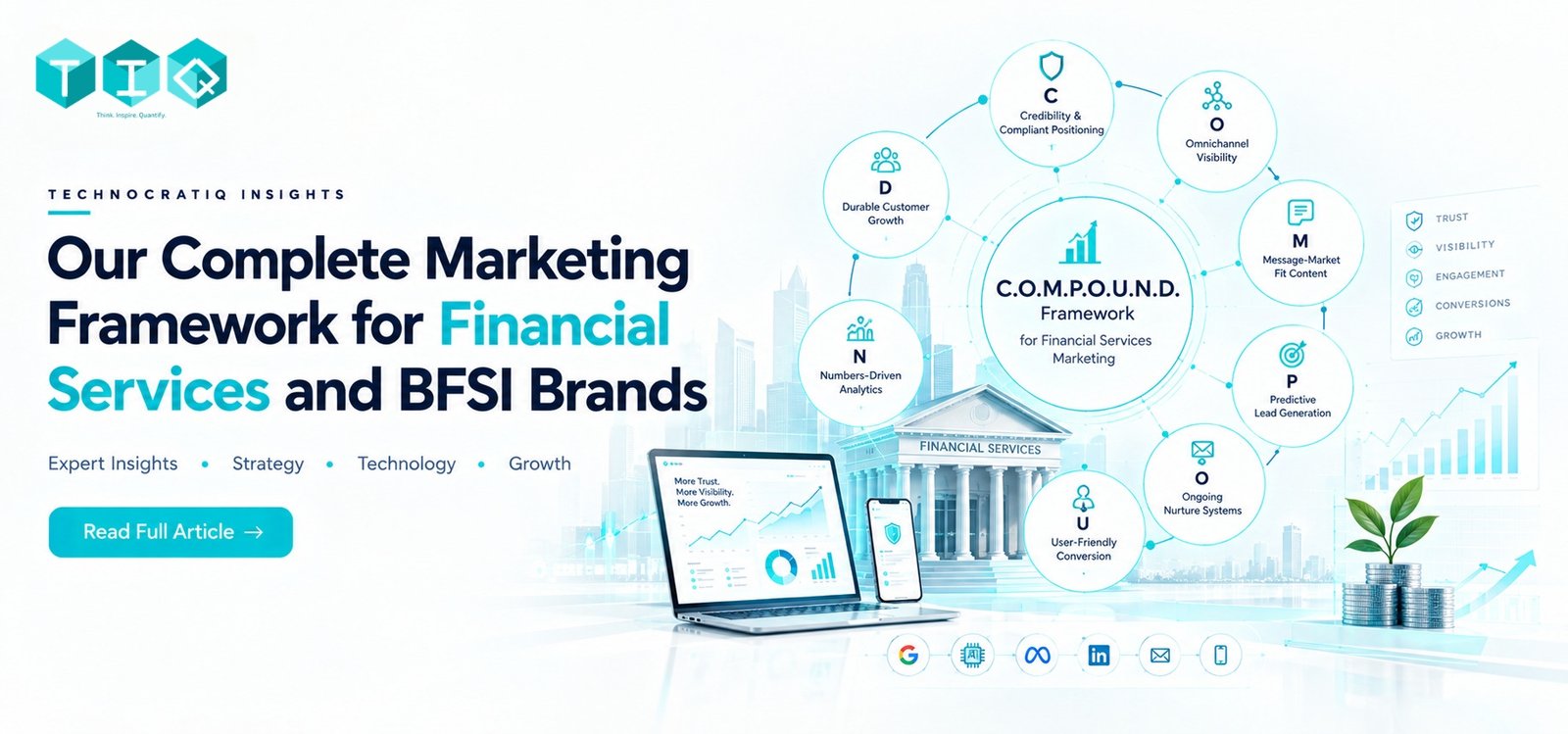
Most financial services brands run marketing as a set of disconnected activities: an SEO push here, a content calendar there, a paid campaign running separately from either. The brands actually winning trust and market share in BFSI run marketing as one compounding system, where every piece reinforces the next. This is the exact financial services marketing strategy we build for CA firms, banks, fintech, and BFSI brands, end to end.
Why Financial Services Marketing Needs a Different Model
Trust, compliance, and long buying cycles make a BFSI marketing strategy fundamentally different from consumer marketing. A buyer choosing a bank, insurer, CA firm, or fintech product isn’t making an impulse decision; they’re evaluating credibility, security, and track record, often over weeks or months.
This is exactly why fragmented marketing efforts fail specifically in financial services. Every touchpoint, a blog post, an ad, a LinkedIn comment functions as a trust test, not just a conversion opportunity. Digital marketing for financial services that treats these touchpoints as separate activities misses the compounding effect that comes from making every one of them reinforce the same credibility.
Where Financial Services Marketing Breaks Down
Most BFSI marketing underperforms not from lack of effort, but from a handful of structural gaps:
- Generic positioning that sounds identical to every other bank, CA firm, or fintech, with no distinct trust signal setting the brand apart
- SEO and content built for volume, not for the compliance-aware, high-consideration searches financial buyers actually run
- Lead generation disconnected from nurturing leads captured through a form, then left cold with no structured follow-up
- Analytics tracking traffic and lead volume, not actual customer lifetime value or retention, which is where financial services revenue really lives
These gaps are why so much financial services digital marketing produces activity without producing durable growth.
The C.O.M.P.O.U.N.D. Framework for Financial Services Marketing
Rather than treating these as separate disciplines, we run financial services marketing as one connected system one where trust and visibility compound, the way interest does.
| Letter | Pillar | What It Delivers |
| C | Credibility & Compliant Positioning | Trust-first positioning built within regulatory boundaries, not generic claims |
| O | Omnichannel Visibility | Presence across Google, AI search platforms, and relevant channels simultaneously |
| M | Message-Market Fit Content | Content built around real buyer questions, not generic finance filler |
| P | Predictive Lead Generation | Data and behavioral signals driving qualified leads, not broad-net advertising |
| O | Ongoing Nurture Systems | Structured follow-up that keeps leads warm through long BFSI decision cycles |
| U | User-Friendly Conversion | Frictionless paths trust signals, simplified forms, clear next steps |
| N | Numbers-Driven Analytics | Real financial services marketing ROI tracked, not vanity traffic metrics |
| D | Durable Customer Growth | Retention, cross-sell, and referral systems built for long-term value |
Credibility and compliant positioning is the foundation for CA firms in particular, this means marketing that works within ICAI’s rules rather than around them; our guide to ethical digital marketing for CA firms breaks down exactly what that looks like in practice. Omnichannel visibility combines financial services SEO with AI marketing for financial services showing up not just in Google, but in the AI-generated answers increasingly shaping financial research; our approach to AI search content strategy applies directly here.
Message-market fit content is where financial services content marketing actually earns real answers to real buyer questions, including the individual thought leadership covered in our personal branding guide for CAs and finance experts. Predictive lead generation and ongoing nurture systems work together to solve the “leads go cold” problem the same sequencing logic behind our retargeting ad strategy guide applies directly to nurturing BFSI leads through long decision cycles.
User-friendly conversion removes the friction that BFSI forms and processes are notorious for. Numbers-driven analytics ties everything back to real financial services marketing ROI, using the same segment-level measurement discipline covered in our micromarketing strategy framework. And durable customer growth is the compounding payoff retention and referrals building on every prior stage, rather than each campaign starting from zero.
Financial Services Marketing vs Generic Digital Marketing
The difference between a repurposed generic playbook and a real financial services marketing framework shows up clearly side by side.
| Generic Digital Marketing | Financial Services Marketing Framework |
| Broad targeting, one message for everyone | Compliance-aware, trust-first positioning per segment |
| Content built for keyword volume | Content built around real buyer research and consideration |
| Platform-reported vanity metrics | Financial services marketing ROI tied to lifetime value |
| One-time campaign thinking | Compounding system connecting acquisition to retention |
| Generic conversion paths | Conversion paths built around trust signals and reduced friction |
This is why a financial services brand borrowing a generic e-commerce or consumer playbook usually underperforms the buying psychology, compliance requirements, and decision timelines simply don’t match.
Applying This Across Banks, Fintech, and Professional Financial Services
The C.O.M.P.O.U.N.D. framework holds across BFSI sub-verticals, but how it’s applied shifts by buyer type and what earns trust in that specific category.
- Marketing strategy for banks leans heavily on trust and local credibility signals branch reputation, security assurances, and long-standing customer relationships carry more weight than flashy creative
- Fintech marketing strategy leans on speed and product education fintech buyers often need to understand how something works before trusting it with their money, more than they need brand heritage
- CA and professional financial services rely on personal and firm-level credibility together where individual thought leadership reinforces the firm’s own authority, not competes with it
Understanding which trust signal matters most for a given audience is what determines how each pillar of the framework gets weighted.
Customer Journey Marketing for BFSI Connecting Every Stage
Customer journey marketing for BFSI and omnichannel marketing for financial services are really describing the same idea: awareness, consideration, conversion, and retention functioning as one connected journey, not four separate campaigns run by different teams with different goals.
The underlying segmentation and measurement mechanics that make this possible are covered in more depth in our micromarketing strategy guide, and the pipeline-and-revenue thinking that ties marketing activity to actual business outcomes is covered in our B2B marketing-to-revenue framework both apply directly to how BFSI brands should be measuring and connecting their own customer journey.
How TechnocraTIQ Builds This Framework for Financial Services Brands
At TechnocraTIQ, we build this exact end-to-end system for CA firms, BFSI brands, and fintech companies not as eight separate services, but as one connected framework where credibility, visibility, and conversion compound together. Digital trust in financial services is the throughline connecting every pillar: compliant positioning earns trust, content and SEO make that trust discoverable, and nurture-to-conversion systems turn it into revenue without ever compromising the compliance boundaries this industry operates under. This is what separates a marketing partner that runs isolated campaigns from one that builds the infrastructure financial services growth actually compounds on. (105 words)
What Compounding Financial Services Marketing Delivers Over Time
- Lower cost per acquisition over time, as trust and visibility compound instead of resetting with each new campaign
- Higher retention and cross-sell revenue from existing customers, who already trust the brand from a consistent, credible presence
- Marketing ROI that’s traceable end to end from first search to closed customer to retained relationship instead of siloed by channel
Conclusion
A real financial services marketing strategy compounds trust, visibility, and conversion reinforcing each other over time rather than resetting with every new campaign the way isolated, channel-by-channel marketing does. For CA firms, BFSI brands, and fintech companies alike, the C.O.M.P.O.U.N.D. framework is what turns marketing from a recurring expense into a durable, compounding asset.
FAQs
What is financial services marketing?
Financial services marketing is the practice of promoting banking, insurance, fintech, and professional financial products or services, typically requiring trust-first positioning and compliance-aware messaging due to the sensitivity and regulation of the industry.
What are the 7 P’s of banking services?
The 7 P’s of banking services extend the traditional marketing mix Product, Price, Place, Promotion, People, Process, and Physical Evidence reflecting the added importance of service quality and process transparency in financial services marketing.
What does BFSI stand for in the financial industry?
BFSI stands for Banking, Financial Services, and Insurance, a sector classification covering banks, NBFCs, insurance companies, fintech firms, and related financial institutions.
What are the four types of financial services?
The four broad types of financial services are banking services, insurance services, investment and wealth management services, and professional financial services such as accounting, tax, and advisory services.
Ready to build a marketing system that compounds instead of resetting every quarter?
We help financial services, BFSI, and professional services brands build compliant, trust-first marketing systems from positioning to retention measured against real ROI, not vanity metrics.
Book your strategy call now, the financial brands compounding trust today are the ones capturing tomorrow’s market share.