Quick Answer: Founders should set up a Google Search profile only if they already have at least 10,000 followers on YouTube, Instagram, or X; most founders and partners don’t yet, so 2027 is the year to build toward it.
- Google opened Search profiles to creators and publishers in India on 6 October 2026, and profiles appear in Google Search and Discover.
- LinkedIn is not a supported platform, so a strong LinkedIn following does not count towards eligibility.
- The older “Add me to Search” people cards are no longer a dependable route, and Search profiles are the closest replacement.
Want clients to find the right things when they Google your name? Plan your 2027 search presence with Technocratiq: what Google shows today, which platform to build for a Search profile, and how to keep it within professional rules. Book a strategy call
Before a client books a meeting with a founder, a CA partner, or a lawyer, they search the person’s name. What they find, or don’t find, shapes their first impression before anyone speaks.
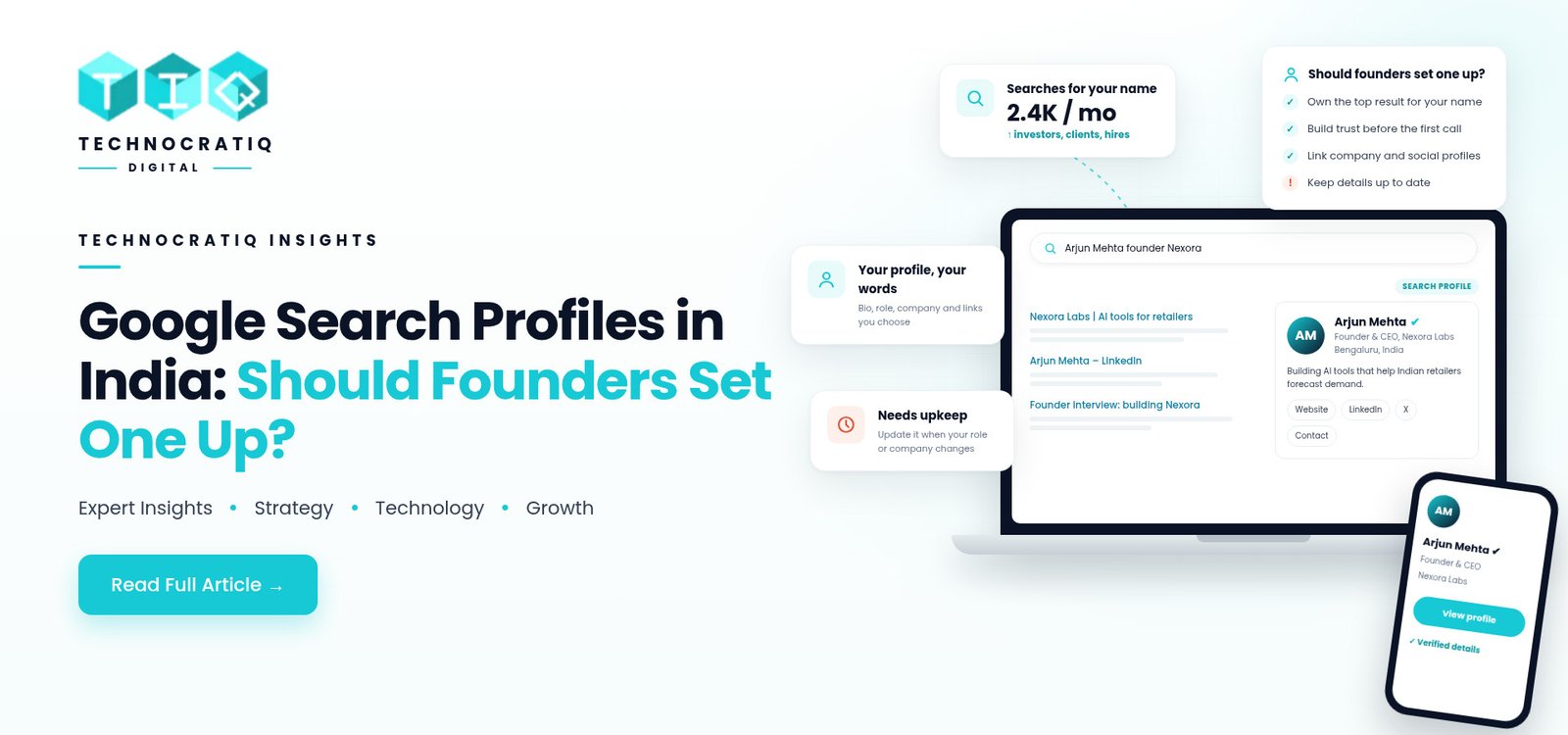
For years, the answer to that in India was a search for add me to Google Search, which created a simple people card. In 2026, Google introduced something more substantial. Google Search profiles are claimable pages on Google that bring a person’s or publisher’s content, social accounts, and links together in one place, shown in Search and Discover. This guide explains what changed, who qualifies in India, how to set one up, and what to build in 2027 if you don’t qualify yet.
What happened to “Add me to Google Search”?
Google launched people cards in India in August 2020. By searching add me to Google Search on a phone, anyone could publish a small public card with their name, profession, location, and links, which appeared when someone searched for them. The feature later reached Kenya, Nigeria, and South Africa.
It is no longer a dependable option. Search Engine Journal has updated its guide to say the functionality has been removed, while some 2026 guides report that it still appears in India but that new cards are inconsistent. Search for the phrase on your own phone to see whether it works for you, but don’t build a plan around it.
For people with an audience, Google Search profiles are now the closest replacement, and they do far more than a people card did.
What Google Search profiles show, and where
A Search profile is a page Google can show when someone searches your name or brand. Once claimed, it can bring together:
- your articles, videos and social posts in one feed
- links to your social accounts and website
- a short biography you write and update yourself
- a follow option, so people who follow you are more likely to see your content in Google Discover
Profiles can also be reached through knowledge panels. Google’s documentation does not say that claiming a profile creates a knowledge panel or changes your eligibility for one, so treat the two as separate.
Who is eligible for a Google Search profile in India?
Google’s Search Help page lists India among the three countries where Search profiles are available, alongside the United States and Canada. Eligibility depends on audience size on a supported platform.
| Requirement | What Google currently asks for |
|---|---|
| Country | United States, Canada or India |
| Audience | At least 10,000 followers or subscribers on one supported platform |
| Supported platforms | YouTube, Instagram, X or TikTok |
| Age | 18 or older |
| Content | Must meet Google’s content policies |
Three details matter for Indian professionals:
- LinkedIn is not on the list. A partner with 15,000 LinkedIn followers and a small Instagram account does not qualify.
- TikTok is not available in India, so in practice the routes are YouTube, Instagram and X.
- The threshold has moved fast. Google launched in June 2026 with 100,000 followers, lowered it to 35,000 in August, and to 10,000 in September. Check the current figure on Google’s help page before planning around it.
A Search profile is also different from a Google Business Profile, which is for businesses with a location or service area. A firm can have both.
People cards vs Google Search profiles: what’s different
| People cards (“Add me to Search”) | Google Search profiles | |
|---|---|---|
| Launched in India | August 2020 | 6 October 2026 |
| Who could create one | Anyone with a Google account in supported countries | Creators and publishers with 10,000+ followers on a supported platform |
| What it showed | Name, profession, location, links, contact details | Content feed, social links, biography, follow option |
| Where it appeared | Google Search on mobile | Google Search and Google Discover |
| Status in 2026 | Reported removed or unreliable | Live in India, the US and Canada |
The shift is clear: Google has moved from a self-made business card for anyone to a content hub for people and publishers with a proven audience.
How to set up a Google Search profile, step by step
If you meet the requirements, setup takes a few minutes:
- Search your own name on Google and check whether a profile already exists. Google’s help page asks you to do this first, because it may have generated one from your online presence.
- Go to profile.google.com and sign in with the Google account linked to your creator activity, such as the account that owns your YouTube channel.
- If a profile exists, claim it. If not, go to profile.google.com/claim to create one.
- Link at least one eligible account. If you use YouTube, start with the channel that has the most subscribers, then add others.
- Add your other social accounts and your website, and write a short, factual biography.
- Select Create Profile, then check how it appears when you search your name.
Claim the profile under an account your business controls long term. One Google account can manage up to 10 profiles, which suits agencies and firms managing several brands or partners, but a profile claimed under the wrong account is difficult to move later.
Should founders, CA partners and law partners set one up?
It depends on where your audience already is.
| Your situation | What to do |
|---|---|
| 10,000+ followers on YouTube, Instagram or X | Claim or create your profile now and link your website |
| Strong LinkedIn presence, small elsewhere | You are not eligible yet; build one supported platform during 2027 |
| Planning a video series or podcast | Make YouTube your route to eligibility |
| No content presence yet | Start with your website and LinkedIn; a profile comes later |
CA partners and advocates should take one extra step. A Search profile is public self-presentation, so it is covered by professional rules. Advocates are bound by Rule 36 of the Bar Council of India Rules, which bars soliciting work, and CAs by ICAI’s advertising guidelines. Keep the biography factual: qualifications, areas of practice, and links to educational content, with no claims, rankings, or offers. Our pages on marketing for CA firms and law firms cover these rules in more detail.
For founders in other sectors, personal branding for professionals works best when the profile points to something worth reading: articles, talks and posts that show how you think.
Not eligible yet? A 2027 plan to build toward a Search profile
Most founders and partners will not qualify today. A year of steady, focused work can change that.
- January to March: audit what Google shows. Search your name in a private window, note what appears on the first page, and fix inaccurate or outdated profiles.
- April to June: build your base. Publish consistent thought leadership on your website and on LinkedIn, focused on two or three topics you want to be known for. LinkedIn personal branding won’t count towards eligibility, but it builds the content and credibility you will repurpose. Our guide on personal branding for CAs and finance experts covers this stage.
- July to September: choose one supported platform. Pick YouTube, Instagram or X, based on where your clients spend time, and repurpose your best content there each week.
- October to December: check and claim. Check your follower count against Google’s current threshold and claim your profile once you qualify.
Done well, this plan improves what clients find when they search your name, whether or not you reach the threshold by year-end.
How Technocratiq builds search presence for founders and partners
Technocratiq Digital’s content and authority work covers thought leadership positioning, authority content and multi-platform distribution, and it runs personal-brand content programmes for founders and professionals. As a content marketing agency in India that works with CA firms, law firms and BFSI brands, it plans each person’s content around the professional rules that apply to them. That means personal branding for professionals built on publishing that will still be useful in a year, not a one-off profile setup. We can’t promise you will reach Google’s eligibility threshold, but we can build the content and channels that make it achievable. If you are comparing a content marketing agency in India for this work, ask how each one handles professional rules before you compare content plans.
Frequently asked questions
Does “Add me to Search” still work in India?
Not reliably. Search Engine Journal reports that the people card feature behind “Add me to Search” has been removed, while some 2026 guides say it still appears in India with inconsistent results. Search the phrase on your phone to check, but for people with an audience, Google Search profiles are now the main option.
How many followers do you need for a Google Search profile in India?
At least 10,000 followers or subscribers on one supported platform: YouTube, Instagram, X or TikTok. Google has lowered this threshold twice since June 2026, from 100,000 to 35,000 to 10,000, so check its Search Help page for the current figure.
Can I use LinkedIn to qualify for a Google Search profile?
No. LinkedIn is not one of the supported platforms, so LinkedIn followers do not count towards eligibility. You can still link your LinkedIn profile once your Search profile exists, and LinkedIn content can be repurposed to grow a supported platform, so LinkedIn personal branding still pays off.
Is a Google Search profile the same as a knowledge panel?
No. A knowledge panel is a box Google generates from information about a person or organisation. A Search profile is a page you claim and manage yourself. Profiles can be reached through knowledge panels, but Google does not say that claiming a profile creates a panel.
Can a CA or lawyer create a Google Search profile?
Yes, if they meet Google’s eligibility requirements. Because a profile is public self-presentation, advocates should keep it within Bar Council Rule 36 and CAs within ICAI’s advertising guidelines: factual details and educational content only, with no claims or offers. If in doubt, have the biography reviewed before it goes live.
Can one Google account manage several Search profiles?
Yes. Google’s help page says you can create up to 10 separate Search profiles for each eligible brand or identity you manage from a single Google account. This suits firms that want profiles for several partners or brands, but each profile still needs its own eligible linked account, so claim them under an account the firm controls long term.
Next step
Search your name today and note what a client would see. If you want a plan for what to fix, what to publish, and which platform to build for a Search profile in 2027, book a strategy call with Technocratiq. It is a better starting point than searching add me to Google Search and hoping a people card still appears.
Last verified: 23 October 2026, against Google’s Search Help page on creating a Search profile and coverage by Search Engine Journal. Google has changed the eligibility rules several times, so check its help page before you plan.