
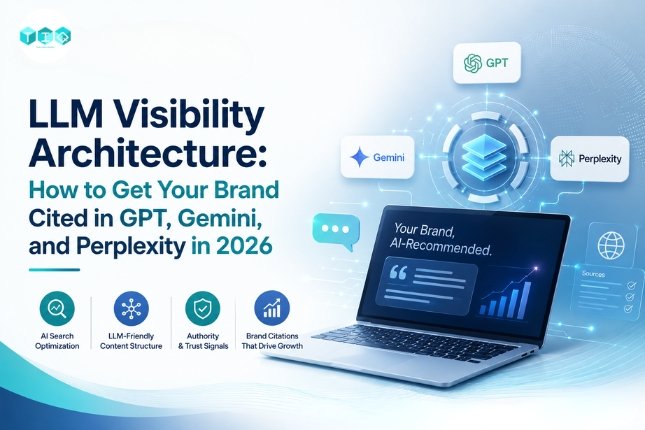
As AI technology continues to evolve, the landscape of digital marketing is transforming at a rapid pace. In 2026, getting your brand cited by leading language models like GPT, Gemini, and Perplexity is more critical than ever. Understanding the nuances of LLM (Large Language Model) visibility architecture is a core part of an AI SEO strategy and is essential for understanding how to rank in AI answers and positioning your brand as a recognized authority in the AI-driven marketplace.
What Is LLM Visibility Architecture?
LLM visibility architecture refers to the strategic framework designed to enhance your brand’s presence within AI-generated content across platforms like ChatGPT, Gemini, and Perplexity. It’s the architecture of tactics and content optimizations crafted to ensure your brand is consistently cited, mentioned, or recommended in the responses generated by these AI models. This approach goes beyond traditional SEO, aiming to establish your brand as a trusted reference within AI-generated answers.
Why Getting Cited in GPT, Gemini, and Perplexity Matters for Brands in 2026
AI search visibility is reshaping how users discover brands. By 2026, AI has supplanted traditional search engines for many consumers, generating direct answers from synthesized information. For brands, being cited in AI-generated content isn’t just advantageous—it’s imperative. A mention in an AI response significantly boosts brand trust and authority, directly influencing user decisions and converting interests into actions. AI search traffic converts at 14.2% compared to 2.8% for traditional Google searches, indicating the importance of AI search optimization.
As AI technologies process billions of queries daily, appearing in an AI response can elevate a brand’s profile, transitioning curiosity into substantial consumer engagement. The trust AI systems impart by featuring a brand is akin to a tacit endorsement, signaling quality and relevance at the moment when buyers are forming opinions and making decisions. Roughly one in six people worldwide now use generative AI tools, according to Microsoft, further emphasizing this trend.
How LLMs Decide Which Brands to Cite in Answers
Large language models don’t randomly recommend brands. They evaluate multiple trust, relevance, and retrieval signals before including a company in an AI-generated answer. While the exact algorithms vary across GPT, Gemini, Perplexity, and other AI platforms, the underlying principles remain remarkably consistent. To simplify these signals into an actionable AI SEO strategy, we’ve developed the V.I.S.I.B.L.E. Framework.
The V.I.S.I.B.L.E. Framework: A Practical AI SEO Strategy for Ranking in AI Answers
Understanding how LLMs evaluate information is only the first step. The next is turning those signals into a repeatable system. That’s where the V.I.S.I.B.L.E. Framework comes in—a practical AI SEO strategy designed to improve your chances of being retrieved, cited, and recommended in AI-generated answers across GPT, Gemini, Perplexity, and other large language models.
Rather than treating AI visibility as a collection of isolated tactics, this framework organizes the core ranking signals into six interconnected pillars.
V — Verified Brand Entities
AI models need confidence that your brand is a distinct, recognizable entity. Maintain consistent business information across your website, social profiles, knowledge panels, directories, press mentions, and review platforms. The stronger your entity consistency, the easier it becomes for AI systems to identify and cite your brand accurately.
I — Information-Rich Content
Generic content rarely earns citations. Instead, publish pages filled with original statistics, expert insights, definitions, examples, comparisons, FAQs, and supporting data. Information density increases the likelihood that AI systems will extract your content when answering user queries.
S — Structured for Retrieval
Large language models favor content that is easy to parse. Use descriptive headings, concise paragraphs, schema markup, tables, bullet points, question-and-answer sections, and clear semantic organization. Well-structured content improves retrieval and helps your pages become reliable sources for AI-generated responses.
I — Industry Authority Signals
AI doesn’t rely solely on your website. It evaluates external trust signals such as media mentions, backlinks, customer reviews, analyst reports, citations from reputable publications, and discussions across communities like Reddit and industry forums. Building authority beyond your own domain strengthens your visibility across AI ecosystems.
B — Brand Freshness
AI systems increasingly prioritize current information. Regularly update statistics, case studies, product information, pricing, documentation, and evergreen resources. Fresh content signals that your brand remains active, relevant, and trustworthy for newer AI-generated answers.
L — Linked Knowledge Ecosystem
The most visible brands don’t publish in isolation. They build interconnected content through topic clusters, internal linking, supporting resources, research pages, glossary content, and consistent references across multiple platforms. This creates a stronger knowledge graph that AI models can understand more confidently.
E — Evidence-Based Optimization
Measure how your brand appears inside AI platforms—not just in traditional search rankings. Track brand mentions, citation frequency, prompt visibility, referral traffic from AI tools, and the types of content that AI consistently references. Continuous measurement allows you to refine your AI SEO strategy based on actual retrieval patterns rather than assumptions.
Why the V.I.S.I.B.L.E. Framework Matters
Many businesses focus exclusively on publishing more content. The brands that consistently rank in AI answers take a different approach—they optimize for retrieval, authority, entity recognition, and evidence simultaneously. The V.I.S.I.B.L.E. Framework brings these elements together into a practical system that supports long-term AI search visibility instead of short-term tactics.
How to Build LLM Visibility Architecture for Your Brand in 90 Days
Phase 1 – Map Your Brand Entities & Content (Days 1–30)
- Audit Existing Content: Identify gaps where your brand’s knowledge entities are not well-represented. This involves understanding where your brand is currently being cited and how consistently these citations align with your desired brand message.
- Consistency is Key: Ensure unified branding across all digital platforms to streamline recognition. Every aspect of your brand’s online presence, from social media to business directories, should echo a consistent theme and voice.
- Documentation and Mapping: Map out the conceptual framework for future content efforts aligning with LLM preferences. This exercise helps uncover insights into the narrative that you want AI platforms to perpetuate about your brand.
Phase 2 – Create LLM-Optimized Content (Days 31–60)
- Develop Core Content: Focus on creating core content that addresses common queries with succinct explanations. It’s about providing value immediately, using authoritative language and data to back claims.
- Leverage Structured Formats: Use tables, bullet points, and clear headings to make content more digestible for AI. Formatting enhancements improve AI comprehension, inviting better data extraction and interpretation.
- Engage with Data: Incorporate fresh statistics and case studies that provide material for AI to cite. Data should be compelling, original, and relevant, appealing directly to the AI’s drive to disseminate verifiable information.
Phase 3 – Build Authority & Track Citations (Days 61–90)
- Expand Your Authority: Secure mentions in reputable publications and on platforms frequented by your audience. Pursuing digital PR opportunities enhances perceived credibility.
- Monitor LLM Performance: Use tools to track how often and where your brand is cited across different AI platforms. Insights from tracking refine content strategies and highlight new areas for development.
- Iterate and Optimize: Regularly update content and approaches based on tracking insights to maintain relevancy and increase citation frequency. This dynamic strategy accommodates shifts in market trends and evolving AI algorithms.
Common Mistakes Brands Make When Trying to Get Cited in LLMs
One notable pitfall is treating LLM visibility like traditional SEO. While they share similarities, the tactics for SEO don’t fully translate to AI optimization. Another mistake is focusing exclusively on content creation without securing third-party validations and mentions, which severely limits the chances of citation by LLMs.
Failing to maintain updated content, or ignoring the importance of third-party reviews, can cause AIs to overlook your brand. It’s crucial to understand that AI-driven content recognition involves an ecosystem of aligned content, authority, and engagement rather than a singular focus on any one aspect. As AI’s dominance grows, McKinsey reports that 20-50% of online traffic could be at risk due to AI, highlighting the importance of integrating AI-focused strategies.
Checklist: Is Your Brand Ready for LLM Visibility in 2026?
- Do you have consistent branding across all digital platforms?
- Is your content structured and data-rich?
- Are you using structured data markup on your site?
- Do you actively maintain listings on trusted third-party sites and directories?
- Is your content optimized for AI retrieval and regularly updated?
How TechnocraTIQ Helps Brands Build AI Visibility
At TechnocraTIQ, we don’t just help brands improve visibility across AI-driven platforms like GPT, Gemini, and Perplexity—we build personalized systems to directly grow revenue. Our focus is on creating scalable digital infrastructure that attract qualified traffic, generate consistent leads, and convert visibility into measurable business growth through entity-focused SEO, AI optimized content strategies, and authority building.
We primarily work with CA firms, BFSI, fintech, and professional services, where trust, authority, and accuracy are critical for both search and AI visibility.
Our approach is centered on building strategies that generate revenue—not just publishing content anywhere without a plan.
FAQs
1. Is LLM visibility the same as traditional SEO?
Not exactly. While both aim at increasing digital visibility, LLM visibility focuses on how AI models reference your brand, whereas SEO focuses on ranking in search engine results.
2. How can I measure my LLM visibility?
Use AI search optimization services or dedicated tools that track AI citations, mention rates, and citation accuracy across platforms like ChatGPT, Perplexity, and Gemini. These tools highlight trends and new opportunities for enhancement. It is important to recognize that AI visibility is binary: your brand is either in the answer or it isn’t.
3. Why is getting cited in LLMs important for brands in 2026?
Being cited increases brand authority and direct user engagement, crucial as consumers increasingly rely on AI-generated content during their buying journey. This trend underscores the growing reliance on AI platforms for brand discovery and decision facilitation. 73% of B2B buyers now use AI for vendor research, making visibility in AI-generated content vital.
4. How do I get my brand cited in GPT, Gemini, and Perplexity?
Focus on entity recognition, consistent branding, authoritative third-party validation, structured data, and regularly updated, data-rich content that’s optimized for AI. Engaging actively through multiple channels ensures that your brand is both visible and perceived as trustworthy.